Why IT Budget Optimization Matters More Than Ever
IT budget optimization is the strategic process of maximizing technology value while minimizing waste—not just cutting costs, but spending smarter. Here’s what effective IT budget optimization delivers:
- Improved efficiency through automation and process optimization
- Cost reduction by eliminating unused licenses and redundant systems
- Better resource allocation aligned with business priorities
- Improved security through proper investment in protective measures
- Sustainable savings that don’t sacrifice performance or innovation
Most businesses waste 32% of their cloud budgets on unused resources, while organizations spend an average of $49 million annually on SaaS subscriptions—often with 30% going to unused or underused licenses. The challenge isn’t just rising IT costs (forecasted to grow 9.3% to $5.74 trillion in 2025), but ensuring every dollar supports your business goals.
The difference between cost cutting and optimization is simple: cost cutting slashes expenses reactively, often harming performance. Optimization improves efficiency proactively while reducing waste, creating sustainable savings that fund innovation rather than stifle it.
For Northeast Ohio businesses managing complex technology environments, this balance is critical. You need systems that work reliably without draining resources on unnecessary spending or creating security gaps through poor management.
I’m Jay Baruffa, and I’ve spent over 20 years helping businesses across Northeast Ohio optimize their IT infrastructure and reduce costs through strategic planning and proactive management. Throughout my career in IT budget optimization, I’ve seen how the right approach transforms technology from a cost center into a competitive advantage.
Understanding the Framework of IT Budget Optimization
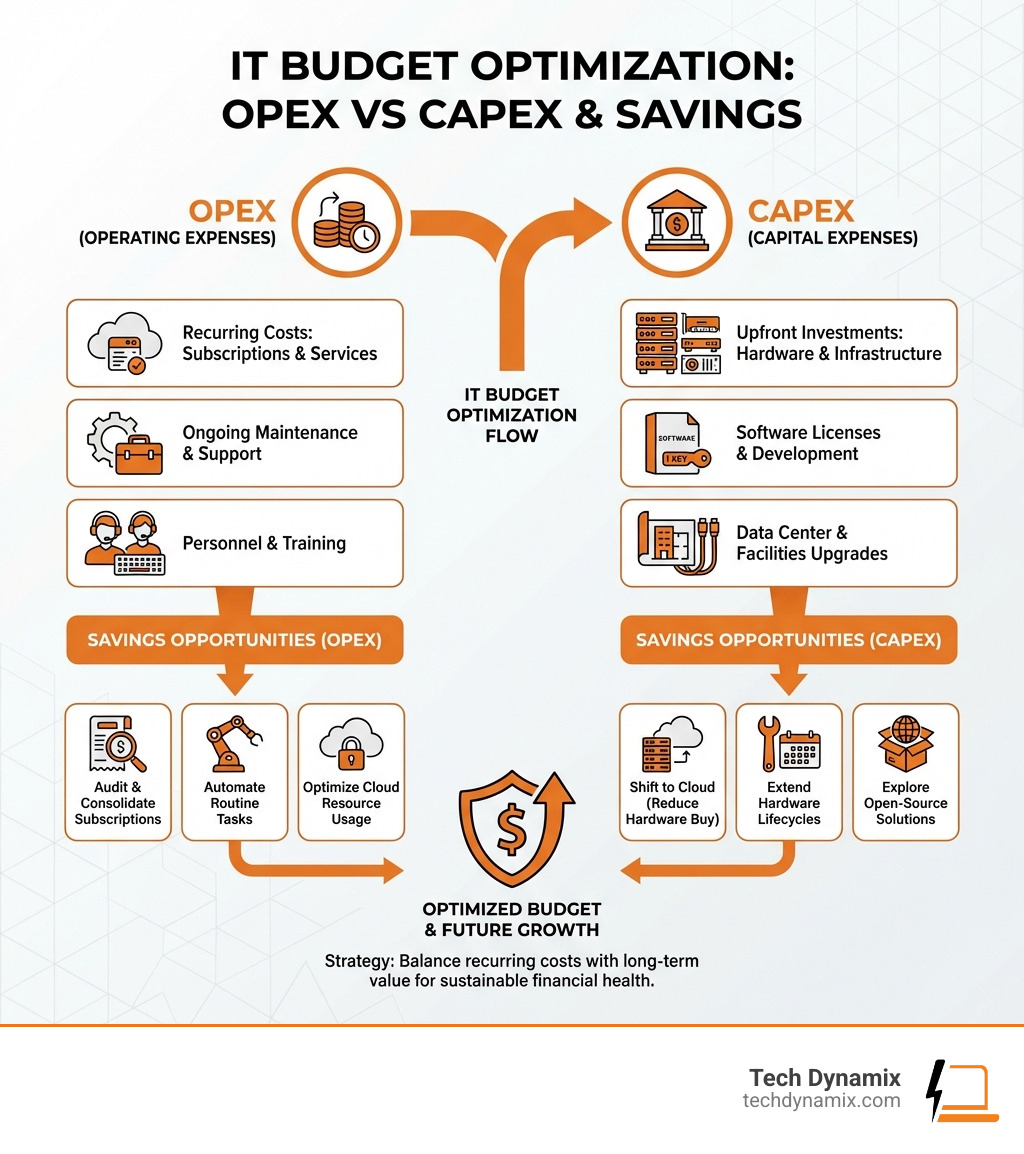
To master IT budget optimization, we need a clear framework. Worldwide IT spending is forecasted to grow by 9.3% to $5.74 trillion in 2025, increasing the pressure to ensure every dollar provides maximum value.
Understanding IT cost categories is crucial:
- Fixed Costs: Constant expenses like annual software licenses, server depreciation, or rent. Optimization involves renegotiating contracts or rationalizing assets.
- Variable Costs: Usage-based costs like cloud consumption or energy. These require continuous monitoring and rightsizing.
- Direct Costs: Attributable to specific services or projects, such as dedicated server hardware or project-specific salaries.
- Indirect Costs: Shared overhead like help desk support or network infrastructure. These often hide significant optimization opportunities.
Different budgeting methodologies offer unique approaches:
| Methodology | Description | Pros | Cons |
|---|---|---|---|
| Traditional | Incremental; based on previous year. | Simple and quick. | Lacks flexibility; can perpetuate waste. |
| Zero-Based (ZBB) | Every expense must be justified from scratch. | Eliminates waste; reallocates based on need. | High workload; time-consuming. |
| Agile ZBB | Evolution of ZBB with short, flexible cycles. | Highly responsive; better strategic alignment. | Requires mature processes. |
| Activity-Based | Analyzes costs based on value-generating activities. | Detailed profitability analysis. | Complex to implement and maintain. |
| IT Fitness | Structured approach to improve economic performance. | Balanced and collaborative; integrates FinOps. | May require external expertise. |
For Northeast Ohio businesses, our IT consulting services can help you choose the best approach for your needs.
Shifting from Cost Reduction to IT Budget Optimization
Cost reduction is a reactive, tactical response that can harm long-term performance. IT budget optimization is a proactive strategy focused on:
- Value Creation: Ensuring IT spend directly contributes to business objectives.
- Long-Term Sustainability: Building resilient infrastructure that adapts to future needs.
- Innovation Funding: Reinvesting savings into new technologies. McKinsey advocates for an agile approach to funding enterprise outcomes to drive competitive advantage.
The Role of IT and Finance Collaboration
Successful optimization requires IT and Finance to work together, moving beyond silos to achieve:
- Financial Transparency: Clear data on IT spend per service or user.
- Chargeback Models: Helping business units understand the cost of the services they consume to encourage responsible usage.
- Shared Accountability: Collaboratively setting budgets and measuring ROI.
- Unit Economics: Breaking down costs to a granular level (e.g., cost per transaction) for data-driven visibility. Our ERP solutions provide the insights needed for this collaboration.
15 Proven Strategies for IT Spend Management
These actionable strategies help maximize value across your IT operations:
- Conduct a Comprehensive IT Audit: Catalog all assets to identify redundancies and uncover “shadow IT.” Cisco provides a guide to identifying shadow IT to help mitigate security risks and unmanaged spend.
- SaaS License Auditing: Review subscriptions to eliminate unused seats or overlapping tools.
- Vendor Consolidation: Reduce the number of vendors to gain volume discounts and simplify management.
- Hardware Lifecycle Extension: Evaluate if upgrades can extend equipment life, reducing capital expenditure.
- Application Rationalization: Retire redundant or obsolete applications to align tool usage enterprise-wide.
- Infrastructure Modernization: Replace legacy systems with cost-effective virtualized or cloud-native solutions.
- Energy Optimization: Improve data center cooling and server utilization to lower power costs.
- Contract Renegotiation: Regularly review vendor terms to secure better rates or flexibility.
- Predictive Maintenance: Use AI to anticipate hardware failures, preventing costly emergency repairs.
- Remote Work Optimization: Align VPN and collaboration tool capacity with actual distributed workforce needs.
- Capacity Planning: Use data to prevent over-provisioning of resources.
- Employee Training: Empower staff to use IT resources efficiently, especially regarding cloud billing.
- Foster a Cost-Conscious Culture: Integrate cost considerations into development and operational processes.
- Review IT Asset Management: Implement robust ITAM to track hardware and software compliance.
- Establish Unit Economics: Analyze financial efficiency at a granular level to enable strategic decisions.
Our managed IT services help Northeast Ohio businesses implement these strategies effectively.
Leveraging Cloud Computing for IT Budget Optimization
Waste accounts for up to 32% of cloud budgets. We optimize cloud spend through:
- Rightsizing Instances: Aligning cloud resource size with actual workloads.
- Reserved Instances and Savings Plans: Committing to steady usage for significant discounts.
- Spot Instances: Using spare capacity for non-critical, fault-tolerant workloads.
- Storage Optimization: Implementing tiered storage and tools like Google Cloud’s Dynamic Compression to reduce data costs.
- FinOps Discipline: Bringing finance and engineering together to manage cloud spending collaboratively.
Our Microsoft 365 cloud support ensures you get the most value from your cloud environment.
Maximizing Efficiency through Automation and AI
88% of IT leaders are increasing investment in automation to reduce operational expenses:
- Automating Support Tasks: AI-powered chatbots can resolve Level 1 tickets instantly, saving hundreds of support hours.
- User Provisioning: Automated onboarding and offboarding improve security and reduce manual workload.
- AI-Powered Self-Service: Empowering employees to find answers independently reduces IT interruptions.
- Predictive Maintenance: Monitoring infrastructure for anomalies to prevent expensive downtime.
Through our automation services, we help businesses build leaner IT operations.
Navigating Challenges in Modern IT Spend
Modern IT environments present several challenges to budget optimization:
- Cybersecurity Risks: The average cost of a data breach is $4.4 million, according to IBM’s 2025 Report. Security is a non-negotiable expense. Our cybersecurity solutions mitigate these risks.
- Decentralized Purchasing: Business units often purchase SaaS independently, leading to shadow IT and budget inefficiencies.
- Technical Debt: Choosing quick fixes over long-term solutions increases future maintenance costs.
- Rapid Technology Trends: The fast adoption of AI and machine learning requires careful ROI tracking to avoid waste.
Strengthening Vendor Negotiation and Asset Management
- Strategic Negotiation: Proactively engage vendors with usage data. Poor contract management costs organizations nearly $2 trillion annually. Look for auto-renewal traps and rigid seat counts.
- Software Asset Management (SAM): Use tools like AWS’s Optimization and Licensing Assessment to ensure license efficiency and compliance.
- Hardware Asset Management (HAM): Track physical assets throughout their lifecycle to optimize utilization.
Ensuring Sustainability in IT Budget Optimization
Optimization must be an ongoing commitment:
- Continuous Monitoring: Implement tools to track usage patterns and spend trends.
- Cost-Conscious Culture: Train employees on efficient resource utilization.
- Governance and Policies: Establish clear spend policies and automate compliance checks for regulations like GDPR.
- Aligning IT with Business Goals: Map IT spend to projects that drive revenue or efficiency. Our backup and business continuity services protect these investments from costly downtime.
Frequently Asked Questions about IT Budget Optimization
What is the difference between IT cost cutting and optimization?
Cost cutting is a reactive, expense-driven measure that focuses on immediate reductions, often harming performance. IT budget optimization is a proactive, value-driven process that eliminates waste and improves efficiency to achieve more with every dollar.
How does shadow IT impact my technology budget?
Shadow IT leads to duplicate licenses, unmanaged spend, and significant security risks. As Cisco’s insights suggest, unauthorized software use prevents organizations from leveraging volume discounts and creates compliance gaps.
Can AI actually reduce IT operational expenses?
Yes. AI reduces expenses by deflecting support tickets through chatbots, automating password resets, and optimizing cloud resource allocation. It also enables predictive maintenance to prevent emergency repairs. Learn more about these solutions through our automation services.
Conclusion
Mastering IT budget optimization is no small feat, but it’s an essential journey for any business aiming for sustainable growth and efficiency in today’s technology-driven world. It’s about making smart, strategic choices that align technology investments with your overarching business goals, rather than simply cutting costs. From understanding the nuances of IT spend categories and budgeting methodologies to leveraging the power of cloud, automation, and AI, every step contributes to a leaner, more effective IT operation.
At Tech Dynamix, we understand the unique challenges faced by small and mid-size businesses across Northeast Ohio. With over 20 years of experience, we pride ourselves on being a proactive technology partner. We specialize in helping businesses like yours steer complex IT environments, implement robust cybersecurity, optimize cloud solutions (including Microsoft 365), and streamline operations through strategic IT consulting and managed services.
Don’t let IT costs become a burden. Let us help you transform your IT budget from a cost center into a powerful engine for innovation and competitive advantage.
Ready to optimize your IT spend and boost your efficiency? Contact Tech Dynamix for IT support today, and let’s start building a smarter, more cost-effective future for your business.