Why Quarter Rack Colocation Makes Sense for Growing Businesses
Quarter rack colocation is a data center service that provides 10U to 12U of secure, private rack space for your servers and networking equipment. It’s ideal for businesses that need more than basic shared hosting but don’t require a full cabinet—offering enterprise-grade infrastructure, redundant power, and professional connectivity at a fraction of the cost.
Quick Answer: What You Get with Quarter Rack Colocation
- Space: 10U to 12U of rack space (approximately 1.5 feet of height)
- Power: Typically 3A to 5A, with options up to 10A @ 120V
- Connectivity: 1Gbps ports, public IP addresses, carrier-neutral network access
- Security: 24/7 physical security, biometric access, CCTV monitoring
- Support: Remote hands, basic reboots, on-site assistance
- Pricing: Starting around $350-$550/month depending on power and location
Being in the IT industry, you know a lot of your services depend on server uptime. Downtime can be caused by issues with internet, power, and cooling—the big culprits. Wouldn’t it be easier if you didn’t have to worry about your server infrastructure? Instead, you could focus on what you do best: providing great service to your customers.
Quarter rack colocation sits between basic server hosting and full cabinet leases. It gives you dedicated physical space in a professional data center, complete with UPS-backed power, N+1 cooling, and redundant network connections—without the expense of building your own server room. You maintain full control over your hardware while the facility handles the infrastructure.
Most quarter rack solutions include a secure, lockable cabinet section, switched PDUs for remote reboot capability, and access to meet-me rooms for direct carrier connections. You can typically upgrade to half or full racks as your needs grow, making it a scalable starting point for businesses transitioning from office-based servers or expanding their IT footprint regionally.
I’m Jay Baruffa, and with over 20 years of IT infrastructure design and network engineering experience across Northeast Ohio, I’ve helped dozens of businesses evaluate and implement quarter rack colocation solutions that balance cost, control, and reliability. My team at Tech Dynamix works closely with clients to design right-sized infrastructure that supports growth without overcommitting resources.
What is Quarter Rack Colocation?
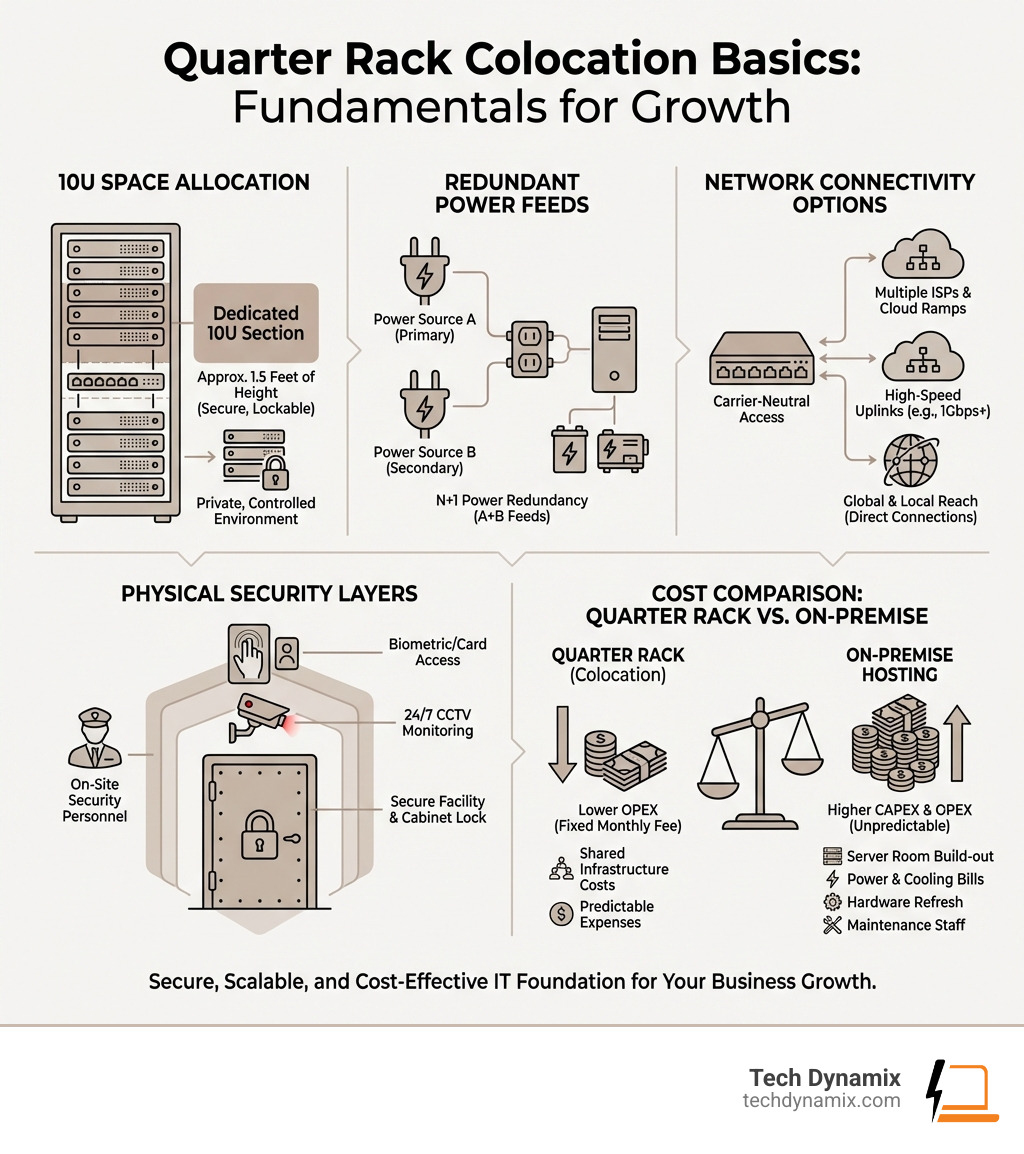
When we talk about quarter rack colocation, we’re referring to a service that offers a segment of a full server rack within a professional data center. Think of it as your own dedicated apartment within a high-rise building, specifically designed for your IT equipment. It’s often called a ¼ Rack, and it typically provides 10U (Units) of space, though some providers might stretch it to 12U. To give you a sense of scale, 10U translates to roughly 1.5 feet of vertical space within a standard 19-inch wide rack.
This service is perfect for businesses that have outgrown basic shared hosting or a cramped server closet, but don’t yet need the extensive space of a half or full rack. It allows you to house your own physical servers, storage devices, and networking gear in a highly secure, climate-controlled environment.
Our facilities in Northeast Ohio, including Painesville, Mentor, Cleveland, and Hudson, offer these precise solutions. We understand that every business’s needs are unique, and a one-size-fits-all approach rarely works in IT. That’s why quarter rack colocation is such a valuable option, providing a sweet spot for many small to mid-sized businesses.
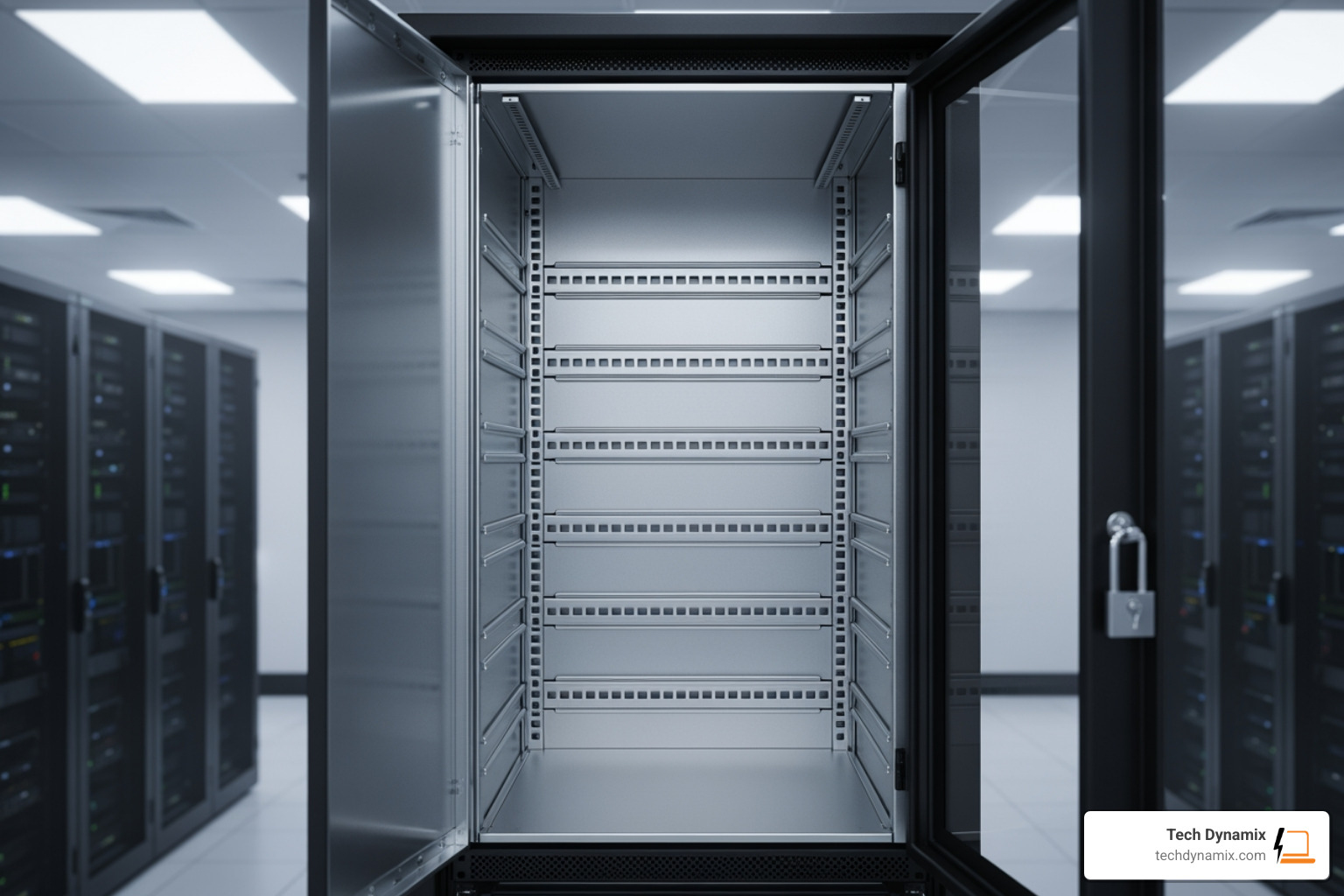
What does this space typically look like? It’s a partitioned section within a larger rack, often with its own secure, lockable door. This ensures that while you’re sharing the physical structure of the rack with other clients, your equipment remains isolated and protected. The industry-standard 19-inch width ensures compatibility with virtually all enterprise-grade hardware.
While you might be thinking, “Do I really need a switch for just a few servers?”, our experience suggests that for a quarter rack, a switch is usually requested. Even if you’re only collocating one or two servers initially, the additional network ports a switch provides are essential for handling future connectivity needs and ensuring proper network segregation. This proactive approach helps us maintain robust and organized network connectivity for all our clients.
Technical Specifications and Connectivity for Quarter Rack Colocation
When you choose quarter rack colocation, you’re not just getting space; you’re gaining access to a robust ecosystem of power, cooling, and connectivity designed for maximum uptime. Let’s dig into the technical heart of what these solutions offer.
Power Specifications:
The power allocated to a quarter rack is a critical factor, directly impacting what equipment you can host. Typically, you can expect:
- Capacity: Standard allocations often range from 2–4 kW. This translates to amperage, with many providers offering 3 Amps, 5 Amps, or even up to 10 Amps at 120V. For instance, some plans provide 960 usable watts (8A @ 120V) or even higher, up to 1920va (16A @ 120V) for more power-hungry setups.
- Redundancy: A key feature is redundant power feeds, often referred to as A/B feeds. This means your equipment draws power from two independent sources, ensuring continuous operation even if one feed fails.
- Voltage: Support for both 120V and 208V is common, with configurable Power Distribution Units (PDUs) to match your equipment’s requirements.
- Backup: All reputable colocation facilities, including those we partner with in Northeast Ohio, feature uninterruptible power supplies (UPS) and powerful backup generators. These ensure that your systems remain online during utility outages, providing clean, consistent power. Many quarter rack solutions include a switched PDU, allowing for remote power cycling of individual outlets—a lifesaver for remote server management.
Cooling Specifications:
Keeping your servers cool is paramount for their longevity and performance. Colocation facilities excel here with:
- Precision Cooling: N+1 redundancy precision cooling infrastructure is standard. The “N+1” means there’s always one redundant cooling unit available should another fail, preventing any disruption.
- Optimized Airflow: Advanced systems like hot and cold aisle containment, along with high-performance hot air extraction, ensure efficient heat dissipation. This means your equipment operates within optimal temperature ranges, reducing the risk of overheating and hardware failure. Our local facilities leverage these best practices to maintain a stable environment.
Connectivity Options:
Connectivity is the lifeline of your IT infrastructure, and quarter rack colocation offers superior options compared to most in-house setups:
- Network Ports: You’ll typically receive 1Gbps network ports, with options to upgrade to 10Gbps or higher depending on your bandwidth needs. Some plans might include two 1Gbps ports for redundancy or load balancing.
- Bandwidth: Providers often include a base amount of bandwidth (e.g., 100Mbps unlimited internet connection or 30TB data transfer/month) with options to scale up. Our focus on robust network design and management ensures that your connection is always optimized.
- IP Addresses: A block of public IP addresses (e.g., a /29 network offering 5 usable IPs) is usually included, facilitating direct access to your servers.
- Redundant Uplinks: Your connection to the internet is redundant, meaning multiple pathways ensure your data always finds a route, even if one connection experiences an issue.
- Carrier-Neutral Access: Many facilities are carrier-neutral, giving you the flexibility to choose your preferred internet service provider or blend multiple providers for improved resilience.
- Meet-Me Room (MMR): Access to a Meet-Me Room allows for direct, low-latency cross-connections to various carriers, cloud providers, or even other clients within the data center.
To better illustrate how a quarter rack fits into the broader colocation landscape, here’s a comparison of typical rack specifications:
| Feature | Quarter Rack (10U) | Half Rack (21U) | Full Rack (42U) |
|---|---|---|---|
| Height | 17.50 inches (approx. 1.5 feet) | 36.75 inches (approx. 3 feet) | 73.50 inches (approx. 6 feet) |
| Power (Typical) | 3-10 Amps @ 120V (2-4 kW) | 20 Amps @ 120V (4-8 kW) | 20-30 Amps @ 120/208V (8-15 kW+) |
| Uplink Speed | 1 Gbps Dedicated (upgradeable) | 1 Gbps Dedicated (upgradeable) | 1 Gbps Dedicated (upgradeable to 10/100 Gbps) |
| IP Addresses | Block of 5-8 usable IPs | Block of 8-13 usable IPs | Block of 13-29 usable IPs |
| Cost (Monthly) | ~$350 – $550+ | ~$699 – $1000+ | ~$999 – $2500+ |
| Best Suited For | Small server deployments, DR sites, growing startups | Medium-sized businesses, multiple applications | Large enterprises, high-density computing |
Key Benefits of Choosing a Quarter Rack Solution
Choosing quarter rack colocation isn’t just about finding a home for your servers; it’s a strategic decision that brings a host of benefits to your business in Northeast Ohio. From cost savings to peace of mind, let’s explore why this solution is often the perfect fit.
Cost Efficiency
One of the most compelling advantages of a quarter rack is its cost-effectiveness. You get enterprise-grade infrastructure without the prohibitive capital expenditure of building and maintaining your own data center. For businesses in areas like Lake County or Summit County, this means significantly reduced operational costs associated with power, cooling, security, and connectivity. Instead of investing heavily in dedicated facilities, you convert those costs into a predictable monthly operational expense. This balance of performance and cost-efficiency makes it an ideal starting point for growing businesses.
Physical Security
Your data and equipment are invaluable, and our colocation facilities prioritize their protection. Beyond a simple lock on a cabinet, you benefit from multi-layered physical security measures that are simply not feasible for most in-house setups:
- 24/7 Monitoring: Round-the-clock surveillance and security personnel.
- Access Controls: Biometric scanners, keycard access, and even “mantraps” (secure, interlocking doors) at entry points ensure only authorized individuals can access the facility.
- CCTV: Extensive video surveillance systems record all activity.
- Secure Cabinets: Your quarter rack comes with a secure, lockable door, providing an additional layer of protection for your hardware.
- Fire Suppression: Advanced fire detection and suppression systems (e.g., dry-pipe) are in place to protect equipment without causing water damage.
These robust measures, combined with our cybersecurity solutions, mean you can rest assured that your physical assets are in safe hands.
Scalability
Growth is the goal for any business, and your IT infrastructure should support it, not hinder it. Quarter rack colocation offers exceptional scalability:
- Path-to-Rack Growth: You can start with a 10U quarter rack and seamlessly scale up to a half rack, full rack, or even a private cage solution as your needs evolve. Many facilities are designed to allow for “path-to-rack growth” with minimal re-cabling or downtime.
- Zero Downtime Expansion: The beauty of colocation is that this scaling can often happen with zero downtime, ensuring your operations remain uninterrupted. This flexibility makes a quarter rack an intelligent, future-proof investment for businesses in the Greater Cleveland Area.
Compliance Standards
For many industries, meeting stringent compliance standards is non-negotiable. Colocation facilities are built with these requirements in mind:
- Industry Certifications: Our partner data centers adhere to critical certifications such as ISO 27001 (information security management), SOC 2 Type II (security, availability, processing integrity, confidentiality, and privacy), PCI-DSS (payment card industry data security standard), and HIPAA (health insurance portability and accountability act).
- Audited Environments: These certifications mean the facilities undergo regular, rigorous audits, providing you with documented proof of their security and operational integrity. This is particularly vital for healthcare providers, financial institutions, and government contractors in Ohio.
Disaster Recovery and Uptime Guarantees
The primary goal of colocation is to keep your systems running, come what may.
- Redundant Infrastructure: We’ve already touched on redundant power (A/B feeds, UPS, generators) and cooling (N+1 precision systems). This redundancy extends to network connectivity, ensuring multiple pathways for your data.
- Disaster Resilience: Our partner data centers are often built to withstand environmental disasters, including floods, earthquakes (depending on seismic zone ratings), and man-made errors, making them a “disaster-free zone” for your equipment.
- Service Level Agreements (SLAs): Colocation providers typically offer strong SLAs, guaranteeing high levels of uptime (e.g., 99.9% or higher). This commitment to availability means you can focus on your core business, knowing your IT infrastructure is in capable hands.
By leveraging these benefits, businesses in Northeast Ohio can transition from the constant worry of managing their own servers to a strategic partnership that ensures reliability, security, and scalability.
Comparing Quarter Rack Colocation vs. Cloud and Dedicated Servers
Choosing the right home for your IT infrastructure involves weighing several options, and quarter rack colocation stands out distinctly from both cloud hosting and dedicated servers. Each has its merits, but understanding the differences in cost, control, and performance is key to making the best decision for your business in Northeast Ohio.
Hardware Control and Customization
- Quarter Rack Colocation: This is where quarter rack truly shines. You own your hardware. This means you have complete control over the choice of servers, storage, and networking equipment. Want a specific brand of GPU for AI workloads? Need a particular RAID configuration for optimal storage performance? It’s your hardware, your rules. This allows for highly customized configurations custom to your unique application demands.
- Dedicated Servers: Similar to colocation, you typically get a single server dedicated entirely to your use. While you don’t own the hardware outright, you have full administrative control over the operating system and software stack. Customization options are usually limited to the configurations offered by the provider.
- Cloud Hosting: With cloud, you’re renting virtual resources (CPU, RAM, storage) on shared physical hardware. While flexible and scalable, you have minimal to no control over the underlying physical infrastructure. Customization is at the software and virtual machine level, not the hardware level.
Cost Structure: CAPEX vs. OPEX
- Quarter Rack Colocation: This model often involves an initial capital expenditure (CAPEX) for purchasing your servers and equipment. The ongoing costs for the colocation space, power, and connectivity are operational expenses (OPEX). This blend gives you the asset ownership benefits while outsourcing the costly data center infrastructure. It can be a cost-effective alternative to half-rack solutions for businesses needing more than basic shared hosting.
- Dedicated Servers: Primarily an OPEX model. You pay a monthly fee for the server and its associated services, with no upfront hardware purchase.
- Cloud Hosting: Almost entirely an OPEX model, often billed on a pay-as-you-go basis. This offers tremendous flexibility but can lead to unpredictable costs if not managed carefully.
Performance Predictability and Latency
- Quarter Rack Colocation: Because you control the hardware and it’s physically isolated in a dedicated space, performance is highly predictable. You’re not subject to “noisy neighbor” issues that can sometimes occur in shared environments. For latency-sensitive applications, having your equipment in a professionally managed data center with direct access to carrier networks (via a Meet-Me Room) can offer superior performance compared to public internet routes.
- Dedicated Servers: Performance is generally predictable as the server’s resources are exclusively yours. However, the physical location and network peering may vary by provider, potentially impacting latency.
- Cloud Hosting: Performance can sometimes vary due to shared resources, though major cloud providers invest heavily in performance optimization. Latency can be a concern for applications requiring ultra-low latency, as you have less control over the physical proximity of your data.
Data Sovereignty and Compliance
- Quarter Rack Colocation: You retain full data sovereignty as your data resides on your physical hardware. This can be crucial for businesses with strict regulatory requirements. Combined with the data center’s compliance certifications (ISO 27001, SOC 2, HIPAA, PCI-DSS), colocation provides a robust environment for meeting various data governance needs.
- Dedicated Servers: Data sovereignty depends on the provider’s location and their own compliance adherence.
- Cloud Hosting: Data sovereignty can be complex in the cloud, as data might be replicated across multiple regions or even countries. While cloud providers offer compliance certifications, the shared nature of the infrastructure can add layers of complexity for certain highly regulated industries.
Resource Dedication and Scalability
- Quarter Rack Colocation: Offers dedicated physical resources, meaning your servers aren’t competing with others for CPU cycles, RAM, or network bandwidth. While it requires you to purchase and manage the hardware, the infrastructure itself is highly scalable. We can help you plan for IT consulting to ensure your quarter rack is configured for future growth.
- Dedicated Servers: Provides dedicated resources on a per-server basis. Scaling typically involves adding more dedicated servers, which can be quick but less granular than cloud.
- Cloud Hosting: Offers unparalleled scalability, allowing you to instantly provision or de-provision resources as needed. However, this flexibility comes at the cost of direct hardware control.
Quarter rack colocation offers the best of both worlds for many businesses: the dedicated control and predictable performance of owning your hardware, combined with the enterprise-grade infrastructure, security, and scalability of a professional data center. It’s a pragmatic choice for those who need more than shared hosting but find cloud hosting too abstract or dedicated servers too restrictive in terms of hardware choice. For businesses in Northeast Ohio, it’s a powerful way to bridge the gap between in-house IT and fully outsourced solutions.
Frequently Asked Questions about Quarter Rack Colocation
We often hear similar questions from businesses in Painesville, Mentor, and Cleveland when they’re considering quarter rack colocation. Let’s address some of the most common ones to help clarify how this solution can benefit your operations.
How much equipment fits in a 10U quarter rack colocation?
A 10U quarter rack colocation typically holds 10 rack units (U) of equipment. To put that into perspective, a standard 1U server is about 1.75 inches tall. This means you could potentially fit:
- Servers: Around 5 to 10 1U servers, depending on their depth and cooling requirements. If you’re using 2U or 4U servers, you’d naturally fit fewer. For example, if you have two 4U servers, that leaves 2U for other components.
- Switch Space: A common configuration would include several servers, plus a network switch (often 1U or 2U) to handle the additional network ports required for connectivity, especially since many quarter rack setups come with multiple network drops.
- PDU Mounting: You’ll also need to account for Power Distribution Units (PDUs), which are essential for power management and often mount vertically at the back of the rack or horizontally, consuming 1U or 2U themselves.
- Cable Management: Don’t forget cable management! Proper cable routing is crucial for airflow and accessibility, and while it doesn’t consume “U” space directly, it requires careful planning to avoid overcrowding.
While some providers might offer up to 12U, 10U is the global standard for a quarter rack. The key is to plan your equipment carefully, considering not just height (U) but also depth and power consumption.
What are the typical power and cooling limits for quarter rack colocation?
Power and cooling are paramount for your equipment’s health and performance in a quarter rack colocation environment.
- Amperage Limits: Typical power allocations range from 3 Amps to 10 Amps at 120V. For example, some quarter rack plans include 3 Amps of power, with additional usage charged per kWh, while others might offer a base of 10A @ 120V (equating to about 960 usable watts). High-power options can extend to 12A or even 16A @ 120V, providing 1440va to 1920va respectively. Our facilities in Northeast Ohio ensure stable power delivery.
- Voltage: You’ll generally find support for both 120V and 208V, catering to various server power supply requirements.
- Heat Dissipation: The power allocation directly correlates with the heat your equipment will generate. Colocation facilities are designed to handle this.
- Precision Cooling: Expect N+1 precision cooling infrastructure, often featuring hot and cold aisle containment and high-performance hot air extraction. This ensures that even with your equipment running at full tilt, the environment remains within optimal temperature ranges, preventing thermal issues and extending hardware lifespan. The goal is to keep your servers cool without you having to lift a finger—or an AC unit!
- Power Density: The included power allocation for a quarter rack (e.g., 2-4 kW) is designed to support a typical density of servers and networking gear, ensuring stable operation without overdrawing resources or overwhelming the cooling system.
Can I scale from a quarter rack to a full cabinet?
Absolutely! One of the most significant advantages of quarter rack colocation is its inherent scalability. We understand that businesses grow, and your infrastructure needs will evolve.
- Path-to-Rack Growth: Colocation providers design their services with “path-to-rack growth” in mind. This means you can seamlessly scale up from a quarter rack to a half rack, a full rack, or even a private cage solution without needing to relocate your entire operation.
- Seamless Migration: Many facilities facilitate this expansion with minimal re-cabling and often with zero downtime. This ensures that as your business in Summit County or the Greater Cleveland Area expands, your IT infrastructure can keep pace without disruption.
- Expansion Options: Whether you need more space for additional servers, higher power draw for more intensive applications, or simply desire more physical segregation, the upgrade path is clear and well-supported. Our team at Tech Dynamix works with you to anticipate these needs and plan for future expansion, ensuring your colocation solution remains right-sized for your business every step of the way. Contract flexibility is often built into these agreements, allowing for upgrades as your requirements change.
Conclusion
In today’s digital landscape, having a reliable, secure, and scalable IT infrastructure is not a luxury—it’s a necessity. For growing businesses across Northeast Ohio, from Painesville to Cleveland, quarter rack colocation presents a compelling solution. It offers the ideal balance of control over your own hardware and the peace of mind that comes from housing it in an enterprise-grade data center, without the hefty investment of building your own.
We’ve explored how a quarter rack provides dedicated space, robust power and cooling, and resilient connectivity, all backed by stringent security and compliance standards. We’ve also seen how it stands as a unique, powerful alternative to both cloud hosting and dedicated servers, giving you the best of both worlds: hardware ownership and outsourced infrastructure management.
At Tech Dynamix, we pride ourselves on providing high-quality IT consulting and managed services to small and mid-size businesses throughout Northeast Ohio. With over two decades of experience, we’re experts in helping local companies like yours steer complex IT decisions and implement solutions that drive success. If you’re looking to lift your IT infrastructure, improve uptime, and gain a competitive edge, let’s talk about how quarter rack colocation can be the mighty power behind your small footprint.