Why Half Rack Colocation Matters for Growing Businesses
Half rack colocation is a data center service that provides 20-21U of dedicated, lockable rack space for your servers and networking equipment. Instead of building your own server room, you rent secure cabinet space in a professionally managed facility with redundant power, cooling, and high-speed internet connectivity.
Quick Answer:
- Space: 20-21 rack units (35-37 inches of vertical mounting space)
- Power: Typically 5-20 amps at 120V or 208V with redundant feeds
- Network: 100 Mbps to 10 Gbps connectivity options
- Security: Lockable cabinet, 24/7 monitoring, biometric access
- Cost: $400-$800/month depending on power and bandwidth needs
- Best for: Businesses outgrowing single servers but not needing a full 42U rack
This middle-ground option gives you more capacity than quarter rack or single server colocation, without the full cost of a complete 42U cabinet. You get enterprise-grade infrastructure—redundant power from separate UPS systems, diesel generator backup, carrier-neutral network access, and environmental controls—while paying only for the space you actually use.
Why businesses choose half rack colocation:
- Cost savings compared to building an on-premise server room
- Physical security with locked cabinets and access controls
- Scalability to upgrade to full rack as you grow
- Reliability with 99.9-99.99% uptime SLAs
- Professional environment with proper cooling and fire suppression
I’m Jay Baruffa, and over my 20+ years designing IT infrastructure across Northeast Ohio, I’ve helped dozens of businesses transition from unreliable on-premise setups to secure colocation solutions. Half rack colocation often provides the perfect balance of capacity and cost-effectiveness for companies with 5-15 servers that need enterprise reliability without enterprise overhead.
What is Half Rack Colocation?
When we talk about Half rack colocation, we are describing a specific tier of data center service designed for businesses that have moved past the “one or two servers in a closet” phase but aren’t quite ready to occupy a massive 42U footprint. Think of it as renting a high-security, climate-controlled apartment for your hardware instead of trying to maintain a whole house yourself.
In a data center, equipment is housed in “racks.” A standard full-sized rack is typically 42U or 48U in height. A Half rack colocation (21U) plan gives you exactly what the name suggests: roughly half of that vertical space. This space is yours and yours alone. Unlike “per-U” colocation where your server might sit above a stranger’s equipment in an open rack, a half rack usually comes as a private cabinet section. It is physically partitioned and lockable, providing a layer of “air-gap” security between your gear and everyone else’s.
For many of our clients in the Greater Cleveland Area, from manufacturing firms in Mentor to nonprofits in Chardon, this is the “Goldilocks” zone of infrastructure. It’s not too small to be restrictive, and it’s not too large to be wasteful. It also pairs perfectly with managed services, where we handle the heavy lifting of monitoring and maintenance while your hardware sits in a pristine environment.
Dimensions and Physical Capacity
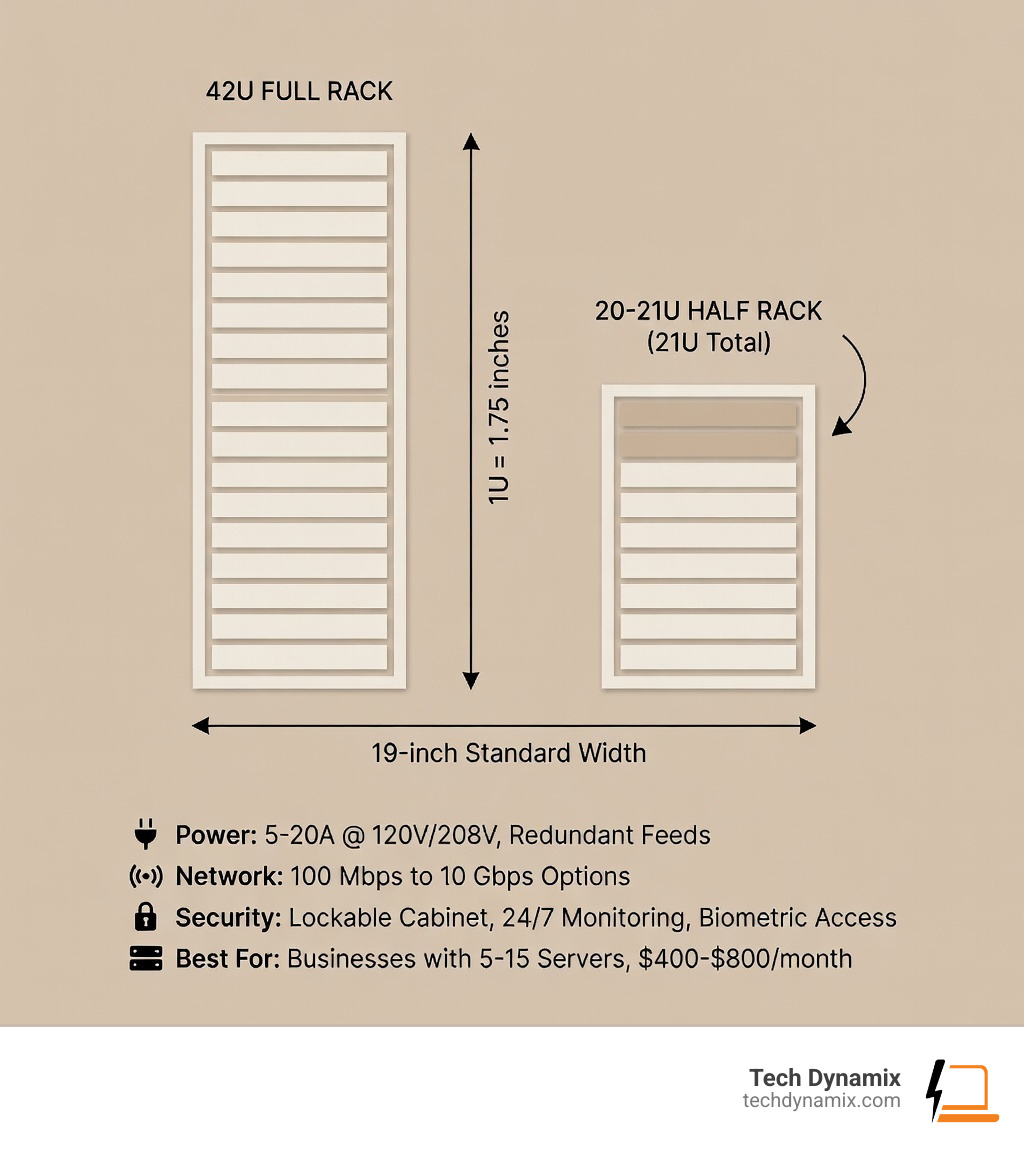
To understand the capacity, we first have to talk about the “U.” A Rack Unit (U) is the standard measurement of vertical storage space in the IT world, exactly 1.75 inches (44.45 mm) in height.
A typical Half rack colocation setup offers a 20U capacity or 21U capacity.
- Height: Approximately 35 to 37 inches of vertical mounting space.
- Width: The industry standard 19-inch width, which fits almost every server, switch, and PDU (Power Distribution Unit) on the market.
- Depth: Usually a generous 36-inch depth (or up to 1000mm/1200mm), allowing plenty of room for those extra-long enterprise servers and organized cable management.
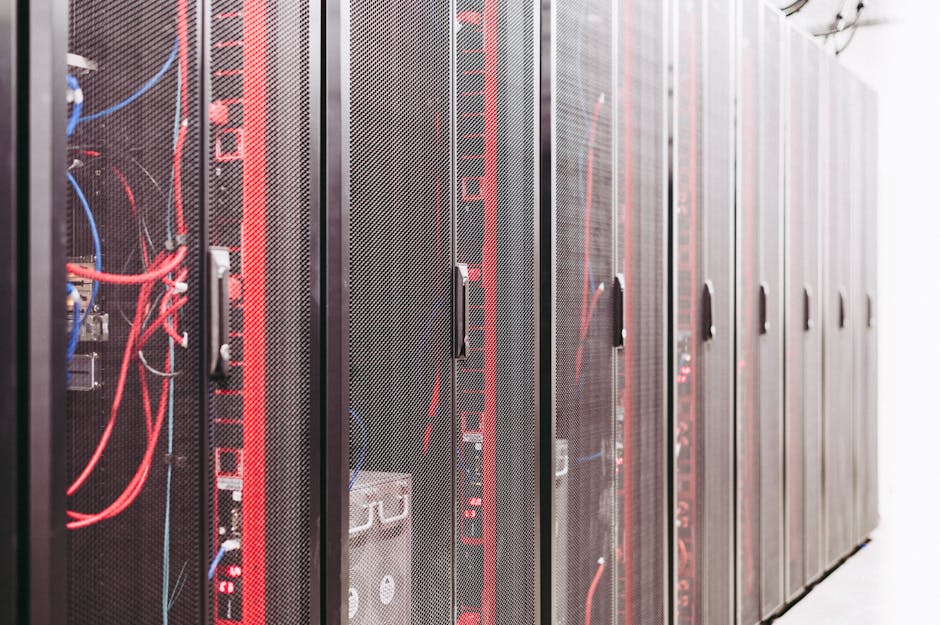
The physical cabinet itself is designed for performance. You’ll find perforated doors on the front and back to facilitate massive airflow. This is critical because, as we know, heat is the number one enemy of electronics. By using a professional Half Rack Colocation Rack Space, you benefit from engineered airflow management that pulls cold air through the front and exhausts hot air out the back—something that’s nearly impossible to replicate in a standard office closet without a massive electric bill.
Power and Bandwidth Specifications
Power is the lifeblood of your servers, and in a colocation environment, it’s much more than just a wall outlet. A half rack typically includes 120V AC or 208V power options. Depending on your hardware density, you might start with a 10 Amp or 20 Amps circuit.
The real magic, however, is in the redundancy. Most professional facilities provide A+B power feeds as a standard. This means your servers (provided they have dual power supplies) are plugged into two completely independent power paths. If one UPS (Uninterruptible Power Supply) fails or a breaker trips on side A, side B keeps everything humming without a millisecond of downtime. This is backed by massive UPS backup batteries and on-site diesel generators that can run the entire facility for days if the local grid goes dark.
On the connectivity side, you aren’t stuck with a basic business cable line. You get direct access to a high-speed backbone. Typical packages include 100 Mbps burstable connections or dedicated 1Gbps ports. Because these facilities are “carrier-neutral,” you often have the choice of multiple fiber providers, ensuring that your Half Rack Colocation Power and Bandwidth is as resilient as the hardware it supports.

Key Benefits of Choosing Half Rack Colocation
Why not just keep the servers in your office in Willoughby or Mayfield Heights? The answer usually comes down to the “Three Cs”: Cost, Cooling, and Certainty.
Building a server room that meets data center standards is prohibitively expensive for most small to mid-size businesses. You need specialized HVAC, fire suppression (that won’t ruin the gear), biometric security, and redundant power. By choosing Half rack colocation, you share the cost of that massive infrastructure with other tenants while keeping your specific hardware in a lockable door cabinet.
Cost-effectiveness is a major driver here. You avoid the massive capital expenditure (CAPEX) of building a facility and trade it for a predictable monthly operating expense (OPEX). Plus, the cooling efficiency of a data center—often utilizing Hot/Cold aisle containment—means your hardware runs at lower temperatures, extending its lifespan significantly.
To give you an idea of how this fits into the hierarchy, look at the comparison below:
Security and Compliance Features
If you are in healthcare or financial services in Northeast Ohio, security isn’t just a “nice to have”—it’s a legal requirement. Professional colocation facilities are built to meet rigorous standards like SSAE 18 and SOC 2 Type II.
When you house your gear in a half rack, you benefit from:
- Biometric access: Fingerprint or iris scanners to even get onto the data center floor.
- CCTV monitoring: 24/7 video surveillance of every aisle and entry point.
- Mantraps: Specialized entry portals that prevent “tailgating” (someone following an authorized person inside).
- Physical Isolation: Your half rack is a private, keyed environment.
This level of protection is a core part of any robust Cybersecurity Solution. We often find that half of staff have too much access to data when servers are kept on-site. Moving hardware to a colocation facility naturally restricts physical access to only those who absolutely need it, which is a great first step during Compliance & Security Audits.
Reliability and Uptime SLAs
In the IT world, “uptime” is the only metric that truly matters. Most colocation providers offer a 99.99% Uptime Service Level Agreement (SLA). They can do this because every single system is redundant—from redundant cooling units to N+1 infrastructure (meaning they have at least one more of everything than they actually need to run at full load).
This reliability extends to the network. Carrier-neutrality means the facility is connected to the internet via multiple different providers. If one fiber line gets cut by a stray backhoe three miles away, your traffic automatically reroutes through a different provider. This level of Network Design & Management is what keeps your business online when your competitors are facing outages.
Strategic Use Cases for Your Infrastructure
Is Half rack colocation right for you? It’s not just about “where the servers go.” It’s a strategic decision that affects how your business handles data. For many of our clients in the Cleveland Metro East Corridor, we use colocation as the backbone for a hybrid cloud strategy. You keep your most sensitive, high-performance hardware in your private rack, while using the cloud for burstable workloads.
This setup is ideal for:
- SMB infrastructure: Consolidating 5-10 aging servers into a modern, high-density virtualized environment.
- Edge computing: Placing processing power closer to your local operations in Northeast Ohio rather than in a distant cloud data center.
- High-density hardware: Running specialized equipment (like GPU-heavy servers for manufacturing design) that would melt a standard office AC unit.
Our IT Consulting & Advisory team often recommends half racks for businesses that want total control over their hardware but don’t want the headache of facility management.
Half rack colocation for Disaster Recovery
One of the most powerful uses for a half rack is Disaster Recovery (DR). If your primary office is in a flood-prone area or a region with an unstable power grid, having a Half Cabinet Colocation Service in a separate geographic location ensures business continuity.
By setting up data replication between your office and the data center, you create geographic redundancy. If your main office goes offline due to a fire, storm, or major hardware failure, your failover systems in the colocation rack can take over, keeping your employees working and your customers served.
Scaling with Half rack colocation
The beauty of the half rack is its growth capacity. It’s a modular expansion strategy. You might only fill 10U of that space today, but you have another 10U of future-proofing ready for when you need to add more storage or new application servers.
If you eventually outgrow the 20U or 21U limit, the transition to a full rack is usually seamless. You aren’t moving to a new building; you’re often just moving to a larger cabinet in the same row. This significantly reduces the complexity of scaling your services and keeps your capital expenditure low while you grow.
Frequently Asked Questions about Half Rack Colocation
How many servers can fit in a half rack?
A 20U capacity half rack can technically hold twenty 1U servers. However, in the real world, you need to account for more than just the servers themselves. You’ll likely have:
- A network switch (1U-2U)
- A firewall (1U)
- A UPS or PDU (1U-2U)
- Cable management space to keep things from becoming a “spaghetti mess”
- PDU mounting (which is often vertical, saving you “U” space)
Most of our clients comfortably fit 8 to 12 servers plus all necessary networking gear in a half rack while still leaving room for airflow and future expansion.
What is the difference between a half rack and a dedicated server?
A dedicated server is a single piece of hardware you rent from a provider. You don’t own it, and you usually can’t touch it. Half rack colocation is about hardware ownership and physical control.
With colocation, you buy the specific servers that meet your needs. This allows for total customization and resource isolation. Over a 3-to-5-year period, the long-term ROI of owning your hardware and colocating it is often much higher than renting dedicated servers, especially as your compute needs grow.
What are “Remote Hands” services?
One of the biggest worries about moving gear to a data center is, “What if I just need to push a button?” That’s where Remote Hands comes in. These are on-site technicians employed by the data center who act as your eyes and ears.
They can perform basic tasks like:
- Server reboots
- Cable swaps or checking connections
- Hardware replacement (like swapping a hot-swappable hard drive)
- Providing 24/7 support for emergency issues
This means you don’t have to drive to the data center at 3:00 AM just because a switch needs a power cycle.
Conclusion
At Tech Dynamix, we believe that your technology should be an asset, not a burden. For businesses throughout Northeast Ohio—from the suburbs of Mentor to the busy corridors of Mayfield Heights—Half rack colocation represents a sophisticated way to professionalize your IT infrastructure. It offers the perfect blend of security, power redundancy, and scalability without the exorbitant costs of a full-scale data center footprint.
Whether you are looking to secure your data against local disasters, meet strict compliance standards, or simply get the humming, heat-generating servers out of your office, we are here to help. Our local expertise and 20+ years of experience make us the ideal partner to manage your transition to a high-performance colocation environment.
Ready to take your infrastructure to the next level? Our IT Consulting & Advisory team can help you evaluate your current setup and design a colocation strategy that fits your budget and your goals.
Contact a colocation expert today to learn how we can help you unlock the full potential of your business with the right colocation solution.