Why Business Continuity Planning Matters for Ohio Organizations
Business continuity Ohio planning is essential for organizations to maintain critical operations during disruptions. Here’s what Ohio businesses need to know:
Key Components of Business Continuity in Ohio:
- Business Impact Analysis – Identify critical functions and recovery time objectives
- Recovery Strategies – Document backup plans for facilities, technology, and personnel
- Testing and Training – Regularly validate plans through exercises and drills
- State Resources – Leverage Ohio-specific tools like the Ohio Ready system and COOP templates
Common Disruptions to Plan For:
- IT system outages and cyberattacks
- Natural disasters (flooding, severe weather)
- Loss of facility access
- Supply chain interruptions
- Pandemic events
When systems go down, the costs add up fast. According to industry research, even a single hour of IT downtime can cost thousands of dollars, with some critical failures reaching up to $1 million per hour. Beyond immediate financial impact, businesses face productivity losses ranging from 43.6% to 64.8%, damaged customer relationships, and potential regulatory penalties.
The reality is stark: insurance doesn’t cover all disruption costs, and customers who can’t reach you will turn to competitors. That’s why organizations across Ohio—from state agencies to universities to private businesses—are implementing structured business continuity programs to protect operations, preserve customer trust, and ensure rapid recovery when disruptions occur.
I’m Jay Barufka, and over my 20 years designing IT infrastructure and supporting critical systems across Northeast Ohio, I’ve seen how Business continuity Ohio planning separates resilient organizations from those that struggle to recover. I’ve helped clients implement network redundancy, security protocols, and proactive monitoring that keep operations running when unexpected events strike.
What is Business Continuity Management in Ohio?

Business Continuity Management (BCM) is a holistic approach to risk management. For organizations in Painesville, Mentor, Cleveland, and across Northeast Ohio, BCM involves establishing frameworks to manage potential threats. Our goal is to build organizational resilience, ensuring we can recover from academic, business, natural, or technological disruptions.
The purpose of BCM is to enable consistency in recovery. This ensures critical functions remain operational, supporting the organization’s mission. As Ohio State University highlights in their Business Continuity Management Policy, BCM is about identifying and managing risk to achieve a mission despite complex operational changes. It is proactive planning, not just reactive damage control.
Defining the Purpose of BCM
At its core, BCM ensures mission-essential functions continue during and after a disruption. This proactive stance helps Ohio organizations mitigate unexpected events, maintain service delivery, and preserve stakeholder trust. Disruptions can range from system outages to cyberattacks. BCM defines how business continues when normal procedures are impossible, involving resources and actions held in readiness. For broader insights, organizations often consult resources like DRJ.com.
Business Continuity Ohio: Enterprise vs. Agency Planning
In Ohio, planning varies by scale. For state entities, there is a distinction between enterprise-level “Business Continuity” and individual agency “Continuity of Operations” (COOP) planning.
Business Continuity for the State of Ohio is an enterprise approach ensuring all departments have viable continuity capabilities. This establishes a comprehensive continuity of government function for millions of citizens. The Ohio Emergency Operations Plan provides the framework for this statewide management.
COOP planning occurs within individual agencies to ensure specific mission-essential functions continue during emergencies like localized natural disasters or technological failures. The State of Ohio’s Office of Collective Bargaining supports these agencies with web-based tools and coordination with the State Emergency Operations Center. For private businesses, the principles remain the same: identify critical functions and ensure resilience. Our expertise in Compliance & Security Audits helps businesses align with these best practices.
The Core Components of an Ohio Business Continuity Plan
A robust Business continuity Ohio plan provides a roadmap for maintaining operations and recovering data. When helping businesses in Painesville, Mentor, and Cleveland, we focus on foundational elements that ensure stability during crises.
Essential Steps for Business Continuity Ohio
Creating a Business Continuity Plan (BCP) involves four essential steps outlined by Ready.gov, which we tailor for Ohio clients:
- Conduct a Business Impact Analysis (BIA): Identify time-sensitive critical functions and the resources supporting them. A BIA helps prioritize recovery based on the effects of disruption. The Business Impact Analysis process is fundamental to understanding business priorities.
- Identify and Implement Recovery Strategies: Develop alternate means to restore operations to a minimum acceptable level for facilities, personnel, and technology.
- Organize a Business Continuity Team: A dedicated team is essential. We help organize this team and compile a plan outlining roles and procedures.
- Conduct Training and Testing: We ensure your team is trained and strategies are evaluated through regular exercises. The Business Continuity Planning Process Diagram provides a visual guide.
Technical Requirements and IT Disaster Recovery
Technology is the backbone of modern business, making IT disaster recovery paramount. This is where our Backup & Business Continuity services are critical. Key considerations include:
- Recovery Time Objective (RTO): The maximum acceptable downtime for a critical system.
- Recovery Point Objective (RPO): The maximum acceptable amount of data loss measured in time.
- Redundancy and Failover: Implementing multiple servers and cloud solutions ensures that if one component fails, another takes over. We recommend load balancing to prevent single points of failure.
- Manual Workarounds: These ensure business continues while systems are restored. The Recovery strategies for information technology emphasize this aspect.
Our Managed Services build resilient environments for Northeast Ohio businesses, providing proactive monitoring and expert support.
Navigating the Business Continuity Management Lifecycle
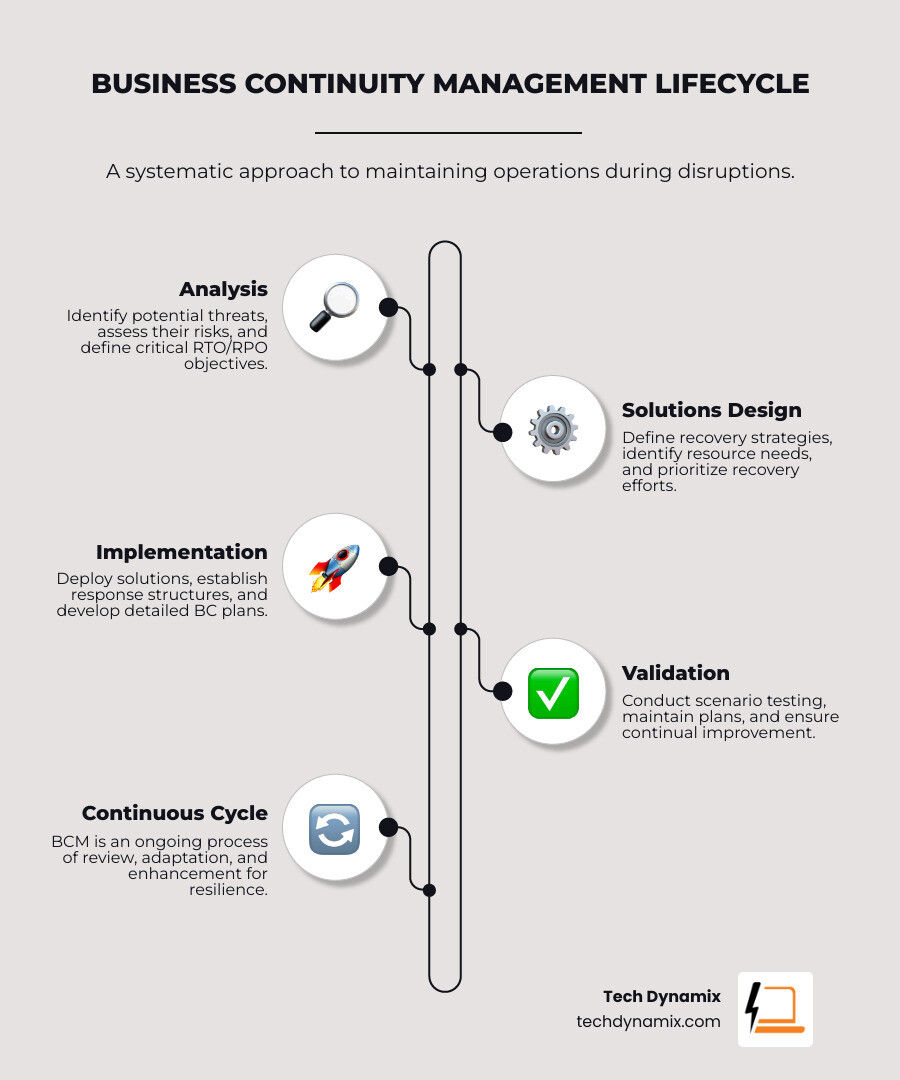
The BCM lifecycle is a dynamic process that evolves with your business. For Ohio entities, this lifecycle provides a structured approach to improving resilience. Ohio State University, for example, uses a consultative lifecycle process to improve departmental readiness.
| Phase | Description |
|---|---|
| Analysis | Identify threats, assess risks, and define RTO, RPO, and Maximum Tolerable Period of Disruption (MTPD). |
| Solutions | Define recovery strategies, resource requirements, and mitigate single points of failure. |
| Enabling | Implement solutions, define response structures, and develop formal BC and IT Continuity Plans. |
| Validation | Conduct scenario testing, maintenance, and continual improvement through regular exercises. |
Analysis and Solutions Design
BCM begins with rigorous analysis. We identify threats—from natural disasters to modern cyber threats—and map dependencies using tools like the Operational & Financial Impacts worksheet. We establish RTOs, RPOs, and the MTPD to understand the cascading effects of disruption. We also analyze supplier risk to avoid fatal flaws in the supply chain.
Solutions design translates findings into action. This involves identifying alternate sites, detailing resource needs via the Business Continuity Resource Requirements worksheet, and prioritizing recovery activities. ISO 22301 and the Professional Practices for Business Continuity Professionals from DRI International provide frameworks for this lifecycle.
Implementation and Validation
Implementation involves deploying backup systems and defining response structures. We develop comprehensive BCPs and IT Service Continuity Plans that outline emergency procedures and communication protocols.
Validation is critical; a plan is only a theory until tested. We conduct scenario exercising and IT recovery testing, including tabletop simulations. As Ready.gov emphasizes, Testing and exercises are vital. Finally, maintenance ensures plans stay current with personnel changes and new technologies.
Ohio State Resources and Sector-Specific Considerations
For businesses and organizations across Northeast Ohio, understanding and leveraging local and state-level resources is a significant advantage in building effective Business continuity Ohio plans.
Leveraging Business Continuity Ohio Resources
Ohio provides a variety of resources to support continuity planning:
- Ohio Ready System (Kuali Systems): Ohio University, for example, uses the Ohio Ready (Kuali Systems) software as a data repository for all campus BCPs. This web-based tool can guide departments through the process, helping them fill in blanks and identify missing information. Its offsite hosting ensures accessibility even if the local Ohio network is down, making plans retrievable from anywhere with internet access.
- Ohio Bureau of Workers’ Compensation (BWC): The BWC offers resources for disaster and pandemic preparedness, focusing on workplace safety and health during emergencies. While not directly IT-focused, it’s a valuable resource for overall organizational resilience.
- Continuity Professionals of Ohio (CPO): This professional organization hosts monthly meetings and events, providing a platform for members to share experiences and insights on continuity planning. Benefits include networking, knowledge sharing, and access to best practices in areas like business impact analysis, risk management, emergency response, and crisis communications. These are invaluable for growing our expertise and staying current with industry trends.
- State of Ohio Business Continuity Program: The state’s Office of Collective Bargaining provides extensive guidance, templates, and tools (like Business Impact Analysis and Risk Assessment tools, and various COOP plan templates) for state agencies. These resources are often based on state and federal guidance and best practices, offering a robust framework that private businesses can also draw inspiration from.
- Ohio HB 96: For cities, counties, and school districts in Ohio, understanding legislation like Ohio HB 96: A Practical Path to Compliance for Cities, Counties, School Districts can be critical, as it often influences their continuity planning requirements.
Challenges for Healthcare and Government Sectors
Different sectors within Ohio face unique challenges and considerations when it comes to business continuity:
- Healthcare: For healthcare providers in Northeast Ohio, such as those in Cleveland and Akron, business continuity is not just about financial stability; it’s about patient safety and lives. Disruptions can lead to missed appointments, delayed treatments, and even compromised patient data. Regulatory penalties for HIPAA violations or service interruptions can be severe. A virtual healthcare startup, for instance, might implement ISO 22301 to ensure the continuity of critical medical services, demonstrating a commitment to patient safety and compliance. This requires meticulous planning for essential records, data availability, and maintaining communication channels. Our IT Consulting & Advisory services are particularly valuable here, helping healthcare organizations steer complex regulatory environments while building robust continuity plans.
- Government Agencies: As we’ve seen with the State of Ohio’s program, government agencies must ensure the continuity of mission-essential functions that citizens rely upon. This includes maintaining essential records, public safety communications, and critical IT systems. Their plans must account for a wide range of emergencies, from natural disasters to cyber incidents, and often require detailed IT/DR plans, essential records plans, and even pandemic response strategies. The distinction between enterprise-wide business continuity and individual agency COOP planning is crucial for effective government functioning.
- Manufacturing: In Lake and Summit Counties, manufacturing businesses face challenges like production machinery breakdowns, supply chain disruptions, and facility damage. Their continuity plans must address shifting production, inventory management, and maintaining customer relationships even when output is affected.
These sector-specific needs highlight why a generic plan won’t cut it. Effective Business continuity Ohio requires custom strategies that account for industry regulations, critical dependencies, and unique risks.
Mitigating Financial Loss and Enhancing Resilience
The financial implications of disruptions make Business continuity Ohio planning a necessity for organizations in Northeast Ohio.
The True Cost of Disruption in Ohio
Beyond lost hours, downtime leads to missed sales, regulatory penalties (especially in healthcare and finance), and emergency IT repair costs. Research indicates productivity losses can reach 64.8% during disruptions. Reputational damage can be even more costly, as customers defect to competitors.
Industry studies show downtime can cost thousands per hour, with critical failures reaching $1 million. Insurance rarely covers intangible costs like customer loyalty. The Open for Business® Toolkit offers resources to protect against these impacts.
Building an Always-On Environment
To mitigate loss, businesses must build an “always-on” environment:
- Redundancy: Use redundant servers and internet connections to ensure seamless failover.
- Proactive Monitoring: Address issues before they cause downtime. Our Cybersecurity Solutions prevent attacks that lead to outages.
- Cloud Migration: Moving to the cloud provides inherent scalability and easier recovery.
- Tested Backups: Backups must be regularly verified for integrity.
- MSP Partnership: Partnering with an MSP like Tech Dynamix provides 24/7 monitoring and expert support. We help manage vulnerabilities across hybrid IT environments, staying informed through resources like Continuity Central.
Frequently Asked Questions about Business Continuity
What is the difference between BCP and Emergency Operations?
- Business Continuity Planning (BCP) focuses on documenting backup plans to continue business operations during a disruption. Its goal is the ongoing availability of critical functions.
- Emergency Operations is the immediate response to ensure the safety of individuals and property. It is about crisis management and protecting lives.
While coordinated, BCP is about getting back to work, while emergency operations are about immediate safety. The Continuity Guidance Circular from FEMA provides more context.
How often should an Ohio BCP be updated?
A BCP is a living document. It should undergo an annual review at minimum. Updates are also required during personnel changes, technology upgrades, or process modifications. After any real-world disruption, a post-incident review should be used to improve the plan. The Business Continuity Resource Requirements worksheet should be revisited during these updates.
What are the benefits of joining the Continuity Professionals of Ohio (CPO)?
Joining the CPO offers networking with peers in Northeast Ohio, knowledge sharing on risk management, and access to industry best practices. It is an excellent resource for professional development and community support during crises. You can learn more about the industry landscape at Continuity Insights.
Conclusion
Effective Business continuity Ohio planning is no longer a luxury; it’s a fundamental requirement for any organization aiming to thrive in an unpredictable world. From understanding the core components of a robust plan to navigating the BCM lifecycle and leveraging Ohio-specific resources, the journey toward resilience is ongoing and essential. The staggering financial costs of downtime and the potential damage to reputation underscore the urgency.
At Tech Dynamix, we understand these challenges intimately. With over 20 years of experience, we provide high-quality IT consulting and managed IT services to small and mid-size businesses across Northeast Ohio, including Painesville, Mentor, Cleveland, Hudson, Lake County, and Summit County. Our offerings, which include proactive IT support, cybersecurity protection, cloud migration and management, and Backup & Business Continuity, are designed to build and maintain the “always-on” environment your business needs.
We’ve seen how thoughtful planning and strategic IT investments can transform vulnerability into resilience. Whether you’re struggling with the complexities of compliance, the threat of cyberattacks, or the need for seamless operational continuity, our local expertise and comprehensive service portfolio make us a dependable all-in-one technology partner. Don’t let unforeseen disruptions derail your progress.
For more information on how we can help your business achieve digital resilience and stay ahead of the curve, explore our digital transformation services. Let’s work together to keep Ohio running, no matter what comes our way.