Understanding Cloud Migration and Why Expert Guidance Matters
Cloud migration expertise is the specialized knowledge required to move applications, data, and infrastructure from on-premises systems to cloud environments while minimizing risk and achieving business goals.
What You Need to Know:
- Core Strategy: Using the 7 Rs (Retire, Retain, Rehost, Relocate, Repurchase, Replatform, Re-architect) to choose the right approach.
- Essential Skills: Certified architects and security specialists in AWS, Azure, or Google Cloud.
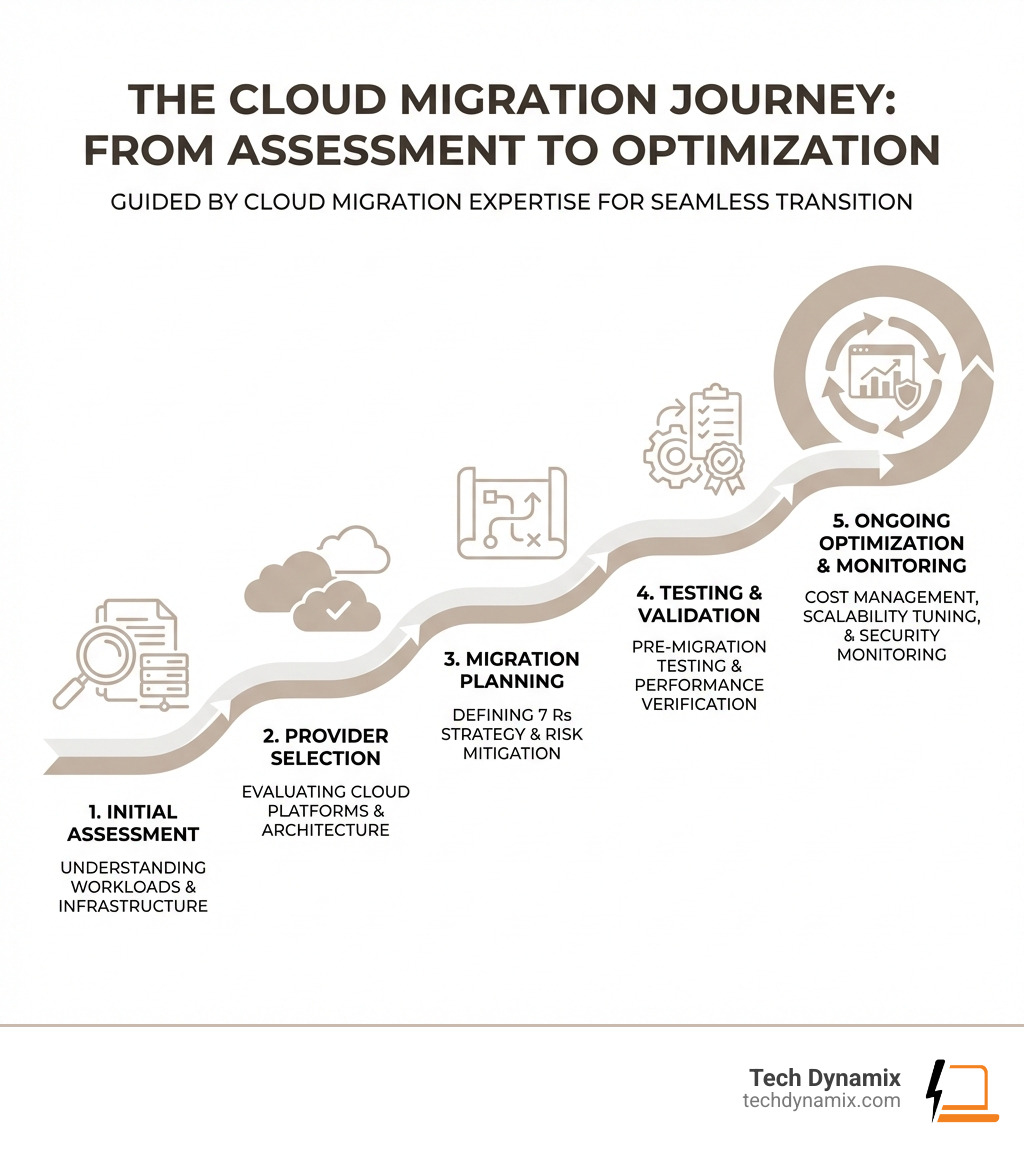
- Key Steps: Assessment, provider evaluation, planning, testing, and optimization.
- Common Challenges: Budget overruns (38% of companies) and timeline delays.
- Expected Outcomes: Cost reduction, scalability, and improved security.
Public cloud spending is projected to reach $679 billion in 2024, a 20.4% increase. However, inefficiencies in coordination cost companies an average of 14% more than planned. Furthermore, 31% of businesses report underperformance because they rushed migrations without proper optimization.
Successful migration requires more than technical skill; it demands a strategic understanding of infrastructure and business objectives. As Jay Baruffa, with over 20 years in IT infrastructure design, I guide Northeast Ohio businesses through complex migrations that balance security and scalability. At Tech Dynamix, we help local companies steer this transition without the typical budget overruns.
Why Organizations are Prioritizing Cloud Migration Expertise
Cloud migration involves moving applications and data from on-premises data centers to cloud environments like AWS, Azure, or Google Cloud. For businesses in Northeast Ohio, from Painesville to Hudson, this shift is about embracing a fundamental change in how they innovate and grow.
Gartner forecasts public cloud spending will reach $679 billion in 2024. Most businesses now host at least 50% of their workloads in the cloud. This massive shift is driven by several key benefits:
- Cost Savings: Eliminates expensive hardware and maintenance, shifting capital expenditures to manageable operational expenses.
- Innovation and Agility: Provides access to AI and machine learning, enabling rapid deployment of new services. This is a core part of modern digital transformation efforts.
- Scalability: Allows businesses to instantly scale resources up or down based on demand.
- Operational Efficiency: Managed services free up IT teams to focus on strategic initiatives.
- Security and Disaster Recovery: Cloud providers offer robust security and backup solutions that often exceed on-premises capabilities.
- Accessibility: Enables seamless remote work and collaboration from anywhere.

| Feature | On-Premises Infrastructure | Cloud-Based Solutions |
|---|---|---|
| Cost Model | High upfront capital expenditure | Operational expenditure (pay-as-you-go) |
| Scalability | Limited, manual upgrades | Highly elastic, instant scaling |
| Maintenance | Internal IT team responsible | Managed by provider, reduced burden |
| Accessibility | Often limited to internal network | Accessible anywhere with internet |
| Disaster Recovery | Requires significant investment | Built-in redundancy, faster recovery |
| Innovation Speed | Slower, hardware-dependent | Faster access to new technologies |
Navigating the 7 Rs: Strategic Approaches to Migration
Cloud migration is not one-size-fits-all. The “7 Rs” framework helps guide strategic decisions, ensuring each workload is handled correctly. This strategic selection is a hallmark of Cloud migration expertise.
- 1. Retire: Decommission applications that no longer provide business value. If usage is minimal, retiring them saves resources and reduces complexity.
- 2. Retain: Keep certain applications on-premises due to regulatory compliance or recent hardware investments until a cloud-native version is available.
- 3. Rehost (Lift-and-Shift): Move applications to the cloud with minimal changes. This is the fastest way to gain scalability and reduce infrastructure costs.
- 4. Relocate: Move infrastructure between cloud environments, such as moving VMware workloads to VMware Cloud on AWS.
- 5. Repurchase: Switch to a cloud-native product, such as replacing an on-premises CRM with a SaaS solution like Salesforce. This is effective for gaining efficiency.
- 6. Replatform: Make minor optimizations, like moving to a managed database service, to leverage cloud capabilities without a full redesign.
- 7. Re-architect (Refactor): Fundamentally redesign applications to be cloud-native. This is necessary for monolithic legacy systems that are difficult to maintain.
Essential Cloud Migration Expertise for Re-architecting
Re-architecting is the most complex strategy. It involves breaking down monolithic designs into microservices or serverless architectures. This requires:
- Cloud-Native Design: Understanding auto-scaling and managed services.
- Refactoring Skills: Rewriting code to decouple components without losing functionality.
- Modern Architectures: Proficiency in Docker, Kubernetes, and serverless computing.
- Data Modernization: Moving to cloud-native databases or data lakes.
- Security by Design: Integrating security into the application architecture from the start.
For businesses in Northeast Ohio, this level of knowledge is often found through IT consulting & advisory services, as it requires dedicated cloud architects.
A Step-by-Step Guide to a Successful Migration Strategy
A well-defined strategy is essential for a smooth transition. This planning is a core component of Cloud migration expertise.
1. Assess Your Current IT Infrastructure: Audit your applications, servers, storage, and network topology. Understand data flows and usage patterns to identify risks. The 2024 State of the Cloud Report insights show that over 50% of businesses are accelerating migrations, making this assessment vital.
2. Evaluate Cloud Solutions and Providers: Choose between IaaS, PaaS, and SaaS. Research providers like AWS, Azure, and Google Cloud based on pricing, security, and support.
3. Identify and Prioritize Change Opportunities: Align migrations with business goals. Start with non-critical workloads to test processes before moving mission-critical systems.
4. Create a Detailed Migration Plan: Develop a roadmap with timelines, budgets, resource allocation, and a rollback strategy.
5. Test and Monitor: Conduct pilot migrations and perform functional, performance, and security testing. Once live, implement continuous monitoring.
Mitigating Risks with Technical Cloud Migration Expertise
Expert guidance reduces risks like data loss and security breaches. Key areas include:
- Data Assessment and Preparation: Involves data findy, classification, and cleansing. We map dependencies to ensure no links are broken during transfer.
- Robust Security Controls: We implement Identity and Access Management (IAM), encryption, and network segmentation. Our Microsoft 365 cloud support often includes these advanced security configurations.
- Thorough Testing: We perform penetration testing and disaster recovery simulations to ensure the environment is resilient.
- Continuous Optimization: Post-migration, we monitor performance and manage cloud spend to prevent budget overruns.
By addressing these areas, we ensure a secure and compliant environment for businesses in Mentor, Ohio, and the surrounding areas, integrating backup & business continuity from day one.
Overcoming Common Challenges and Missteps
Cloud migration can be more difficult and expensive than expected without Cloud migration expertise. Here are common pitfalls we help Northeast Ohio businesses avoid:
- 1. Lack of Executive Sponsorship: Migration is an organizational change. Without leadership backing, resource conflicts and resistance can derail the project.
- 2. Poor Planning: Inadequate coordination costs companies 14% more than planned. Rushed migrations often lead to performance issues.
- 3. Improper Data Preparation: Migrating data without cleansing leads to inaccurate analytics and compliance risks.
- 4. Insufficient Security and Testing: Neglecting security controls or skipping tests can lead to breaches and downtime.
- 5. Failing to Optimize: 38% of decision-makers miscalculate their cloud budget. Simply moving to the cloud isn’t enough; you must optimize workloads for cost and performance. Managing spend is now the top cloud challenge for many organizations.
- 6. Wrong Provider Choice: Selecting a provider based only on cost can lead to vendor lock-in or compatibility issues.
- 7. Skill Gaps: Cloud migration requires specialized architects and engineers. Partnering with a firm for managed services provides the necessary expertise.
Frequently Asked Questions about Cloud Migration
What are the primary benefits of migrating to the cloud?
Cloud migration offers cost savings by replacing hardware with a pay-as-you-go model. It provides rapid scalability, improved security through provider investment, better accessibility for remote teams, and robust disaster recovery solutions.
How do I choose the right cloud provider?
Consider their service offerings, pricing models (including egress fees), performance history, and security compliance. Compatibility with your existing tools and the provider’s market stability are also critical factors.
Why do cloud migrations often exceed their budgets?
Budgets are often exceeded due to a lack of comprehensive planning, improper data assessment, and a failure to optimize workloads. Hidden egress fees and inefficient resource provisioning also contribute to unexpected costs. Specialized Cloud migration expertise is essential to manage these costs effectively.
Conclusion
Cloud migration requires strategic foresight and specialized Cloud migration expertise. While the benefits—cost savings, agility, and security—are significant, the journey requires careful navigation to avoid budget overruns and delays.
For businesses in Northeast Ohio, Tech Dynamix provides the local expertise needed to assess infrastructure and execute a successful migration. With over 20 years of experience, we help you choose the right strategy and optimize your environment for long-term success. We ensure your cloud journey drives innovation and secures a competitive edge.
Ready to transform your IT operations? Unlock expert cloud services with Tech Dynamix today.