Why Cloud Based DCIM Is Replacing Legacy Data Center Management
Cloud based DCIM (Data Center Infrastructure Management) is software that gives you real-time visibility into your data center’s power, cooling, assets, and capacity — delivered through the cloud instead of clunky on-premise systems.
Here’s a quick snapshot of what it does and why it matters:
| Feature | What It Means for You |
|---|---|
| Real-time monitoring | See power, temperature, and assets across all sites instantly |
| Cloud delivery | No servers to maintain, automatic updates, access from anywhere |
| AI-assisted management | Predict failures before they happen |
| Subscription pricing | Pay as you go, starting as low as $125/month |
| Integrations | Connects with your CMDB, ITSM, and BMS tools |
If your team is still managing infrastructure with spreadsheets, manual floor walks, or aging on-premise software, you’re not alone — but you’re at risk.
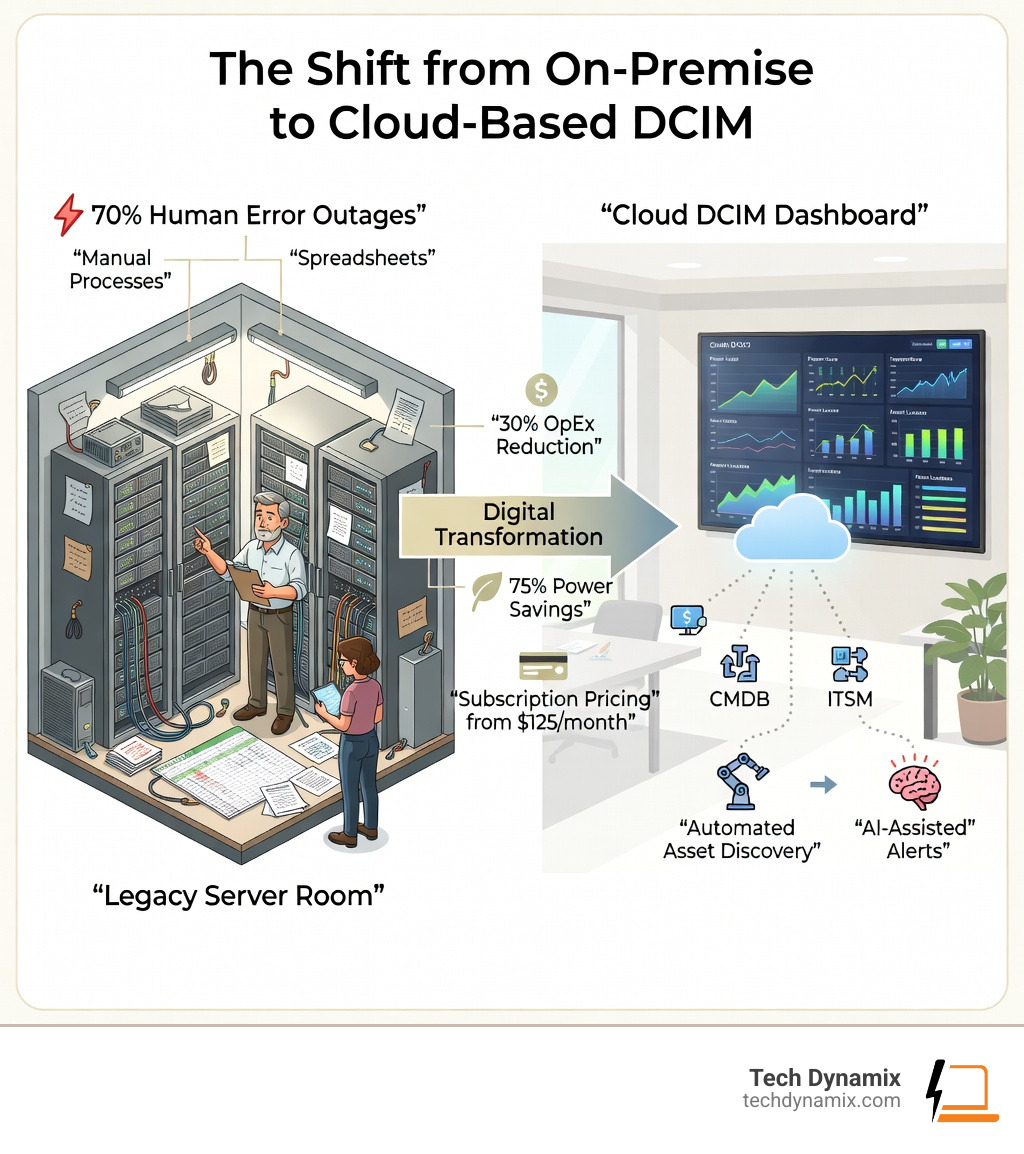
70% of data center outages are caused by human error. That’s not a hardware problem. That’s a visibility problem.
Legacy DCIM tools were built for a different era. They’re expensive to maintain, slow to update, and completely blind to the distributed, hybrid environments most organizations run today. Meanwhile, your data center keeps growing — more racks, more edge sites, more complexity.
“Running your IT infrastructure without DCIM is like driving a car with most of the windshield covered. Disaster is never too far away.”
Cloud-based DCIM fixes this by putting accurate, up-to-the-minute infrastructure data in your hands — from any device, at any time, without a six-figure software deployment.
I’m Jay Baruffa, and with over 20 years designing and supporting enterprise IT infrastructure across Northeast Ohio, I’ve seen how the right cloud based DCIM strategy can turn a reactive, error-prone operation into a lean, proactive one. Let’s walk through exactly how it works and what to look for.
The Evolution of Infrastructure: Why Move to Cloud Based DCIM?
In the late 90s, managing a data center meant physical clipboards and Excel sheets. If you were “high-tech,” you had an on-premise DCIM installation that required its own dedicated server, a database administrator to keep it running, and a massive capital expenditure (CapEx) just to get the login screen to appear.
Today, the landscape has shifted. We are helping businesses throughout Mentor, Willoughby, and the Greater Cleveland area embrace digital transformation by moving critical management layers to the cloud. A cloud based dcim platform is “cloud-native,” meaning it was built from the ground up to leverage the flexibility and scalability of the cloud.
Scalability and Deployment
Unlike legacy systems that take months to configure, cloud DCIM offers rapid deployment. You don’t need to buy hardware or install local databases. You simply deploy lightweight “collectors” or use agentless discovery to start seeing your data. This is particularly vital for organizations with distributed sites—like a school district managing racks across dozens of buildings or a healthcare provider with multiple clinics in Lake County.
OpEx vs. CapEx
Traditional DCIM is a budgetary nightmare of upfront licensing and heavy maintenance fees. Cloud solutions shift this to an Operating Expense (OpEx) model. With subscriptions starting as low as $125 per month, it becomes accessible for mid-size businesses in Northeast Ohio that previously couldn’t justify the cost of enterprise-grade monitoring.
Automated Intelligence
On-premise tools are often static. Cloud-based platforms, however, connect to global “data lakes.” This allows the software to learn from thousands of different data centers, using that collective intelligence to provide better insights for your specific environment.
| Feature | On-Premise DCIM | Cloud-Based DCIM |
|---|---|---|
| Deployment Time | Weeks to Months | Days or Hours |
| Updates | Manual (High Risk) | Automatic & Seamless |
| Cost Model | Heavy CapEx + Maintenance | Predictable Subscription (OpEx) |
| Accessibility | VPN/Local Network Only | Secure Access from Anywhere |
| AI/ML Insights | Limited/None | Advanced Predictive Analytics |
Maximizing ROI Through Intelligent Asset and Power Management
One of the biggest questions we get at Tech Dynamix is: “Will this actually save me money?” The data says a resounding yes. Organizations using cloud based dcim have seen operating expenses (OpEx) drop by as much as 30% through more intelligent power, cooling, and capacity management.
Eliminating “Zombie” Servers
A “zombie” server is a physical machine that is plugged in, powered on, and sucking up electricity, but doing absolutely zero useful work. One US school district discovered that a staggering 30% of the servers across their 1,800 schools were zombies. By identifying and decommissioning these assets, they saved hundreds of thousands in power and maintenance.
Real-World Savings
The financial impact isn’t just theoretical. Consider these benchmarks from the industry:
- Power Reductions: One organization achieved a 75% reduction in power usage simply by using DCIM data to “rightsize” their data center.
- Maintenance Recovery: A company saved $160,000 by finding unused assets that were still under active (and expensive) maintenance contracts.
- Consolidation: Cisco achieved a 66% consolidation of colocation cages, saving $40,000 every single month.
Capacity Planning
Are you actually out of space, or are your racks just disorganized? Cloud DCIM provides a “single pane of glass” view of your floor plan. It helps you visualize power paths to identify single points of failure and prevents overprovisioning. For businesses looking for IT consulting and advisory, this data is gold. It allows us to help you plan your next five years of growth based on hard facts, not “gut feelings.” You can even read more about cloud-based vs legacy DCIM to see how the two compare in a deep-dive environment.
Advanced Capabilities of Modern DCIM Platforms
Modern cloud based dcim isn’t just a digital version of a spreadsheet; it’s an active participant in your IT operations.
AI and Predictive Analytics in Cloud Based DCIM
The “secret sauce” of the newest platforms is Artificial Intelligence. These tools use machine learning to distinguish between “normal” operational noise and actual “abnormal” alarms.
- Predictive Maintenance: Instead of replacing UPS batteries on a fixed calendar (which is wasteful), AI analyzes discharge/recharge patterns to tell you exactly when a battery is likely to fail.
- Thermal Monitoring: Platforms monitor ASHRAE thermal compliance to ensure your cooling is optimized—not too hot to risk equipment, but not so cold that you’re burning money.
- Sustainability Reporting: With new regulations on the horizon, tracking your carbon footprint and CO2 emissions across applications and locations is becoming a requirement. You can even explore the AI Assistant in some platforms to see how these queries work in real-time.
Integrating Cloud Based DCIM with Your Existing IT Stack
Your data center doesn’t live in a vacuum. To be effective, your DCIM must talk to the rest of your tools. Modern platforms use an “API-first” architecture, allowing for seamless network design and management integration.
- CMDB and ITSM: Automatically sync your asset data with tools like ServiceNow or Jira so your helpdesk always has accurate info.
- Automated Discovery: Most cloud DCIM tools are vendor-agnostic and use agentless discovery to find servers, storage, VMs, UPS units, and even generators across your entire estate.
- BMS Integration: Connect to Building Management Systems to get a holistic view of the facility’s health alongside the IT equipment health.
Security Standards and Pricing Models for the Cloud Era
A common concern for IT directors in Northeast Ohio is the security of putting infrastructure data in the cloud. However, modern cloud based dcim is often more secure than on-premise versions because it is maintained by thousands of security experts at the provider level.
Essential Security Features
When evaluating a platform, look for these “must-haves”:
- Encryption: Data must be encrypted both “at rest” (stored) and “in transit” (moving).
- Two-Factor Authentication (2FA): Essential for preventing unauthorized access to your infrastructure maps.
- Fine-Grained Access Control: You should be able to let a technician see rack elevations without giving them access to power billing data.
- Audit Logs: A complete record of every change made within the platform.
For more on how to protect your entire environment, check out our cybersecurity solutions.
Transparent Pricing Models
The days of “call for a quote” and being shocked by a $50k bill are over. Most cloud DCIM vendors use a transparent, asset-based model:
- Per-Asset Pricing: Some vendors charge as little as $2 per asset per year.
- Low Entry Point: Subscriptions often start around $125 per month, with a minimum of 50 assets.
- No Hidden Fees: Because it’s self-service, you often don’t need the expensive “professional services” or “implementation consultants” required by legacy vendors.
Frequently Asked Questions about Cloud DCIM
How does cloud DCIM prevent data center outages?
Human error causes 70% of outages. Cloud DCIM reduces this by automating repetitive tasks like asset tracking and firmware updates. It also visualizes “single points of failure” in your power path. If a PDU is nearing its limit or a cooling unit is struggling, the system alerts you before the breaker trips or the server melts.
Is cloud-based DCIM more secure than on-premise solutions?
In many cases, yes. On-premise DCIM often sits on an unpatched server in a corner of the data center. Cloud-based DCIM platforms follow a security-focused development lifecycle, receive automatic security patches, and are hosted on hardened infrastructure with 24/7 monitoring.
What are the typical pricing models for cloud DCIM?
Most follow a subscription model based on the number of assets (servers, PDUs, UPS) you monitor. This allows you to start small—perhaps just monitoring your core switches and power—and scale up as your budget allows.
Conclusion
If you are still managing your infrastructure using the methods of twenty years ago, you are leaving money on the table and inviting downtime. Moving to a cloud based dcim solution isn’t just about a fancy 3D view of your racks; it’s about gaining the intelligence needed to run a modern, efficient, and reliable IT operation.
At Tech Dynamix, we specialize in helping businesses across Northeast Ohio—from Mentor to Cleveland—navigate these transitions. Whether you need managed services to handle the day-to-day or expert consulting to design your next phase of growth, we have the local expertise to be your dependable technology partner.
Don’t let your data center management stay stuck in 1999. Reach out to us today to see how we can help you gain total visibility over your infrastructure.