Why Cloud Solutions Matter for Modern Businesses
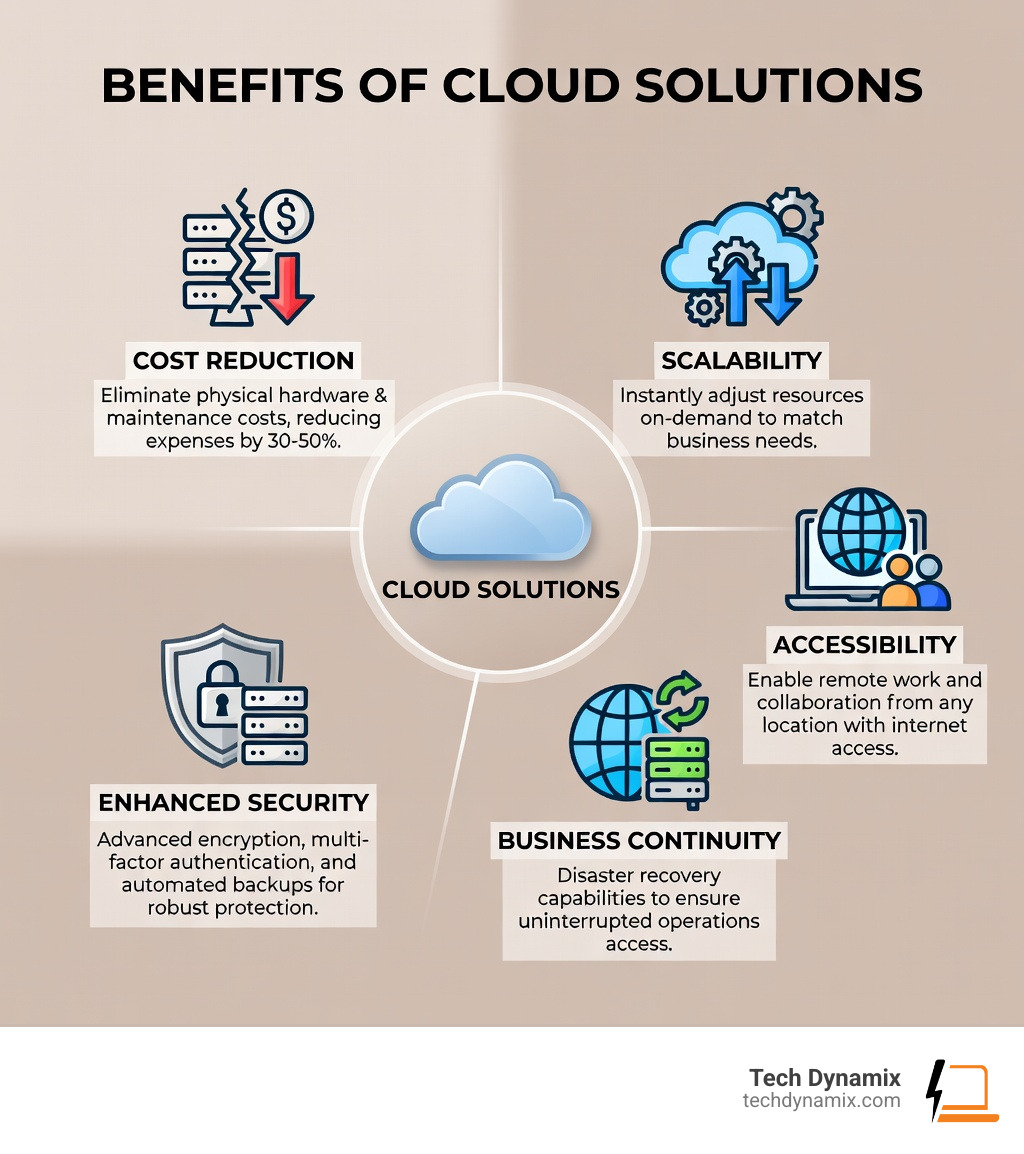
Cloud solutions deliver computing services—including servers, storage, databases, networking, software, and analytics—over the internet, eliminating the need for physical infrastructure while enabling faster innovation and flexible scalability.
Key benefits of cloud solutions include:
- Cost savings through pay-as-you-go pricing and elimination of hardware investments
- Scalability to instantly adjust resources based on business demand
- Enhanced security with advanced encryption, multi-factor authentication, and automated backups
- Business agility with deployment times reduced from months to minutes
- Accessibility allowing teams to work from anywhere with internet connectivity
- Automatic updates keeping systems current without manual intervention
If you’re a Northeast Ohio business facing challenges with aging infrastructure, rising IT costs, or security concerns, cloud solutions offer a path to modernization without the burden of managing physical servers.
The cloud isn’t just about storage anymore. It’s become the foundation for AI tools, real-time collaboration platforms, and industry-specific applications that help businesses compete in today’s digital economy. Whether you’re running a small manufacturing operation or managing a healthcare facility, cloud platforms now offer pre-configured solutions you can deploy in minutes rather than months.
I’m Jay Baruffa, and over my 20+ years designing IT infrastructure and managing complex systems, I’ve helped Northeast Ohio businesses transition to cloud solutions that reduce risk while improving operational efficiency. At Tech Dynamix, we’ve guided companies through cloud migrations that align with their specific needs—whether that’s improving disaster recovery, enabling remote work, or integrating AI-powered tools into daily operations.
Understanding Cloud Solutions and Their Core Benefits
At its heart, cloud computing is the delivery of computing services over the internet. Instead of owning and maintaining physical data centers and servers, we access technology power—like storage and databases—on an as-needed basis. This shift represents a massive leap in how businesses in Mentor, Willoughby, and across the Greater Cleveland Area operate.
One of the most critical concepts to understand is the Shared Responsibility Model. In a traditional on-premises setup, you are responsible for everything: the building, the electricity, the physical server, the virtualization, the operating system, and the data. With cloud solutions, the provider handles the “heavy lifting” of the physical infrastructure, while we focus on managing the data and applications that drive your business.
Why the Shift to Cloud Makes Sense
The move toward digital transformation is fueled by several undeniable advantages:
- Cost Savings: You trade capital expenses (buying big servers upfront) for variable expenses. You only pay for the computing resources you actually consume.
- Scalability: If your business has a peak season—common for our local retail and manufacturing clients—you can scale up your resources instantly and then scale back down when things quiet out.
- Innovation Speed: In the cloud, you can go from an idea to implementation several orders of magnitude faster. You don’t have to wait weeks for hardware to arrive and be installed.
- Economies of Scale: Major providers aggregate usage from millions of customers, allowing them to offer lower pay-as-you-go prices than any single business could achieve on its own.
| Feature | On-Premises Infrastructure | Cloud Solutions |
|---|---|---|
| Upfront Cost | High (Hardware, Space, Power) | Low (Subscription-based) |
| Maintenance | Your team handles all repairs | Provider handles hardware maintenance |
| Scalability | Manual and slow (Buy more RAM/Disks) | Instant and automated |
| Disaster Recovery | Expensive to build redundancy | Built-in automated backups & recovery |
| Accessibility | Limited (VPN required) | High (Anywhere with internet) |
Exploring Industry-Specific Cloud Solutions
Not all cloud solutions are created equal. Depending on whether you are running a medical clinic in Chardon or a manufacturing plant in Painesville, your needs will vary. Modern cloud platforms now offer specialized tools tailored to the unique regulatory and operational requirements of different sectors.
For example, many organizations are moving toward cloud-based contact centre software to improve customer service. This allows local businesses to provide 24/7 support without needing a physical call center located in Northeast Ohio.
Tailored Cloud Solutions for Retail and Healthcare
The retail sector has seen a massive shift, with 9 out of the top 10 retail companies globally trusting major cloud platforms to handle their data. By using cloud solutions, retailers can run analytics at scale. For instance, using modern data warehouses like BigQuery can result in a 26%–34% lower three-year Total Cost of Ownership (TCO) compared to traditional alternatives.
In healthcare, the cloud is literally saving lives. We see providers using AI-driven tools to:
- Improve clinician-patient experiences by automating documentation.
- Advance R&D through faster data processing.
- Enhance disease detection and risk prediction using machine learning models.
Modernizing Infrastructure with Government-Grade Cloud Solutions
Government agencies in Lake and Geauga Counties have unique security and collaboration needs. Google Workspace for Government provides secure collaboration tools and program management resources specifically designed to meet these requirements.
Modernization often involves migrating away from legacy mainframes. Cloud platforms offer “Sovereign Cloud” options, which support digital sovereignty—giving government entities more choice and control over where their data resides and how it is protected.
Accelerating Innovation with AI and Jump Start Solutions
One of the most exciting developments in cloud solutions is the integration of Artificial Intelligence (AI). We are no longer just talking about “storing files”; we are talking about “understanding data.”
Tools like Microsoft Copilot, Gemini, and Vertex AI are changing the way we work. These aren’t just toys; they are productivity engines. For example, Microsoft 365 cloud support now includes AI assistants that can draft emails, summarize long documents, and even generate code.
Deploying Pre-configured Cloud Solutions with Jump Start
Many business owners worry that the cloud is too complex to set up. This is where “Jump Start Solutions” come in. These are pre-configured, interactive solution templates that allow you to deploy applications directly from a cloud console.
Common Jump Start applications include:
- Dynamic Websites: Building and operating a sample website using responsive frameworks.
- Three-Tier Web Apps: Creating a model app with a frontend, middle tier, and backend database.
- Document Summarization: Using generative AI to detect text in raw files and automate summaries.
- Retrieval-Augmented Generation (RAG): Creating chat applications that can “read” your company’s specific documents to provide accurate answers.
Enhancing Productivity through AI-Integrated Cloud Solutions
AI integration allows for “agentic commerce,” where AI agents can help manage customer workflows or subscriptions. In our work across Northeast Ohio, we’ve seen businesses use these tools for:
- Real-time transcription and translation for international meetings.
- Automated image generation for localized marketing materials.
- AI-powered code generation to help internal dev teams build apps faster.
Security, Compliance, and the Role of DevSecOps
Security is often the number one concern for businesses in the Greater Cleveland Area when considering a move to the cloud. The reality is that major cloud providers invest billions in security, often providing a level of protection that a small or mid-sized business could never afford on its own.
For instance, Google currently monitors over 500 threat actors through its threat intelligence teams. By using cloud solutions, you benefit from this global “immune system.” However, it is vital to have a solid plan for backup and business continuity to ensure your data is always reachable, even if a local disaster occurs.
Embedding Security into Developer Workflows
The modern approach to security is called DevSecOps. This means embedding security directly into the developer workflow rather than treating it as an afterthought.
- Vulnerability Assessments: Automatically scanning code for weaknesses.
- Identity Security: Using Multi-Factor Authentication (MFA) and Single Sign-On (SSO) to ensure only the right people have access.
- SOC Monitoring: Leveraging 24/7 Security Operations Centers to detect and respond to threats in real-time.
Meeting Regulatory Requirements in the Cloud
Whether you’re dealing with HIPAA in healthcare or FINRA in finance, cloud solutions provide the compliance certifications you need. Features like audit logging, data encryption at rest and in transit, and unified threat management dashboards make it much easier to pass audits and keep your data private.
Strategic Implementation: How to Choose the Right Cloud Solution
Choosing a cloud provider is a big decision. While names like Google Cloud and Microsoft Azure dominate the market, the “right” choice depends on your specific business readiness and industry.
We often recommend a Hybrid Cloud or Multicloud approach. This means you don’t put all your eggs in one basket, which helps avoid “vendor lock-in.” You might keep some highly sensitive data on a private server while using the public cloud for your web applications and AI tools.
Steps to get started:
- Readiness Assessment: Evaluate your current aging hardware and software.
- Free Trials & Credits: Most providers offer a “Free Tier.” For example, new customers can often get $300 in free credits to experiment.
- Startup Programs: If you are a new business, some programs offer up to $350,000 in cloud credits to help you get off the ground.
- Partner with Experts: Working with a local managed IT partner ensures your migration is handled correctly from day one, avoiding costly configuration errors.
Frequently Asked Questions about Cloud Solutions
How do cloud solutions reduce total cost of ownership (TCO)?
Cloud solutions reduce TCO by eliminating the need for expensive hardware refreshes every 3-5 years. You also save on “hidden” costs like electricity, cooling, physical security for server rooms, and the labor required to maintain physical machines. Analytics platforms like BigQuery are proven to offer 26%–34% lower TCO over three years compared to traditional on-premise data warehouses.
What is the difference between application and infrastructure modernization?
Infrastructure modernization is often a “lift and shift”—moving your existing servers and databases into a cloud environment. Application modernization goes deeper; it involves refactoring your software to use “cloud-native” features like serverless computing or containerization (using tools like Google Kubernetes Engine). This makes your apps faster, more reliable, and easier to update.
How can small businesses and startups get started with the cloud?
Start small! Most businesses begin with a simple migration to Microsoft 365 for email and document collaboration. From there, you can explore rapid deployment templates for your website or use free credits to test out an AI-powered internal knowledge base. The key is to use the “pay-as-you-go” model to ensure you aren’t over-spending while you find what works for you.
Conclusion
Navigating cloud solutions can feel overwhelming, but you don’t have to do it alone. At Tech Dynamix, we specialize in helping small and mid-sized businesses across Northeast Ohio—from Mentor to Mayfield Heights—harness the power of the cloud.
Whether you need managed services to handle your day-to-day IT or a strategic partner for a complex cloud migration, we bring over 20 years of local expertise to the table. Our goal is to make your technology work for you, providing the proactive support and cybersecurity protection you need to grow confidently.
Ready to see how the cloud can transform your business? Discover our full range of IT services and let’s build your digital future together.