Why Akron Businesses Are Moving to the Cloud
Cloud services Akron businesses rely on provide scalable, secure infrastructure without the cost and complexity of managing physical servers. The cloud has become essential infrastructure for businesses across Akron.
What started as a way to cut server costs has evolved into a complete change of how companies work. Manufacturing firms, healthcare providers, professional services, and retail businesses are all finding the same truth: cloud computing enables growth that on-premises systems simply can’t match.
The benefits go far beyond cost savings. Cloud services let your team access files from anywhere, scale resources instantly as you grow, and maintain operations even during unexpected disruptions. You get enterprise-level security without needing a full IT department, and you only pay for what you actually use.
But finding the right cloud partner matters. You need someone who understands both the technology and the unique challenges facing Northeast Ohio businesses—from compliance requirements to the practical realities of keeping operations running smoothly during migration.
I’m Jay Baruffa, and over my 20+ years designing IT infrastructure and supporting complex networks across Northeast Ohio, I’ve guided dozens of businesses through successful cloud migrations. At Tech Dynamix, we’ve built our reputation on making Cloud services Akron businesses depend on simple, secure, and custom to each company’s specific needs—whether you’re taking your first steps into the cloud or optimizing an existing environment.
Strategic Advantages of Cloud Services Akron
For businesses in Akron and across Northeast Ohio, adopting Cloud services Akron offers a strategic advantage that goes beyond mere technological upgrade. It’s about empowering your business to be more agile, efficient, and competitive in today’s fast-evolving market. Cloud computing transforms IT infrastructure management from a reactive, costly burden into a proactive, value-driving asset.

One of the most compelling aspects of cloud adoption is the inherent scalability and flexibility it provides. Unlike traditional on-premises systems that require significant upfront investment and can be cumbersome to upgrade, cloud resources can be scaled up or down almost instantly. Need more storage for a new project? Expanding your team and require more processing power? The cloud allows you to adjust your resources with ease, paying only for what you use. This agility means your IT infrastructure can grow precisely with your business, without over-provisioning or facing costly hardware obsolescence. This flexibility significantly impacts your business’s ability to undergo digital transformation, allowing for rapid adaptation to market changes and new opportunities.
Primary Benefits of Cloud Services Akron
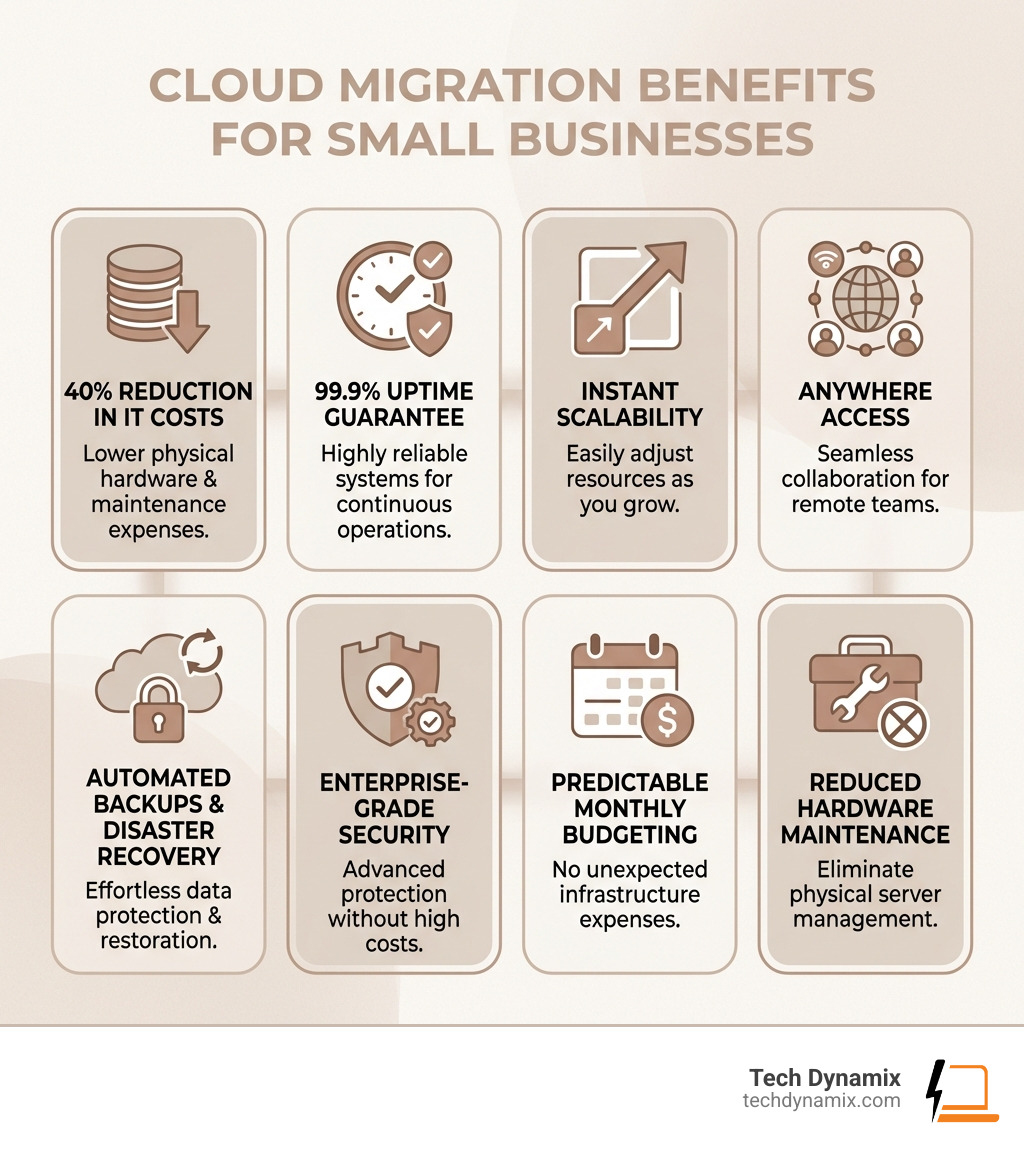
The primary benefits of cloud computing for Akron businesses are multifaceted, touching every aspect of operations:
- Cost Savings and Predictable Budgeting: Moving to the cloud significantly reduces capital expenditures associated with buying and maintaining physical hardware. Instead, you shift to an operational expense model, often on a predictable monthly fee. This allows for more consistent budgeting for IT costs, freeing up capital that can be reinvested into your core business. Outsourcing IT needs to a trusted provider means you can budget for IT costs consistently, allowing you to redirect your attention and resources to your business’s needs. This helps companies achieve cost predictability and focus on their core operations.
- Improved Scalability and Flexibility: As mentioned, the cloud’s ability to instantly scale resources is a game-changer. Whether you experience seasonal peaks, rapid growth, or need to quickly deploy new applications, cloud services ensure your IT infrastructure can keep pace without bottlenecks. This means you can quickly increase your space or access to applications, whether you add more people to your team or need more processing power, simply by informing your cloud provider.
- Improved Mobility and Accessibility: With cloud services, your data and applications are accessible from anywhere, on any device, with an internet connection. This is crucial for today’s dynamic work environments, enabling employees to work remotely, from client sites, or while traveling, fostering a truly mobile workforce.
- Resource Optimization: Cloud providers manage the underlying infrastructure, meaning your internal IT team (if you have one) can focus on strategic initiatives rather than routine maintenance. This optimizes your human resources and ensures your IT efforts are aligned with business growth.
- Reduced IT Overhead: By offloading server management, software updates, and infrastructure maintenance to cloud providers, you drastically reduce your internal IT overhead. This is particularly beneficial for small and mid-sized businesses that might not have the resources for a large in-house IT department. Many businesses find that engaging with a provider for managed services helps them optimize their IT strategy.
Enabling Remote and Hybrid Work
The shift towards remote and hybrid work models has accelerated the adoption of Cloud services Akron organizations. Cloud computing is the backbone of these modern work environments, enabling seamless collaboration and sustained productivity.
- Anywhere Access: Cloud solutions allow employees to securely access company files, applications, and communication tools from any location, fostering flexibility and continuity. This means teams can work together effectively whether they are in the office, at home, or on the road.
- Improved Team Collaboration: Cloud-based productivity suites (like Microsoft 365) and collaboration platforms facilitate real-time document editing, shared workspaces, and virtual meetings. Teams can work together on shared documents, join presentations, and fulfill tasks asynchronously, ensuring everyone stays connected and productive. For example, we offer comprehensive cloud support in Akron to help businesses leverage these tools effectively.
- Secure File Sharing: Cloud services provide robust tools for secure file sharing, ensuring that sensitive information is exchanged safely within and outside the organization, with granular control over access permissions. This eliminates the need for insecure methods and improves data governance.
Navigating Cloud Models and Infrastructure
Understanding the different types of cloud services and deployment models is key to choosing the right strategy for your Akron business. The cloud isn’t a one-size-fits-all solution; it’s a spectrum of options designed to meet various needs, from simple application hosting to complex infrastructure management.
Types of Cloud Services Akron Businesses Use
Cloud services are generally categorized into three main types:
- Infrastructure as a Service (IaaS): This model provides virtualized computing resources over the internet. You get access to virtual machines, storage, networks, and operating systems, but you manage your applications and data. It’s like renting the foundation of a building and furnishing it yourself. Local businesses often use IaaS to replace physical servers with scalable, high-performance virtual machines, allowing them to rent server space to run their own applications without the heavy investment in hardware.
- Platform as a Service (PaaS): PaaS offers a complete development and deployment environment in the cloud, with everything needed to build, run, and manage applications without the complexity of building and maintaining the infrastructure typically associated with developing and launching an app. This frees developers to focus on coding.
- Software as a Service (SaaS): SaaS delivers ready-to-use applications over the internet, typically on a subscription basis. Users simply access the software via a web browser or mobile app, and the cloud provider manages all the underlying infrastructure, platforms, and software. Think of popular services like Microsoft 365, accounting software, or CRM systems. Businesses can rent these applications for specific users, implementing them only for necessary personnel without the burden of license management or local installation.
Beyond these types, businesses also choose between different deployment models:
- Public Cloud: Resources owned and operated by a third-party cloud service provider and delivered over the internet.
- Private Cloud: Cloud computing resources used exclusively by one business. It can be physically located on the company’s on-site datacenter or hosted by a third-party service provider.
- Hybrid Cloud: A combination of public and private clouds, allowing data and applications to be shared between them. This offers greater flexibility and more deployment options.
For Akron businesses, popular specific Cloud services Akron providers offer include Microsoft 365 and Exchange Online (for email, collaboration, and productivity), virtual servers, and comprehensive cloud hosting solutions. Many also focus on IoT (Internet of Things) readiness, where cloud computing manages mobile device connectivity and cross-platform matters. The cloud facilitates quick application deployment without needing extensive in-house infrastructure, ensuring your business stays connected with robust network connectivity.
The Role of Local Data Centers
While much of the cloud appears “up in the sky,” it’s grounded in physical data centers. For Akron businesses, understanding the role of local data centers is important. These facilities house the servers, storage, and networking equipment that power cloud services.
- Tier III Infrastructure: The Involta Akron data center, for instance, is a Tier III infrastructure facility. This classification signifies high levels of redundancy for power, cooling, and network connectivity, ensuring greater uptime and reliability for critical business operations.
- Colocation Services: Businesses can also use colocation services within these data centers, where they own their servers but house them in a professional facility, benefiting from the data center’s security, power, and bandwidth infrastructure.
- Bandwidth and Power Redundancy: Local data centers provide the robust bandwidth and redundant power systems necessary to ensure consistent, high-performance access to cloud resources, minimizing downtime and maximizing efficiency.
Security, Compliance, and Disaster Recovery
For any business considering Cloud services Akron, security is paramount. While the cloud offers immense benefits, it also introduces new considerations for protecting sensitive data and maintaining operational integrity.
Cloud providers invest heavily in security infrastructure, often exceeding what individual businesses can afford. Key security measures include:
- Multi-Factor Authentication (MFA): A crucial layer of security that requires users to provide two or more verification factors to gain access to an application or resource.
- Data Encryption: Data is encrypted both in transit (as it moves between your device and the cloud) and at rest (when stored on servers), making it unreadable to unauthorized parties.
- Intrusion Detection and Unified Threat Management (UTM): Advanced systems that monitor networks for malicious activity or policy violations and offer comprehensive protection against various cyber threats.
- Regular Security Audits and Updates: Cloud providers continuously update their systems and conduct audits to identify and mitigate vulnerabilities.
However, security is a shared responsibility. While the provider secures the cloud infrastructure, businesses are responsible for securing their data in the cloud (e.g., configuring access controls, managing user identities). Understanding these responsibilities is critical for a strong security posture. For a broader understanding of state compliance and cybersecurity, insights can be found on Crain’s Cleveland. We also provide comprehensive cybersecurity solutions to protect your business.
Disaster Recovery and Business Continuity
Cloud services are a cornerstone of modern disaster recovery (DR) and business continuity (BC) strategies. They significantly reduce the impact of unexpected events, from natural disasters to ransomware attacks.
- Offsite Storage and Redundant Backups: Cloud providers store data in geographically dispersed data centers, offering built-in redundancy. This means your data is replicated in multiple locations, ensuring availability even if one site is compromised. This is far more robust than traditional on-site backups.
- Rapid Recovery: In the event of a system failure or data loss, cloud-based DR solutions allow for rapid recovery of applications and data, minimizing downtime and ensuring operations can resume quickly.
- Ransomware Protection: Cloud backups are often immutable or versioned, meaning they cannot be altered or encrypted by ransomware, providing a clean recovery point. The importance of protecting against such threats has been highlighted by experts discussing incidents, including those on Fox8 and The Advocate with Nick Phillips. A robust business continuity plan is essential to prevent operational failure. We specialize in backup and business continuity services to keep your business resilient.
Ensuring Industry Compliance
For Akron businesses in regulated industries (e.g., healthcare, finance, manufacturing), ensuring compliance is non-negotiable. Cloud services Akron providers understand these requirements and offer solutions designed to help meet them.
- Data Privacy: Cloud providers offer tools and configurations to help businesses adhere to data privacy regulations by controlling where data is stored and who can access it.
- Access Management: Implementing smart permission controls and identity management tools within the cloud environment ensures that only authorized personnel can access sensitive data, simplifying login processes and maintaining user access sync across platforms.
- Certifications and Audits: Reputable cloud providers maintain various industry certifications (e.g., HIPAA, SOC 2, ISO 27001), demonstrating their commitment to security and compliance standards. Businesses can leverage these certifications to support their own compliance efforts.
Choosing the Right Cloud Services Akron Partner
Choosing the right partner for your Cloud services Akron journey is one of the most critical decisions your business will make. You need a partner who offers not just technology, but also local expertise, a deep understanding of your business, and a commitment to your success.
When evaluating providers, consider the following:
- Local Support and Fast Response: A local partner, like us at Tech Dynamix, understands the unique economic landscape and challenges faced by businesses in Akron and Northeast Ohio. We offer fast response times and on-site assistance when needed, ensuring you’re never left waiting.
- Industry Experience and Certifications: Look for a provider with a proven track record and relevant industry certifications. With over 20 years of experience, we bring a wealth of knowledge to ensure your cloud solutions are expertly managed.
- Partnership Approach: We believe technology should work for you, not the other way around. A good cloud partner acts as an extension of your team, aligning IT goals with organizational goals and providing strategic IT consulting & advisory services. We work to understand your core processes and mission to maximize your company’s potential.
- Comprehensive Service Portfolio: Ensure the provider offers a full suite of services, from cloud migration planning and execution to ongoing management, security, and support. This holistic approach simplifies your IT management.
Overcoming Migration Challenges
Migrating to the cloud can seem daunting, but with the right partner, common challenges can be effectively overcome.
- Downtime Mitigation: A well-planned migration strategy minimizes disruption to your business operations. This involves careful scheduling, phased rollouts, and thorough testing to ensure seamless transitions.
- Data Transfer and Legacy Systems: Moving large volumes of data and integrating legacy systems into a cloud environment requires expertise. Your partner should have experience with various data transfer methods and strategies for connecting older systems with new cloud infrastructure.
- Staff Training: Cloud adoption often requires new skills. Your partner should provide adequate training and support for your team to ensure they can effectively use and manage new cloud-based tools and applications.
- Migration Timeline: The duration of a cloud migration can vary significantly. Depending on the size and complexity of your environment, migrations can range from a few days to several weeks. A clear, realistic timeline and transparent communication from your provider are essential.
Frequently Asked Questions about Cloud Computing
How long does a typical cloud migration take for an Akron business?
The timeline for a cloud migration in Akron can vary significantly based on the size and complexity of your IT environment. For smaller businesses with fewer applications and data, a migration might take anywhere from a few days to a couple of weeks. Larger organizations with extensive data, numerous applications, and complex integrations could see the process extend over several weeks or even a few months. A thorough assessment and detailed planning with your cloud provider are essential to establish a realistic timeline and minimize disruption.
Is the cloud more secure than on-premises servers?
In many cases, yes. Modern cloud platforms from leading providers invest billions in security infrastructure, personnel, and compliance certifications that most individual businesses cannot match. They offer advanced features like multi-factor authentication, robust encryption, intrusion detection, and continuous security monitoring. While the cloud provider secures the underlying infrastructure, businesses are responsible for securing their data and configurations within the cloud (e.g., access controls, user permissions). When properly configured and managed, Cloud services Akron can provide a significantly more secure environment than traditional on-premises servers, especially for businesses without dedicated cybersecurity teams.
How does cloud computing contribute to cost savings?
Cloud computing contributes to cost savings in several key ways for Akron companies:
- Reduced Capital Expenditures: Eliminates the need to purchase expensive hardware, servers, and networking equipment.
- Lower Operational Costs: Reduces expenses related to power consumption, cooling, and physical space required for on-site servers.
- Predictable IT Budgeting: Shifts IT costs from unpredictable capital expenditures to predictable monthly operational expenses. You only pay for the resources you consume.
- Reduced Maintenance and Staffing: Offloads the burden of hardware maintenance, software updates, and patching to the cloud provider, potentially reducing the need for extensive in-house IT staff.
- Optimized Resource Utilization: Allows businesses to scale resources up or down as needed, preventing over-provisioning and ensuring you only pay for what you use, avoiding wasted capacity.
Conclusion
The journey to the cloud is more than just a technological upgrade; it’s a strategic move that positions Akron businesses for sustained growth, innovation, and resilience. By embracing Cloud services Akron, companies gain unparalleled scalability, flexibility, robust security, and the ability to empower a modern workforce. This change impacts everything from daily operations and collaboration to disaster recovery and long-term strategic planning.
As the digital landscape continues to evolve, future trends in cloud computing for the Akron market will likely include even greater integration of AI and machine learning services, improved edge computing for faster data processing closer to the source, and increasingly sophisticated cybersecurity measures. Businesses that accept these trends will be better equipped to innovate and compete.
At Tech Dynamix, we are proud to be your local experts in Northeast Ohio, with over 20 years of experience guiding businesses through their cloud journey. We understand that your organization’s success depends on a reliable and innovative IT infrastructure. We’re here to build a lasting partnership, providing the custom business IT services that protect your systems, assist with operations, and reduce risk exposure.
Ready to open up the full potential of Cloud services Akron for your business? Start your cloud journey today with Tech Dynamix.