What Enterprise Cloud Services Really Mean for Your Business
Enterprise cloud services are on-demand computing resources — including software, storage, processing power, and networking — hosted by third-party providers and delivered over the internet, specifically designed to meet the scale, security, and compliance needs of large organizations.
Here’s a quick breakdown of what that includes:
| Type | What It Does | Common Use Case |
|---|---|---|
| SaaS | Ready-to-use software via browser | CRM, email, marketing tools |
| PaaS | Platform for building and managing apps | Custom app development |
| IaaS | Raw compute, storage, and networking | Data centers, virtual servers |
| Public Cloud | Shared infrastructure, high scalability | Marketing workloads, analytics |
| Private Cloud | Dedicated infrastructure, maximum control | Regulated data, sensitive systems |
| Hybrid Cloud | Mix of public and private | Most enterprise environments |
The core idea is simple: instead of buying and maintaining your own servers and software, you lease those capabilities from specialists. Your IT team focuses on strategy. The heavy lifting happens offsite.
Today’s leading cloud platforms handle trillions of workload operations annually. The shift from on-premises infrastructure to cloud isn’t just a technology upgrade — it’s a fundamental change in how businesses operate, compete, and grow.
I’m Jay Baruffa, founder of Tech Dynamix, and with over 20 years of hands-on experience designing enterprise IT infrastructure and navigating complex cloud environments, I’ve helped businesses across Northeast Ohio harness enterprise cloud services to reduce risk, cut costs, and scale with confidence. In this guide, I’ll walk you through everything you need to make smart, informed cloud decisions for your organization.
Discover more about Enterprise cloud services:
Defining Enterprise Cloud Services and Their Core Models
When we talk about Enterprise cloud services, we aren’t just talking about a place to store your photos. We are talking about the industrial-strength engine that powers modern business. For companies in Northeast Ohio—from manufacturing plants in Mentor to professional services in downtown Cleveland—understanding the “stack” is the first step toward digital transformation.
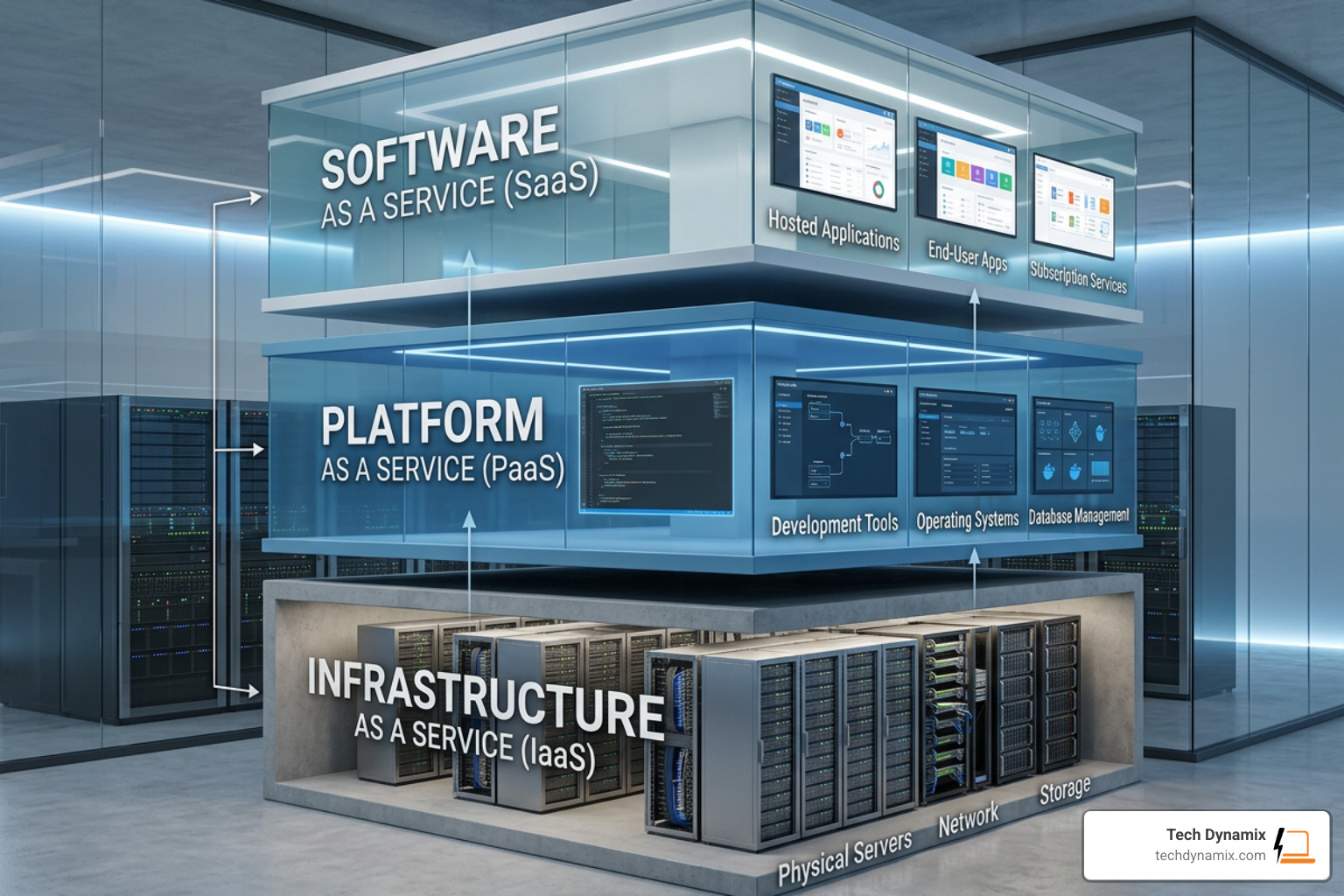
The cloud is generally divided into three primary service models:
- Infrastructure as a Service (IaaS): This is the foundation. It provides on-demand access to fundamental computing resources like servers, storage, and networking. With IaaS, the vendor handles the physical hardware and security of the data center, while you manage the operating systems and applications. It is the ultimate “pay-per-use” model for raw power.
- Platform as a Service (PaaS): Think of this as the middle layer. It provides a framework where your developers can build, test, and manage custom applications without worrying about the underlying infrastructure. It eliminates the need for on-site platform maintenance, allowing your team to focus entirely on coding and innovation.
- Software as a Service (SaaS): This is the most visible layer. These are ready-to-use applications delivered via a web browser or API. Whether it’s your CRM, email, or specialized marketing tools, SaaS offers automatic upgrades and subscription-based pricing, removing the burden of software ownership.
For those looking for more exclusive control, you might consider unlocking the power of managed private cloud, which offers dedicated resources tailored to your specific security and performance requirements.
How Enterprise Cloud Services Differ from Consumer Solutions
While you might use a consumer cloud to sync your phone, Enterprise cloud services operate on a different playing field. The stakes are higher, and the requirements are more rigid:
- Data Governance: Enterprises require strict control over where data resides and who accesses it to ensure compliance with industry regulations.
- Service-Level Agreements (SLAs): Businesses can’t afford “best effort” uptime. Enterprise providers offer guaranteed availability—often up to 99.999%—with financial penalties if they fail to meet those marks.
- Multi-User Administration: Enterprise solutions feature robust identity and access management (IAM), allowing IT to manage thousands of users with varying permission levels.
- Enterprise-Grade Security: This includes advanced encryption, threat detection, and the ability to integrate with existing corporate security frameworks.
The Strategic Shift to Leased Specialist Resources
In the old days, if a company in Willoughby or Wickliffe wanted to launch a new application, they had to buy servers, find space in a cooled room, and hire people to keep the lights on. This led to massive legacy costs and “zombie” hardware that sat idle 90% of the time.
By shifting to Enterprise cloud services, you are moving from a “buy and maintain” model to a “leased specialist” model. This optimizes resources because you only pay for what you use. More importantly, it allows your local team to stop acting as “hardware mechanics” and start acting as strategic partners who focus on your core business goals.
Public, Private, and Hybrid: Choosing the Right Architecture
Selecting the right deployment model is like choosing the right office space. Do you want a coworking space (Public), a standalone building (Private), or a main office with flexible satellite locations (Hybrid)?
Each model serves a specific purpose:
- Public Cloud: Resources are shared across multiple organizations. It offers the highest scalability and is perfect for non-sensitive workloads or applications with fluctuating traffic.
- Private Cloud: The infrastructure is dedicated solely to your organization. It provides the highest level of control and security, making it the go-to for highly regulated industries like healthcare in Mayfield Heights or financial services in Richmond Heights.
- Hybrid Cloud: This is the “best of both worlds.” It allows data and applications to move between public and private clouds. You might keep sensitive customer data in a private cloud while using the public cloud to run high-volume analytics.
To understand the physical backbone of these models, check out our comprehensive guide to demystifying cloud data centers.
When to Deploy Private vs. Public Infrastructure
The decision usually comes down to four factors:
- Sensitive Data: If you are handling proprietary manufacturing designs or HIPAA-protected health records, a private or managed cloud is often the safer bet for regulatory compliance.
- Workload Volatility: If your traffic spikes during certain seasons (like retail during the holidays), the public cloud’s ability to “burst” and scale instantly is a major cost-saver.
- Cost-Efficiency: Public cloud usually has lower upfront costs, but for steady, predictable workloads, a private cloud can sometimes offer a lower total cost of ownership (TCO) over time.
- Dedicated Hardware: Some legacy applications require specific hardware configurations that only a private environment can provide.
Strategic Benefits of Enterprise Cloud Services for Modern Marketing
Cloud services aren’t just for the IT department; they are the secret weapon for CMOs. Modern marketing requires personalization at scale—the ability to deliver 1:1 experiences to millions of customers in real-time.
Leading platforms, such as Adobe Experience Cloud, allow marketing teams to orchestrate customer journeys from a single interface. By eliminating data silos, these services provide real-time insights that can boost marketing ROI significantly. For example, natively integrated cloud applications can help organizations avoid millions in legacy point solution costs while allowing them to launch campaigns in hours rather than weeks.
Driving Innovation with AI and High-Performance Infrastructure
The cloud is the primary delivery vehicle for the most exciting technology of our era: Artificial Intelligence. Whether it’s Generative AI (GenAI) or predictive analytics, the massive computing power required to train and run these models is only feasible through Enterprise cloud services.
Major providers are now integrating AI directly into their core offerings:
- Google Cloud offers Vertex AI and Gemini, enabling businesses to build AI agents that can handle everything from customer service to complex data analysis. In fact, 9 out of the top 10 retail companies trust Google Cloud for their operations.
- Microsoft Azure provides AI-ready databases that allow companies to build “agentic” AI apps. One enterprise used these tools to eliminate 98% of clerical errors, saving 40 man-hours every month.
- IBM Cloud has focused on “AI-ready” infrastructure, helping organizations process millions of data points in seconds to provide instant insights.
If you are a developer or a tech-heavy firm in the Greater Cleveland Area, you can access Google Developer Program resources to start experimenting with these tools through free trials and no-cost training.
Enhancing Efficiency through Automated Workflows
Automation is where the cloud pays for itself. By using tools like Dynamics 365 or Amazon Q Business, enterprises can automate repetitive tasks. This isn’t just about replacing manual work; it’s about accuracy. When a system can process 2.7 million datapoints in seconds—as seen at major sporting events using IBM Cloud—the potential for real-time business adjustment is staggering.
Security and Trust in the AI Era
As we lean more on AI, security becomes paramount. Modern Enterprise cloud services utilize “Zero-Trust” architectures, where no user or system is trusted by default.
- Threat Intelligence: Providers like Google and AWS use global data to identify and block threats before they reach your network.
- Data Encryption: Your data is encrypted both “at rest” (on the server) and “in transit” (moving across the web).
- ISO Certifications: Top-tier providers and integrators maintain certifications like ISO 27001 (Information Security) and ISO 9001 (Quality Management) to prove their commitment to safety.
Navigating the Migration to Major Cloud Providers
Moving to the cloud isn’t a “flip of the switch” event. It’s a journey that requires a solid roadmap. Whether you are looking at AWS, Azure, or Google Cloud, each has its own strengths.
For a deep dive into the most popular platform, read our article on Ohio’s cloud frontier and Amazon Web Services. If you’re feeling overwhelmed by the process, we’ve also outlined how to achieve seamless skies by unlocking cloud migration expertise.
Comparing Enterprise Offerings for Global Scale
While all major providers offer a wide range of services, they often cater to different enterprise needs:
- AWS: The most comprehensive and widely adopted. It is the go-to for massive scale and has a deep ecosystem of tools for almost every use case imaginable.
- Microsoft Azure: The preferred choice for enterprises heavily invested in the Microsoft ecosystem (Office 365, Windows). It is also the top choice for running SAP workloads.
- Google Cloud: Known for its leadership in data analytics and AI. Tools like BigQuery offer a 26%–34% lower three-year TCO compared to some cloud data warehouse alternatives.
- IBM Cloud: A leader in hybrid cloud for regulated industries. They recently helped their own CIO platform achieve 90% cost savings by hosting containerized workloads on a hybrid model.
- Oracle Cloud (OCI): Often cited for its performance with heavy database workloads, claiming significantly lower costs for compute and networking egress compared to competitors. You can accelerate your cloud journey with IBM Cloud VPC or similar virtual private environments to maintain control.
Implementation Strategies for Enterprise Cloud Services
Success in the cloud depends on preparation. We recommend following these steps:
- Use a Migration Evaluator: Don’t guess your costs. Use tools to analyze your current on-premises footprint and project your cloud spend accurately.
- Follow the Well-Architected Framework: Each major provider has a set of best practices for security, reliability, and cost-optimization. Stick to them.
- Establish Hybrid Connectivity: Use dedicated connections (like AWS Direct Connect or Azure ExpressRoute) to ensure fast, secure communication between your local office in Concord Township and the cloud.
- Start with Pilot Programs: Don’t move your entire ERP system on day one. Start with a low-risk workload to test your configurations and train your team.
Frequently Asked Questions about Enterprise Cloud
What are the primary cost benefits of switching to enterprise cloud?
The biggest shift is from Capital Expenditure (CapEx) to Operational Expenditure (OpEx). Instead of a massive upfront check for hardware that depreciates, you pay a monthly fee for what you use. You also save on electricity, cooling, physical security, and the “hidden” costs of downtime and maintenance.
How do hybrid models solve data silo issues?
Data silos happen when different departments use different systems that don’t talk to each other. A hybrid cloud acts as a unifying layer. By using a Platform as a Service (PaaS) or a unified data lake, you can pull information from on-premises databases and various SaaS tools into one place for a “single source of truth.”
What role do integrators play in cloud deployment?
Cloud providers give you the tools, but integrators like us at Tech Dynamix help you build the house. We ensure that your cloud strategy aligns with your business goals, handle the complex migration of data, and provide ongoing management to ensure your environment stays secure and cost-effective.
Conclusion
At Tech Dynamix, we believe that Enterprise cloud services should be an equalizer, giving small and mid-size businesses in Northeast Ohio the same technological “muscles” as Fortune 500 companies. Whether you are in Lake County, Geauga County, or the Greater Cleveland Area, the cloud offers a path to unmatched agility and innovation.
We specialize in taking the complexity out of the cloud. From initial assessments and cybersecurity protection to full-scale cloud migration and ongoing managed IT, we ensure your infrastructure is robust, secure, and—most importantly—aligned with your business processes.
Don’t let legacy systems hold your business back. Explore our Managed IT Services today and let’s build a future-ready infrastructure together. Reach out to us in Mentor, Chardon, or anywhere across the Northcoast—we’re here to help you reach Cloud Nine.