Why Cloud Migration Ohio is Critical for Business Growth in 2026
Cloud migration Ohio is becoming a strategic priority for businesses across the state looking to reduce IT costs, improve scalability, and support remote work. Whether you’re in Columbus, Cleveland, or anywhere in Northeast Ohio, moving to the cloud can cut infrastructure expenses by up to 25% while increasing operational efficiency by 30%.
Quick Answer: What You Need to Know About Cloud Migration in Ohio
- Top Benefits: Reduced hardware costs, improved security, better disaster recovery, and easier scaling
- Common Challenges: Legacy system compatibility, data transfer complexity, and minimizing downtime
- Success Rate: Leading Ohio providers report 98% migration success rates
- Timeline: Most migrations take 2-12 weeks depending on complexity
- Cost Impact: Businesses typically see 25% IT cost reduction and potential 50% revenue growth with proper data management
Many Ohio businesses hesitate to move to the cloud because they worry about downtime, data security, and choosing the wrong partner. The reality is that successful cloud migrations depend on three things: thorough planning, experienced local support, and the right migration strategy for your specific situation.
The stakes are high. Research shows that 56% of technology projects fail to deliver expected value due to poor data management. But when done right, cloud migration transforms how Ohio companies operate—from healthcare providers meeting HIPAA requirements to manufacturers scaling operations without expensive hardware investments.
Local expertise matters more than you might think. Ohio-based providers understand regional compliance requirements like Ohio HB 96, work in your timezone, and can be on-site when needed. They know the specific challenges facing Northeast Ohio businesses, from aging infrastructure in older facilities to the need for robust disaster recovery in our unpredictable weather.
I’m Jay Baruffa, and over the past 20 years I’ve helped dozens of Northeast Ohio businesses steer cloud migration Ohio projects—from initial assessment through post-migration optimization. At Tech Dynamix, we’ve seen how the right cloud strategy eliminates IT headaches while positioning companies for sustainable growth.
Why Ohio Businesses are Prioritizing cloud migration Ohio

The landscape of business in the Greater Cleveland Area and across Northeast Ohio has shifted dramatically. We are no longer tied to physical server rooms in the basement of a Mentor or Willoughby office building. Instead, companies are looking toward the horizon—specifically, the cloud.
One of the primary reasons we see businesses in Lake County and Cuyahoga County prioritizing cloud migration Ohio is the sheer need for scalability. In a traditional setup, if your business grows, you have to buy more “iron”—expensive physical servers that take weeks to ship and hours to configure. In the cloud, scaling is as simple as clicking a button.
Furthermore, the shift toward digital transformation has made remote work a permanent fixture for many. Whether your team is based in Eastlake or working remotely from Ashtabula, the cloud provides seamless access to files and applications without the lag of old-school VPNs.
The statistics back this up: companies implementing effective data management and cloud strategies can increase operational efficiency by up to 30%. We’ve even seen institutions like Ohio State Google Cloud Platform lead the way in showing how large-scale organizations can leverage these tools for research and administrative excellence. For the small to mid-sized businesses we serve in the Cleveland Metro East Corridor, this means gaining enterprise-level power on a small-business budget.
Key Challenges and Strategies for Success
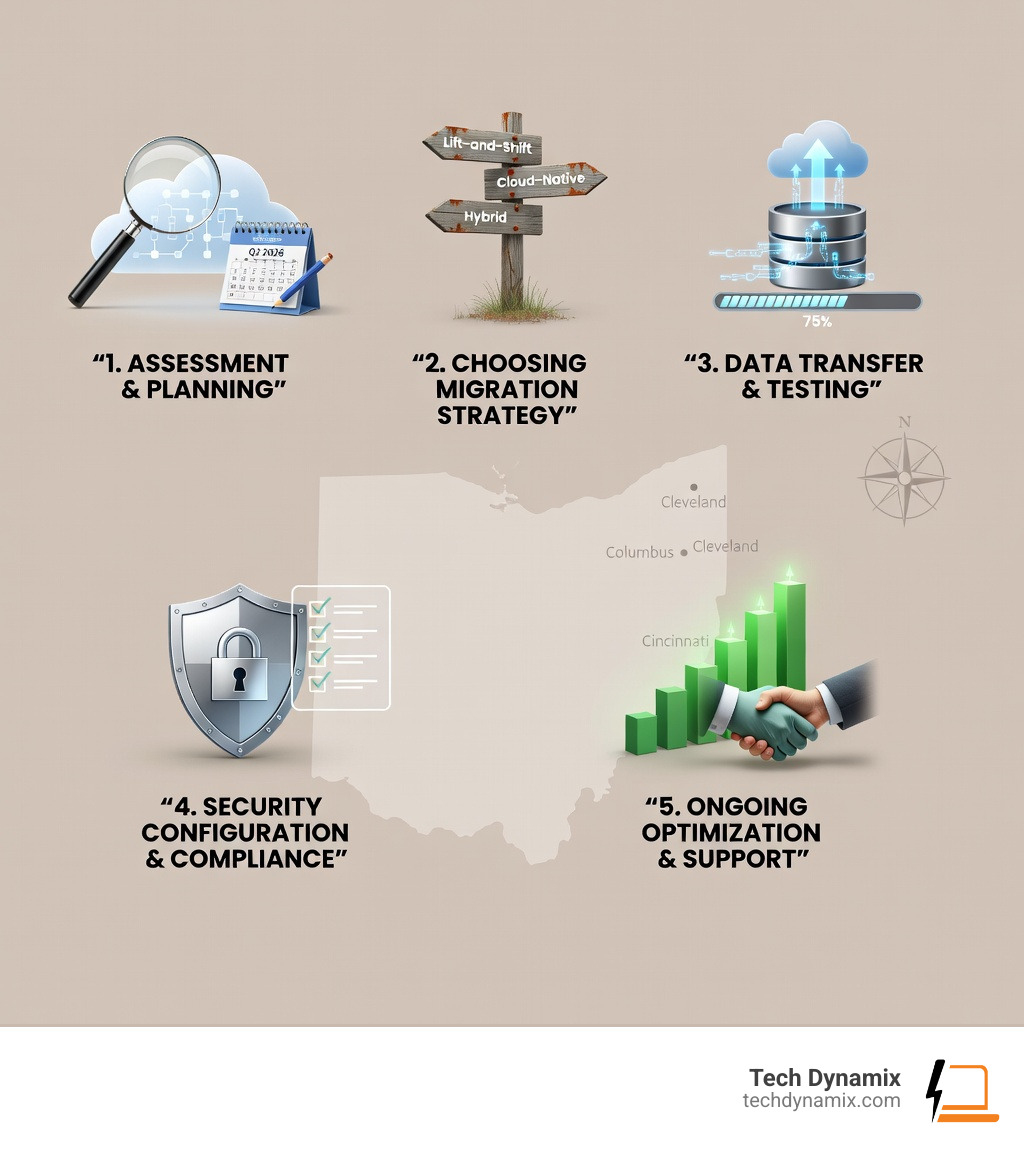
Moving to the cloud isn’t just about moving files from Point A to Point B. It requires a thoughtful approach to how your applications will live in their new home. We often help our clients choose between three primary strategies:
| Strategy | Definition | Best For |
|---|---|---|
| Lift-and-Shift | Moving applications exactly as they are to the cloud. | Quick migrations, legacy software that still works well. |
| Re-platforming | Making minor adjustments to take advantage of cloud features. | Improving performance without a full rewrite. |
| Re-architecting | Completely redesigning the app for a cloud-native environment. | Long-term scalability and maximum efficiency. |
Many Northeast Ohio businesses struggle with aging legacy architecture. These systems are like old houses in Chardon or Madison—charming, but the wiring might not support modern appliances. Legacy data infrastructure doesn’t improve with age; it often hinders compatibility.
To overcome this, we focus on workload mobility and automated cutover. By using real-time change capture, we can replicate your data to the cloud while you keep working, ensuring near-zero downtime. This means your production systems in Painesville or Wickliffe don’t have to go dark just because you’re upgrading your tech.
Data management is another hurdle. As the research indicates, 56% of M&A deals fail to deliver expected value due to poor data management. Whether you’re growing through acquisition or organic sales, having a clean data strategy is essential. This includes understanding NIST SP 800-171 requirements, especially for our clients in the manufacturing and government sectors who handle sensitive information.
Overcoming Security Problems in cloud migration Ohio
Security is often the #1 concern we hear during consultations in Mayfield Heights or Lyndhurst. Is my data safer in a data center than in my own office? Usually, the answer is a resounding yes—provided you have the right protocols.
Cloud platforms offer built-in security features that make meeting Compliance & Security Audits much easier. For our healthcare clients, this means maintaining HIPAA compliance through encrypted storage and strict access controls. For others, it’s about meeting SOC 2 standards to prove to their customers that their data is handled with care.
We also pay close attention to local regulations like Ohio HB 96 compliance. This is particularly vital for cities, counties, and school districts in the Lake County Region that need a practical path to cyber-compliance.
A successful cloud migration Ohio must also include a robust plan for disaster recovery. By using secure, off-site cloud backups, your business can recover from an outage or a cyber-attack in minutes rather than days. It’s about more than just moving data; it’s about protecting the future of your company.
Comparing the 5 Best Types of Cloud Migration Partners
When you start looking for a partner to help with your transition, you’ll find they generally fall into five categories. Choosing the right one depends on your size, industry, and how much “hand-holding” you need.
- Managed Service Providers (MSPs): This is where we sit. We offer Managed Services that cover everything from the initial assessment to 24/7 post-migration support. This is ideal for SMBs that don’t have a massive internal IT team.
- Cloud-Only Consultants: These firms specialize strictly in the migration itself. They are great for one-off projects but may leave you hanging once the data is moved.
- Data Management Specialists: These partners focus heavily on the data integrity and governance side of things. As we saw in the research, prioritizing data during transitions can lead to 50% more revenue growth.
- Hardware-Centric Providers: Some local providers still focus heavily on the physical infrastructure (hybrid clouds). They are useful if you have a massive investment in on-site servers that you aren’t ready to abandon.
- Niche Industry Experts: Some providers focus only on one area, like healthcare or education. For example, How an Ohio College streamlined migration shows how specialized knowledge in higher education can make a lift-and-shift approach highly effective for small IT teams.
When evaluating these partners, look for a proven track record. A 98% success rate and at least 15 years of experience (we have over 20!) are good benchmarks for ensuring your business isn’t a “test case” for a new firm.
The Role of Local Support in Successful cloud migration Ohio
There is a massive difference between calling a 1-800 number and calling a partner in Mentor or Concord Township. Local support means direct collaboration and, crucially, no outsourcing. When you work with a local team for IT Consulting & Advisory services, you get people who can actually drive to your office if a physical hardware issue arises during the transition.
Local providers offer:
- Downtime Minimization: We understand the “rhythm” of Ohio business and can plan migrations during your slowest hours.
- Personalized Guidance: We don’t give you a cookie-cutter plan. We assess your specific hardware, software, and business processes.
- Regional Expertise: We know the specific compliance and connectivity challenges of the Chagrin Valley or the Western Lake Erie Shore.
ROI and Cost Considerations for Ohio SMBs
Let’s talk about the bottom line. Is cloud migration Ohio worth the investment? The research says yes. Effective data management and cloud implementation can reduce IT costs by up to 25%. How? By eliminating the need for constant hardware maintenance, reducing energy bills, and moving to a pay-as-you-go model.
In the old days, you’d pay for the maximum capacity you might need one day. In the cloud, you only pay for what you use today. This is a huge win for Gaining Efficiency in small and mid-sized businesses.
The ROI goes beyond just saving money; it’s about making money. Companies that prioritize data integration—especially during mergers or acquisitions—achieve 30% more cost synergies. Furthermore, businesses that treat their data as a strategic asset during these transitions can see up to 50% more revenue growth than those that don’t. By making your data accessible and searchable in the cloud, you’re turning a storage problem into a business intelligence opportunity.
Frequently Asked Questions about Cloud Migration
How long does a typical cloud migration take?
While every project is unique, most cloud migration Ohio projects for small to mid-sized businesses take between 2 and 12 weeks. This includes the initial assessment, planning, the actual data transfer, and a period of post-launch support to ensure everything is running smoothly.
Will my data be safe during the transition?
Yes, provided you use professional migration tools and encryption. We use WAN-efficient encryption during the transfer process to ensure that your data is protected from the moment it leaves your server in Perry Township until it arrives in its secure cloud environment.
What are the most common migration strategies?
The “Big Three” are Lift-and-Shift (moving as-is), Re-platforming (making small tweaks for the cloud), and Re-architecting (rebuilding for the cloud). Most Ohio SMBs start with a Lift-and-Shift to get off end-of-life hardware quickly, then optimize their environment over time.
Conclusion
Navigating the complexities of cloud migration Ohio doesn’t have to be a headache. Whether you are a manufacturer in Mentor, a medical practice in Mayfield Heights, or a non-profit in Ashtabula, the cloud offers a path to greater security, lower costs, and better efficiency.
At Tech Dynamix, we bring over 20 years of experience to the table. We aren’t just a voice on the phone; we are your neighbors in Northeast Ohio, dedicated to helping you grow through smart, proactive IT. We handle the heavy lifting—from planning and compliance audits to 24/7 helpdesk support—so you can focus on what you do best: running your business.
Ready to leave the limitations of physical hardware behind? Start your digital transformation today and see how the right cloud strategy can power your business for the next 20 years.