Why Business Network Security Can’t Wait Another Day

Business network security protects your company’s computers, data, and operations from cyberattacks, unauthorized access, and digital threats. For small and medium-sized businesses in Northeast Ohio and beyond, it’s no longer optional—it’s essential for survival.
Key Components of Business Network Security:
- Firewalls – Block unauthorized traffic and secure network entry points
- Multi-Factor Authentication (MFA) – Prevent 99% of account breaches
- VPN (Virtual Private Network) – Encrypt remote connections and protect data in transit
- Antivirus/Antimalware – Detect and stop malicious software in real-time
- Network Segmentation – Limit access and contain potential breaches
- Regular Backups – Ensure business continuity after an attack
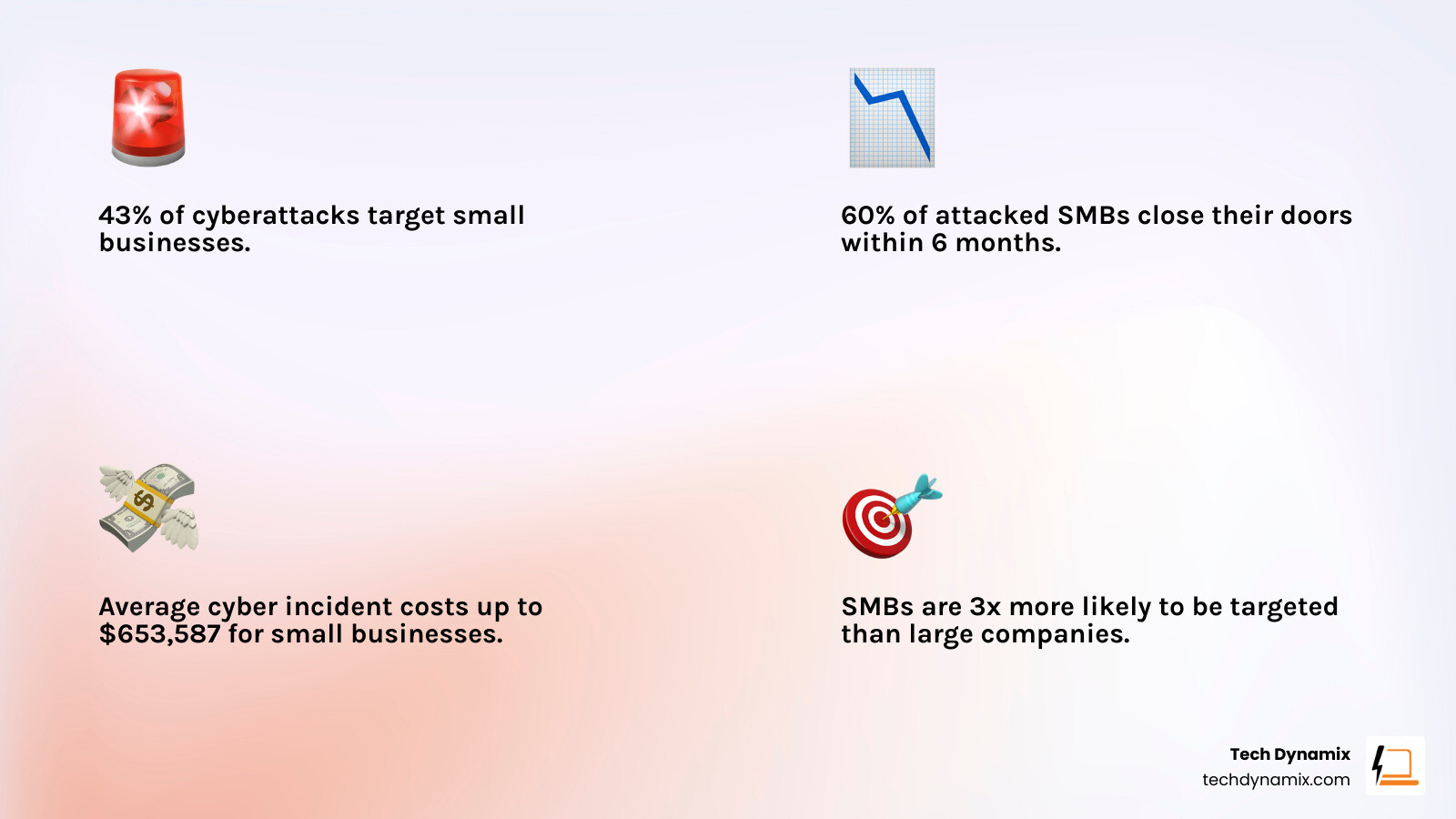
Here’s the reality: 43% of cyberattacks target small businesses, and 60% of those hit close their doors within six months. That’s not a scare tactic—it’s what the data shows. In 2021 alone, 61% of small businesses fell victim to cyberattacks, with the average incident costing up to $653,587.
You might think your business is too small to be a target. The opposite is true. Small businesses are three times more likely to be targeted than larger companies because hackers know you often have fewer defenses in place. Only 14% of small businesses have adequate security measures ready to defend against attacks.
The threats are real and growing. Ransomware now accounts for 25% of all breaches—a 13% jump from the previous year—and 82% of those attacks hit companies with fewer than 1,000 employees. Business email compromise alone cost American businesses over $2.7 billion in 2024, according to the FBI.
But there’s good news: most of these attacks are preventable with the right strategy and tools in place.
I’m Jay Baruffa, and I’ve spent over 20 years designing IT infrastructure and cybersecurity solutions for businesses across Northeast Ohio. At Tech Dynamix, we’ve helped countless small and mid-sized companies build robust business network security systems that stop threats before they become disasters.
Why Small Businesses are the Primary Target for Cybercriminals
It’s a common misconception that cybercriminals only go after the big fish—Fortune 500 companies with vast amounts of data and deep pockets. But the truth is far more insidious: small and medium-sized businesses (SMBs) are increasingly in the crosshairs. Why? Because hackers view them as easier targets, often with fewer resources dedicated to robust Security measures.
Consider these alarming statistics:
- A staggering 43% of all cybersecurity attacks are directed at small businesses.
- 46% of all data breaches happen to businesses with fewer than 1,000 employees.
- In 2021, 61% of small businesses were victims of cyberattacks.
- Small businesses are three times more likely to be targeted by cybercriminals than larger companies.
These numbers paint a clear picture: if you’re running a business in Painesville, Mentor, Cleveland, Hudson, or anywhere in Northeast Ohio, you’re a potential target. Cybercriminals aren’t just looking for financial gain; they’re after sensitive customer data, intellectual property, and even the ability to disrupt your operations for ransom. The consequences can be devastating, leading to significant financial loss and irreparable reputational damage.
At Tech Dynamix, we understand that for SMBs, every dollar spent on IT needs to deliver tangible value. We often hear concerns about the cost of implementing comprehensive business network security. However, when we look at the potential costs of not having adequate security, the picture changes dramatically.
| Security Investment (Annual Estimate) | Average Breach Recovery Cost (Single Incident) |
|---|---|
| Antivirus: $60/user | Ransomware Payment: $300,000+ |
| VPN: $10/user/month | Cybercrime Incident: Up to $653,587 |
| MFA: Free with many services | Business Interruption: 20 days (average) |
| Employee Training: \~$50-$100/user | Reputational Damage: Priceless |
| Managed Security Services: Varies | Bankruptcy Filing: Up to 60% of SMBs |
It’s clear that investing in preventative business network security is far more cost-effective than dealing with the aftermath of an attack. The FBI’s recent warnings, like the FBI Issue New Ransomware Warning, underscore the urgency of this issue for businesses of all sizes.
The High Cost of Poor Security
The impact of a cyberattack extends far beyond the immediate financial hit. For small businesses, the consequences can be existential. Research shows that up to 60% of small businesses end up filing for bankruptcy within six months of suffering a data breach. This isn’t just about losing money; it’s about losing your livelihood, your employees’ jobs, and the trust you’ve built with your customers.
One of the most immediate consequences is business interruption. On average, a cyberattack can lead to 20 days of downtime. Imagine your operations grinding to a halt for nearly three weeks—payroll systems offline, customer orders delayed, communication channels severed. This kind of disruption can quickly cripple a business, especially in competitive markets like Northeast Ohio.
The financial toll is staggering. While the average ransom payment can exceed $300,000, the total costs of a breach are often many times that figure, including legal fees, forensic investigations, IT overtime, customer churn, and long-term erosion of your reputation.
And the threats are becoming more sophisticated. With 80% of malware now powered by AI, as highlighted in our article 80% of Malware Powered by AI, cybercriminals are deploying increasingly intelligent and evasive attacks. Business Email Compromise (BEC) schemes, where attackers trick employees into transferring funds or revealing sensitive information, are particularly devastating. The FBI reported over $2.7 billion in losses from BEC alone in 2024. These aren’t abstract threats; they are real, evolving dangers that demand proactive and robust business network security.
6 Essential Components of business network security
Protecting your business network isn’t about setting up a single defense and calling it a day. It’s about building a layered, comprehensive strategy – a defense-in-depth approach – that anticipates and mitigates threats from multiple angles. Think of it like securing your home: you don’t just lock the front door; you also have window locks, an alarm system, and maybe even a dog. Each layer adds to your overall safety.
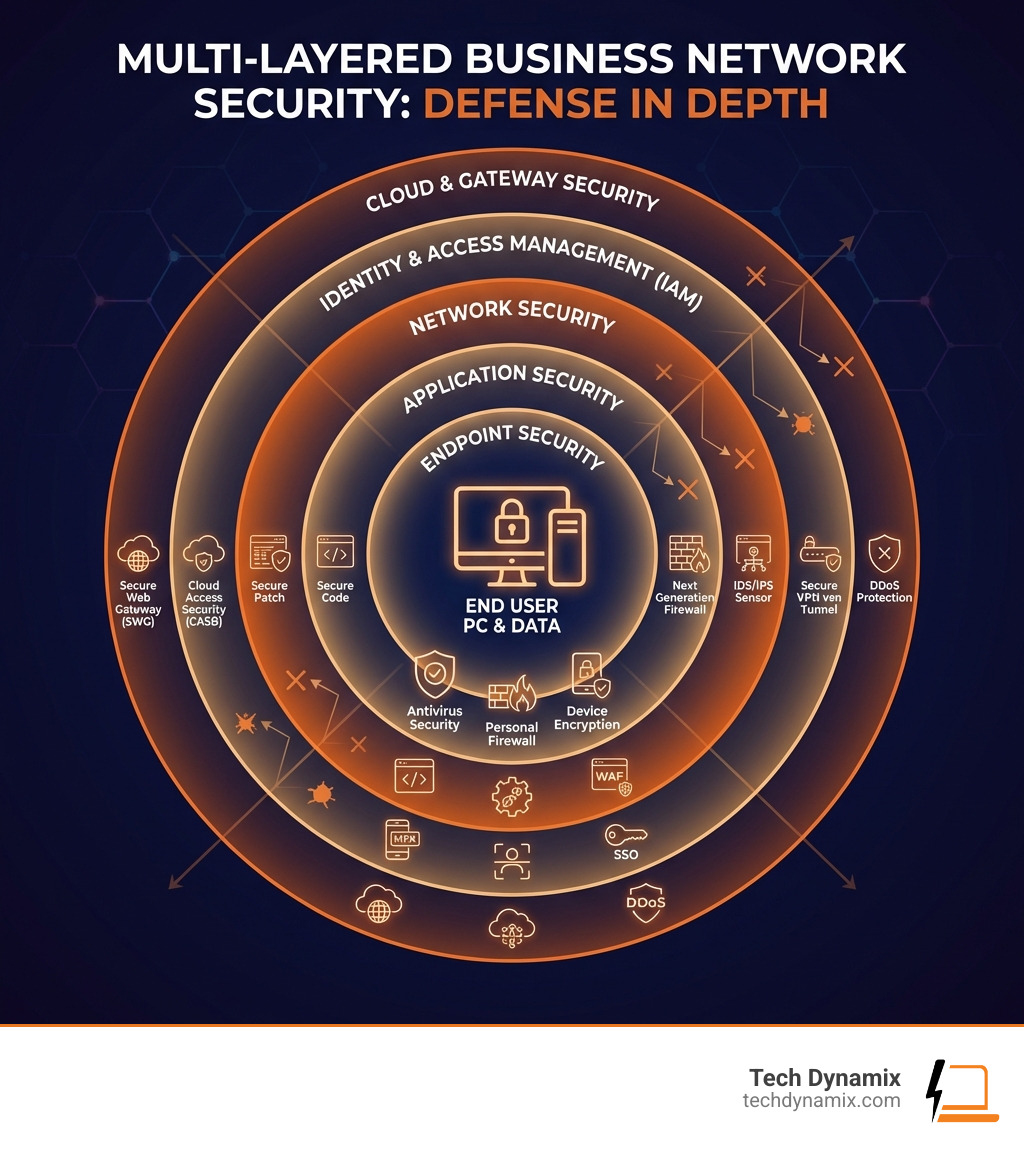
At Tech Dynamix, our Cybersecurity Solutions are built on this principle. We understand that effective business network security requires a combination of hardware, software, policies, and practices working in concert. This approach ensures that even if one layer is breached, others are there to catch the threat. The goal is to manage access, block malicious actors, and protect the usability and integrity of your network and data. This aligns perfectly with the guidance from organizations like CISA: Secure Your Business, which emphasizes a proactive and comprehensive security posture.
Here are six essential components that form the backbone of a robust business network security strategy:
1. The Role of Firewalls in business network security
A firewall is the first line of defense for your network, acting as a crucial barrier between your internal network and the untrusted external world (the internet). Imagine it as a digital bouncer, carefully checking IDs and guest lists before allowing anyone into your exclusive club.
Firewalls work by setting predefined rules to filter and monitor incoming and outgoing network traffic. They inspect data packets, checking their source, destination, and content against these rules. If a packet doesn’t meet the criteria, the firewall blocks it, preventing unauthorized access and malicious data from entering your network. This capability is critical for protecting your business’s data and operations by securing network ports that cybercriminals often exploit.
There are different types of firewalls, each offering unique capabilities:
- Traditional Firewalls: These primarily control traffic based on IP addresses and ports.
- Next-Generation Firewalls (NGFWs): These offer deeper packet inspection, intrusion prevention, and application-level control.
- Web Application Firewalls (WAFs): Specifically designed to protect web applications from attacks such as SQL injection and cross-site scripting, a web application firewall (WAF) is crucial for any business that operates an e-commerce site or hosts web-facing applications.
For small businesses in Northeast Ohio, implementing a firewall (or ensuring your existing one is properly configured) is non-negotiable. It’s an affordable yet incredibly effective security solution that safeguards your business against a wide array of threats.
2. Why MFA is Critical for business network security
If you want to dramatically reduce the risk of account breaches, Multi-Factor Authentication (MFA) is your superhero. According to Microsoft’s research, a staggering 99% of Office 365 account breaches would not have happened if MFA had been used properly. That’s an incredible statistic that highlights just how powerful this simple step can be for your business network security.
MFA works by requiring users to provide two or more verification factors to gain access to an account or system. Instead of just a password (something you know), MFA typically adds another layer, such as:
- Something you have: A code sent to your phone, a hardware token, or an authenticator app.
- Something you are: A fingerprint scan or facial recognition.
This means that even if a cybercriminal manages to steal an employee’s password – perhaps through a phishing attack – they still can’t access the account without that second factor. MFA is a robust defense against credential theft, unauthorized access, and many common cyberattack vectors. As we discussed in Microsoft Edge Introduce A New Scam Protection Tool, protecting user credentials is paramount, and MFA is a cornerstone of that protection. Implementing MFA across all your business accounts, from email to critical applications, is one of the most effective and affordable ways to bolster your security posture.
3. Virtual Private Networks (VPNs) for Remote Work
In today’s flexible work environment, remote access is common, even for businesses in Lake County, Summit County, and the greater Cleveland area. But accessing your company’s network from outside the office – whether from a coffee shop, a home office, or a client site – can introduce significant security risks. This is where a Virtual Private Network (VPN) becomes an indispensable tool for business network security.
A VPN creates a secure, encrypted “tunnel” over a public network, like the internet, to a private network. It effectively extends your company’s secure internal network to remote users, allowing them to access resources as if they were physically in the office, but with added layers of protection.
Here’s how VPNs improve security:
- Data Encryption: All data traveling through the VPN tunnel is encrypted, making it unreadable to anyone who might intercept it. This is crucial for protecting sensitive information from eavesdropping.
- Secure Remote Access: Employees can securely log into your network from any location, maintaining productivity without compromising security.
- IP Masking: A VPN masks your device’s actual IP address, making it harder for cybercriminals to track your online activities or pinpoint your location.
While VPNs offer immense benefits, ensure they are properly configured and managed. As some research suggests, traditional VPN deployments can carry inherent business risks due to potential misconfigurations. At Tech Dynamix, we specialize in ensuring secure Network Connectivity, including robust VPN solutions that are custom to your business needs, providing peace of mind for your remote workforce.
4. Advanced Antivirus and Malware Protection
Antivirus software has evolved significantly from its early days. Today’s advanced antivirus and anti-malware solutions are a critical component of business network security, providing real-time protection against a constantly evolving landscape of threats. These tools are designed to detect, prevent, and remove malicious software that can compromise your systems, steal data, or disrupt operations.
Modern antivirus solutions employ several techniques:
- Signature-Based Detection: This traditional method scans files for known patterns (signatures) of viruses and malware. It’s effective against established threats.
- System Monitoring (Heuristics): This software monitors the behavior of programs on your computer, looking for suspicious activities that might indicate a new or unknown threat. If a program tries to do something unusual, like encrypting all your files, it can be flagged as malicious.
- Machine Learning Antivirus: This cutting-edge approach uses artificial intelligence to analyze files and behaviors, allowing it to identify and block new and emerging threats even without a known signature. This is crucial as cybercriminals constantly develop new ways to bypass traditional defenses, as we highlighted in our post Beware Fake App Containing Malware.
For small businesses, robust antivirus and anti-malware protection is a foundational security measure. It’s also surprisingly affordable, with the average cost of antivirus software being around $30 per year. Combined with email scanning, download protection, and regular spyware scans, it forms a powerful shield for your endpoints and network.
5. Network Segmentation and Access Control
Imagine your business network as a building with many rooms. Would you give everyone a master key to every room, regardless of their role? Probably not. You’d restrict access, giving people keys only to the areas they need. This is the essence of network segmentation and access control in business network security.
Network segmentation involves dividing your network into smaller, isolated segments. If an attacker breaches one segment, they are contained, limiting their ability to move laterally across your entire network and access critical data. For example, you might create separate segments for:
- Guest Wi-Fi networks (crucial for businesses in public-facing roles).
- Point-of-sale (POS) systems.
- Sensitive financial data servers.
- Employee workstations.
Access control works hand-in-hand with segmentation by enforcing the “principle of least privilege.” This means users and systems are granted only the minimum level of access necessary to perform their job functions. No more, no less. This prevents situations where, for example, a marketing intern has access to your company’s confidential financial records. Our article Half Staff Have Too Much Access To Data digs into the risks of excessive data access.
Implementing these measures helps to:
- Limit infiltration paths for hackers.
- Contain potential breaches, reducing their impact.
- Protect sensitive data by keeping it isolated.
- Improve compliance by ensuring data access is strictly controlled.
Utilizing “allow lists” (explicitly permitting access to specific resources) is generally more secure than “deny lists” (blocking known bad actors), as it proactively restricts access to only what’s needed.
6. The 3-2-1 Data Backup Strategy
Even with the most robust business network security measures in place, the possibility of data loss due to a cyberattack, natural disaster, or human error always exists. That’s why a comprehensive data backup strategy is not just a good idea – it’s absolutely critical for your business’s survival and continuity. Think of it as your digital insurance policy.
At Tech Dynamix, we strongly advocate for the 3-2-1 backup strategy, a widely recognized best practice for ensuring data resilience:
- 3 Copies of Your Data: Keep one primary copy of your data and at least two additional copies.
- 2 Different Media Types: Store your backups on at least two different types of storage media (e.g., internal hard drive, external hard drive, network-attached storage, cloud storage). This reduces the risk of all backups being compromised by a single failure.
- 1 Off-Site Copy: Keep at least one copy of your backup data in an off-site location. This is vital for protecting against localized disasters like fires, floods, or even ransomware that could encrypt all local backups. Cloud storage is an excellent option for off-site backups.
This strategy is particularly effective against ransomware attacks, which encrypt your data and demand payment. With a solid 3-2-1 backup in place, you can restore your systems and data without paying the ransom, minimizing downtime and financial impact. It’s a cornerstone of disaster recovery and business continuity planning, often playing a role in meeting requirements for Compliance & Security Audits. Don’t wait until it’s too late; make data backup a priority for your Northeast Ohio business.
Best Practices for a Proactive Defense
Effective business network security isn’t a one-time setup; it’s an ongoing commitment to vigilance and adaptation. Cyber threats are constantly evolving, and your defenses must evolve with them. A proactive approach means anticipating potential attacks, continuously strengthening your safeguards, and being ready to respond swiftly.
This involves a combination of technological updates, policy enforcement, and, crucially, human awareness. Regularly updating your frontline defenses, like firewalls and antivirus software, is just the beginning. It also means staying informed about the latest threats, as suggested by resources like the Cybersecurity Tip Sheet from the FCC. Furthermore, it requires meticulous Network Design & Management to ensure your infrastructure is secure by design, not just as an afterthought.
Employee Training and Security Culture
Your employees are your greatest asset, but they can also be your biggest vulnerability if not properly educated. Cybercriminals often exploit the human element through tactics like phishing and social engineering because it’s often easier than breaking through technical defenses. Our article New Staff, New Security Risk underscores this point perfectly.
This is why employee training is paramount for business network security. It’s not enough to tell staff to “be careful”; they need practical, ongoing education on:
- Phishing Awareness: How to spot suspicious emails, links, and attachments.
- Social Engineering Tactics: Recognizing attempts by criminals to manipulate them into divulging sensitive information.
- Strong Password Hygiene: The importance of unique, complex passwords and using a password manager.
- Reporting Suspicious Activity: Encouraging a “neighborhood watch” approach where employees feel empowered to report anything that seems off.
Fostering a strong security culture means making everyone in the company, from the CEO to the newest hire, understand their role in protecting the business. Regular training, clear policies, and open communication can transform your workforce into a powerful line of defense against cyber threats.
Regular Audits and Penetration Testing
How do you know if your business network security measures are actually working? You test them! Regular network audits and penetration testing are crucial for identifying weaknesses before cybercriminals do. These are not luxuries for large enterprises; they are essential practices for any business serious about protecting its assets in Northeast Ohio.
Network Audits: A comprehensive network audit is like a health check-up for your IT infrastructure. It involves:
- Identifying existing security holes.
- Evaluating firewall capacity and configuration.
- Checking malware prevention programs.
- Reviewing backup schedules and history.
- Assessing all applications, software, and servers for vulnerabilities and unnecessary components.
Penetration Testing (Pen Testing): This takes auditing a step further. A penetration test simulates a real-world cyberattack, with authorized security experts attempting to breach your systems using the same tactics as malicious hackers. This allows us to:
- Uncover exploitable vulnerabilities.
- Test the effectiveness of your existing defenses.
- Identify potential entry points for cybercriminals.
- Evaluate your incident response capabilities.
You can use online tools to run basic penetration tests, or, for more thorough assessments, we often recommend hiring specialized companies. The insights gained from these activities are invaluable, helping you prioritize improvements and ensure your security posture is up-to-date and effective against evolving threats. Resources like the NIST Small Business Cybersecurity Corner also offer guidance on these practices. At Tech Dynamix, our IT Consulting & Advisory services include conducting these vital assessments to ensure your business is as secure as possible.
Frequently Asked Questions about Business Security
We understand that business network security can feel overwhelming, especially for small businesses. Here are answers to some common questions we encounter from our clients in Greater Cleveland and beyond.
What is the most common threat to small business networks?
While there’s a wide array of threats, phishing and social engineering attacks are consistently among the most common and effective ways cybercriminals target small businesses. These attacks prey on human psychology, manipulating employees into clicking malicious links, revealing credentials, or performing unauthorized actions. Ransomware, often delivered via phishing, is also a rapidly growing and devastating threat, disproportionately affecting SMBs. Unpatched software vulnerabilities and weak access controls (like easily guessed passwords or lack of MFA) also remain significant entry points for attackers.
How can a small business secure its network on a budget?
Securing your network doesn’t have to break the bank. Many effective business network security measures are affordable or even free:
- Implement MFA: Many services offer MFA at no additional cost. It’s incredibly effective, preventing 99% of certain account breaches.
- Strong Passwords & Password Managers: Enforce strong password policies. Password managers are often low-cost or free and significantly improve credential security.
- Basic Antivirus Software: The average cost of antivirus software is around $30 per year, making it a highly affordable and effective solution.
- Firewall: Ensure your operating system’s built-in firewall is enabled, or invest in a robust, yet affordable, hardware firewall.
- Employee Training: Free or low-cost online resources can provide essential training on phishing and security awareness.
- Regular Software Updates: Keep all operating systems, applications, and firmware updated. This is free and closes known vulnerabilities.
- Basic Data Backup: Implement the 3-2-1 strategy using a combination of external drives and affordable cloud storage.
- Free VPNs (with caution): While paid VPNs offer more features and reliability, some free options can provide basic encryption for very small operations, though we always recommend professional-grade solutions for business use.
How often should we update our network security protocols?
Business network security protocols are not a “set it and forget it” affair. They should be reviewed and updated regularly and continuously. Here’s a general guideline:
- Software and Firmware: As soon as updates and patches are released. Many systems can be set to update automatically.
- Antivirus/Anti-malware Definitions: Daily, or even hourly, as new threats emerge. Most modern solutions do this automatically.
- Employee Training: Annually at a minimum, but ideally with quarterly refreshers or whenever new significant threats (like a new phishing campaign) emerge.
- Password Policies: While changing passwords every 90 days used to be standard, current best practices emphasize unique, strong passwords and MFA, with changes only if a breach is suspected.
- Security Audits & Penetration Tests: Annually for most small businesses, or more frequently if there are significant changes to your network, new services are implemented, or new compliance requirements arise.
- Overall Security Strategy: Review your entire business network security strategy annually with your IT partner to adapt to evolving threats and business needs.
Conclusion
In today’s digital landscape, robust business network security isn’t just an IT concern; it’s a fundamental pillar of business resilience and success. For small and medium-sized businesses across Northeast Ohio, from Painesville to Cleveland, ignoring the growing tide of cyber threats is a risk no business can afford to take. The statistics are clear: cybercriminals are targeting SMBs, and the consequences of a breach—from financial ruin to reputational damage and prolonged downtime—can be catastrophic.
But as we’ve explored, the good news is that most cyberattacks are preventable. By implementing essential components like firewalls, Multi-Factor Authentication, VPNs, advanced antivirus, network segmentation, and a solid 3-2-1 backup strategy, you can build a formidable defense. Coupled with proactive best practices like continuous employee training and regular security audits, your business can confidently steer the digital world.
At Tech Dynamix, we understand the unique challenges faced by small and mid-sized businesses. With over 20 years of experience, we provide high-quality IT Consulting & Advisory and Managed Services custom to your needs. Our local expertise, comprehensive service portfolio, and commitment to proactive support, as evidenced by certifications like our Why CyberCert SMB1001 Bronze Certification Makes Us The Secure Choice For SMBs, make us your dependable all-in-one technology partner.
Don’t wait for a cyberattack to become a costly lesson. Take control of your business network security today. Let us help you build a secure, resilient foundation that protects your data, your operations, and your peace of mind.
Ready to secure your business network? Contact us today for a consultation and let’s discuss how we can tailor a solution that fits your needs.