Why Computer Security Incident Management Can Make or Break Your Business
Computer security incident management is the structured process of detecting, responding to, and recovering from security threats on your systems and networks — before they cause serious damage.
Here’s what it covers at a glance:
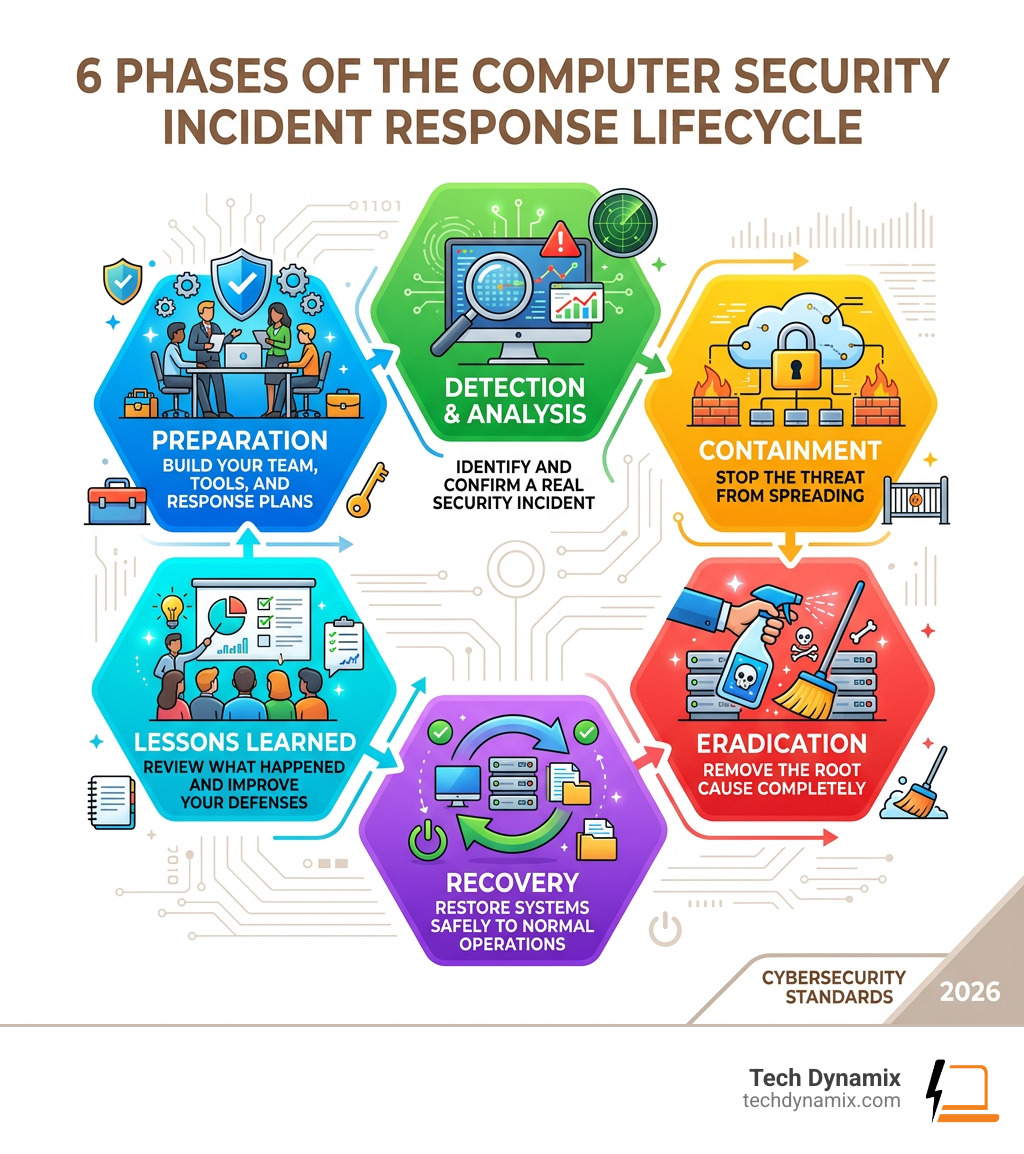
| Phase | What Happens |
|---|---|
| Preparation | Build your team, tools, and response plans |
| Detection & Analysis | Identify and confirm a real security incident |
| Containment | Stop the threat from spreading |
| Eradication | Remove the root cause completely |
| Recovery | Restore systems safely to normal operations |
| Lessons Learned | Review what happened and improve your defenses |
The stakes are real. The number of security incidents keeps climbing — and so does the cost of dealing with them. As NIST puts it in their Computer Security Incident Handling Guide, cyberattacks have become “not only more numerous and diverse but also more damaging and disruptive.”
The hard truth? You can have strong security tools in place and still get hit. Not every incident can be prevented. What separates organizations that recover quickly from those that suffer lasting damage is having a clear, practiced plan ready before anything goes wrong.
I’m Jay Baruffa, and with over 20 years in IT infrastructure, cybersecurity, and compliance, computer security incident management is something I’ve helped Northeast Ohio businesses navigate firsthand. In this guide, I’ll walk you through everything you need to build, run, and improve a response program that actually works.
Know your computer security incident management terms:
The Fundamentals of Computer Security Incident Management
At its core, computer security incident management is about resilience. It’s the art of taking a punch and staying on your feet. For businesses in Northeast Ohio—from manufacturing plants in Mentor to healthcare providers in Willoughby—this isn’t just an “IT thing.” It’s a business continuity thing.
When a security event occurs, the clock starts ticking. Every minute of downtime translates to lost revenue, frustrated customers, and potential data exposure. Effective management ensures that we aren’t just reacting wildly; we are following a script designed to mitigate risk and restore services as quickly as possible.
A major part of this foundation is having a rock-solid backup and business continuity strategy. If an attacker encrypts your files, your incident management process relies heavily on your ability to pull clean data from a safe location. Without this, “recovery” becomes a very expensive conversation about paying a ransom—which we never recommend.
The financial impact of a data breach is often much higher than the initial “clean-up” cost. You have to account for legal fees, regulatory fines, and the “reputation tax” that comes when customers lose trust. Following the NIST Computer Security Incident Handling Guide provides a roadmap to avoid these pitfalls by using standardized, proven methods.
Defining a Security Incident
Not every weird glitch on a computer is a security incident. We need to distinguish between a “security event” (any observable occurrence in a network or system) and a “security incident.”
A computer security incident is a violation or imminent threat of violation of computer security policies, acceptable use policies, or standard security practices. Common examples include:
- Malware Infection: A workstation in your Chardon office starts reaching out to known malicious command-and-control servers.
- Unauthorized Access: Someone logs into your payroll system from an IP address in a country where you have no employees.
- Data Disclosure: Sensitive client information is accidentally emailed to a public distribution list.
- Imminent Threat: Your IT team discovers a “precursor,” like a new vulnerability in your web server that attackers are actively scanning for.
Why Organizations Need a Formal Response Plan
If you wait until you’re staring at a blue screen or a ransom note to decide who’s in charge, you’ve already lost. Formal plans are essential for several reasons:
- Escalating Costs: Ad hoc responses are disorganized and slow. Speed saves money.
- Regulatory Compliance: Laws like HIPAA or Ohio’s data breach notification requirements demand that you handle incidents in a specific way.
- Public Confidence: How you handle a crisis tells the world how professional you are. A botched response can be more damaging than the hack itself.
- Operational Downtime: Protecting small businesses from hacking is about keeping the lights on. A formal plan minimizes the time your team spends sitting on their hands while the network is down.
The Incident Response Lifecycle: NIST and ISO Standards
To keep things predictable, we use international frameworks. The two heavy hitters are ISO/IEC 27035 and NIST SP 800-61. While they use slightly different labels, they both aim for the same goal: a repeatable, forensic-friendly process that removes the guesswork.
| Feature | NIST SP 800-61 | ISO/IEC 27035 |
|---|---|---|
| Primary Focus | Technical handling and lifecycle | Management process and planning |
| Phases | 4 main phases (Preparation, Detection/Analysis, Containment/Eradication/Recovery, Post-Incident) | 5 phases (Preparation, Detection/Reporting, Assessment/Decision, Response, Lessons Learned) |
| Best For | Hands-on IT teams and federal compliance | Organizations seeking ISO certification |
By using these frameworks, we ensure forensic preservation. This means we don’t just “fix the problem” and delete the evidence. We handle the system in a way that allows us to figure out how they got in, which is vital for preventing a repeat performance.
Preparation: Building Your Computer Security Incident Management Team
Preparation is the most important phase because it happens when things are calm. This is when you form your Computer Security Incident Response Team (CSIRT).
Organizations usually choose one of two structures:
- Centralized Model: A single team handles incidents for the entire organization. This is common for mid-sized businesses in Lake County or Geauga County.
- Distributed Model: Multiple teams handle different departments or geographic locations, coordinated by a central hub.
Roles must be clearly defined. You need a team lead, technical experts (who understand your specific servers and apps), and “non-technical” members like legal counsel and PR. new staff security risks are a factor here; ensure your IR team is vetted and trained on the latest playbooks.
A “playbook” is a step-by-step guide for a specific type of attack—like a “Ransomware Playbook” or a “Lost Laptop Playbook.” It tells everyone exactly what to do so no one has to play hero or guess.
Detection and Analysis: Identifying the Indicators

How do you know you’re under attack? You look for indicators.
- Precursors: These are signs that an incident might happen in the future (e.g., a spike in port scanning).
- Indicators: These are signs that an incident is happening or has happened (e.g., a system administrator’s account logging in at 3 AM).
We use tools like SIEM (Security Information and Event Management) and IDS (Intrusion Detection Systems) to correlate logs from across your network. For example, AI’s impact on network security automation has made it much easier to spot “weird” behavior that a human might miss. If five workstations in your Mayfield Heights office all start encrypted files at the same time, an AI-driven tool can flag that in milliseconds.
Strategies for Containment, Eradication, and Recovery
Once an incident is confirmed, we move into the “active” phases. Think of this like a fire department: first, they stop the fire from spreading (containment), then they put it out (eradication), and then they make sure the house is safe to live in again (recovery).
- System Isolation: Disconnect the affected server from the internet but keep it powered on (if possible) to preserve evidence in the RAM.
- Network Segmentation: Use your firewall to “wall off” the infected part of the network so the rest of your business can keep running.
- Evidence Gathering: Take “snapshots” of the affected systems. This is crucial for insurance claims and potential legal action.
Our comprehensive cybersecurity solutions focus on making these steps as seamless as possible. During eradication, we don’t just delete the virus; we identify all affected accounts and reset passwords, patch the vulnerability the attacker used, and sometimes reimage the entire machine to be 100% sure the “bad guys” are gone.
Prioritizing Incidents by Impact and Effort
You can’t treat a forgotten password the same way you treat a database breach. We use three categories for triage:
- Functional Impact: How much does this affect your ability to provide services? (e.g., Is your whole manufacturing line down in Mentor, or just one printer?)
- Information Impact: Was sensitive data changed, deleted, or stolen?
- Recoverability Effort: How much time and how many people will it take to fix?
By scoring incidents this way, we ensure that resources are allocated to the most critical threats first.
Post-Incident Activity and Lessons Learned
The “Lessons Learned” phase is the most skipped step in computer security incident management, and that’s a huge mistake. Within two weeks of closing an incident, you should hold a debriefing.
Ask:
- Exactly what happened, and at what times?
- How well did the team follow the playbook?
- What information did we lack when we needed it?
- What can we do to prevent this from happening again?
This is also a great time for mastering IT security audits. Use the incident data to update your policies and strengthen your defenses. If an attacker got in through a phishing email, maybe it’s time for more employee training.
Compliance, Tools, and Performance Metrics
If you operate in the government or financial sectors, you have “bosses” outside your company who care about your security. FISMA requires federal agencies to report to US-CERT, and businesses in Northeast Ohio must stay aware of state-level requirements like Ohio HB 96 compliance. This law provides a “legal safe harbor” for organizations that follow recognized cybersecurity frameworks—a huge incentive to get your incident management right.
Communication is key. You may need to coordinate with:
- Law Enforcement: The FBI or local police if a crime was committed.
- Media Relations: To manage the public narrative.
- ISPs: To block malicious traffic at the source.
Essential Tools for Incident Detection and Management
You wouldn’t fight a fire with a garden hose. You need the right tools:
- Endpoint Detection and Response (EDR): Think of this as a security camera and a security guard for every laptop and server.
- Data Loss Prevention (DLP): Tools that stop sensitive data from leaving your network (e.g., blocking someone from uploading your client list to a personal Dropbox).
- Vulnerability Scanners: Tools that find the “unlocked windows” in your network before the bad guys do.
For those working with the Department of Defense, understanding CMMC requirements 101 is vital, as incident response is a core component of that certification.
Integrating Computer Security Incident Management with NIST CSF 2.0
The latest version of the NIST Cybersecurity Framework (CSF 2.0) changed how we think about IR. It’s no longer a standalone silo; it’s integrated into everything.
The NIST SP 800-61r3 Incident Response Recommendations (the newest update) align with the CSF functions:
- Govern: Establish the policies and leadership for IR.
- Identify: Know your assets and risks.
- Protect: Use safeguards to prevent incidents.
- Detect: Find the incidents that the safeguards missed.
- Respond: Take action to contain and mitigate.
- Recover: Get back to business and improve for next time.
Frequently Asked Questions about Incident Management
What is the difference between an event and an incident?
An event is any observable change in your system (like a user logging in or a file being saved). An incident is an event that negatively impacts security or violates your policies. All incidents are events, but not all events are incidents.
How often should an incident response plan be tested?
At least once a year, or whenever you make a major change to your network. We recommend “Tabletop Exercises,” where your team sits in a room and walks through a hypothetical scenario (like a ransomware attack) to see if everyone knows their roles.
When should law enforcement be involved in a cyber incident?
You should involve law enforcement if there is a threat to public safety, if the incident involves a significant financial crime, or if your legal counsel advises it. In many cases, reporting to the FBI’s IC3 (Internet Crime Complaint Center) is a standard best practice for documenting the crime.
Conclusion
Computer security incident management isn’t about being perfect; it’s about being prepared. In the Greater Cleveland area, we’ve seen everything from small retail shops to large manufacturing firms get hit by cyber threats. The ones that survive—and thrive—are the ones that treat security as a continuous process of improvement.
Proactive defense is always cheaper than reactive clean-up. By building a strong team, choosing the right tools, and following established frameworks like NIST and ISO, you turn a potential catastrophe into a manageable hurdle.
At Tech Dynamix, we’ve spent over 20 years providing managed IT services and cybersecurity expertise to our neighbors across Lake, Geauga, and Cuyahoga counties. We don’t just set up firewalls; we help you build a culture of resilience. If you’re ready to move from “hoping it won’t happen” to “knowing you’re ready,” we’re here to help.
Secure your business with professional cybersecurity solutions and let’s make sure your organization is prepared for whatever comes next.