The Honest Guide to Choosing an IT Outsourcing Provider That Won’t Let You Down
An IT outsourcing provider is a third-party company that manages some or all of your technology needs — from help desk support and cybersecurity to cloud infrastructure and software development — so your team can focus on running the business.
Quick answer: What should you look for in an IT outsourcing provider?
- Proven experience in your industry with verifiable references
- Security certifications (ISO 27001, SOC 2, HIPAA compliance where relevant)
- Clear SLAs with defined response times and uptime guarantees
- Transparent pricing — no hidden fees or surprise invoices
- Cultural and communication fit — time zone overlap, language, and partnership approach
- Scalability — can they grow with your business?
- Data ownership clarity — what happens to your data if you leave?
The global IT outsourcing market is projected to hit $812 billion by 2029. That kind of growth doesn’t happen by accident. Businesses are outsourcing IT because they have to — 77% of employers report serious difficulty finding qualified tech talent, and the cybersecurity threat landscape is getting worse every year.
But here’s the problem: not every provider is a real partner. Some are just vendors who take your money and open tickets. Finding one that actually cares about your outcomes takes knowing what to look for — and what to avoid.
I’m Jay Baruffa, founder of Tech Dynamix, and with over 20 years in IT infrastructure and systems support, I’ve seen what separates a great IT outsourcing provider from one that leaves you worse off than when you started.
Understanding the IT Outsourcing Landscape in 2026
As we move through April 2026, the technology landscape has shifted dramatically. What used to be a “nice-to-have” for cost-cutting has become a survival strategy for businesses across Northeast Ohio. The global IT outsourcing market is currently soaring toward its projected $812.71 billion valuation by 2029, growing at a steady CAGR of over 8%.
Why the sudden rush? It’s simple: the talent gap is no longer a gap; it’s a canyon. Recent data shows that 77% of employers face extreme difficulties finding talent with the necessary technical skills. In the U.S. alone, we’ve seen nearly 500,000 unfilled tech jobs. For a mid-sized manufacturer in Willoughby or a healthcare provider in Ashtabula, trying to hire a full-time, high-level cybersecurity expert or cloud architect is not only expensive—it’s nearly impossible.
This is where a strategic Managed IT Services Complete Guide becomes essential. Businesses are realizing that they don’t just need “extra hands”; they need a partner that brings a collective brain trust to the table.
Defining the Role of a Modern IT Outsourcing Provider
In 2026, the definition of an IT outsourcing provider has evolved. We’ve moved past the “break-fix” era where you only called someone when the server smoked. Today’s providers act as managed service partners. This means providing proactive support—finding and fixing a security patch or a failing hard drive before you even know there’s a problem.
A modern provider handles:
- 24/7 Help Desk: Immediate resolution of user issues.
- Cybersecurity: Using AI-driven tools to block threats in real-time.
- Cloud Management: Ensuring your Microsoft 365 or Azure environment is optimized and secure.
- Strategic Consulting: Acting as a fractional CIO to align tech with your business goals.
Why Vendor Consolidation is the New Standard
One trend we are seeing across the Greater Cleveland Area is “vendor fatigue.” Many businesses have one guy for the phones, another for the website, a third for the hardware, and a fourth for cybersecurity. This creates “piecemeal” systems that don’t talk to each other.
The new standard is vendor consolidation. By choosing an all-in-one IT outsourcing provider, you gain operational clarity. When one team manages your entire stack, they can see “around corners.” They ensure that a change in your network doesn’t break your VoIP phones or leave a hole in your firewall. This consolidation creates the “innovation space” needed for your business to actually grow rather than just tread water.
Strategic Benefits: Why Businesses Outsource in 2026
If you’re sitting in an office in Mentor or Highland Heights wondering if it’s time to make the switch, the numbers tell a compelling story. Strategic outsourcing isn’t just about offloading work; it’s about financial and operational leverage.
Data shows that companies using a strategic IT outsourcing provider typically save between 20% and 40% on technology operational costs compared to maintaining a full in-house team. When you factor in the cost of benefits, training, equipment, and the inevitable turnover of IT staff, the savings can actually reach up to 85% in specific operational areas. Check out our guide on IT Support That Saves You Money to see how these numbers break down for local Ohio firms.

Accessing Global Talent and Specialized Expertise
Even if you have a “tech guy” on staff, can he be an expert in everything? Can he handle a ransomware negotiation at 3 AM, migrate your legacy database to the cloud on Monday, and fix the CEO’s printer on Tuesday?
Outsourcing gives you access to a “talent pool” rather than a single person. You get the benefit of specialized engineers who have seen hundreds of different environments. This round-the-clock availability means that while your team in Cuyahoga County is sleeping, your IT outsourcing provider is monitoring your backups and running security scans.
Shifting Focus to Core Business Innovation
The biggest “hidden” benefit of outsourcing is the reclamation of your own time. We’ve seen business owners in the Chagrin Valley who were spending 10 hours a week dealing with password resets and software updates.
When you delegate those routine functions, you reallocate your most precious resource—mental bandwidth—back to R&D, customer engagement, and strategic growth. You stop being the “IT manager by default” and go back to being the visionary for your company.
Critical Factors When Selecting an IT Outsourcing Provider
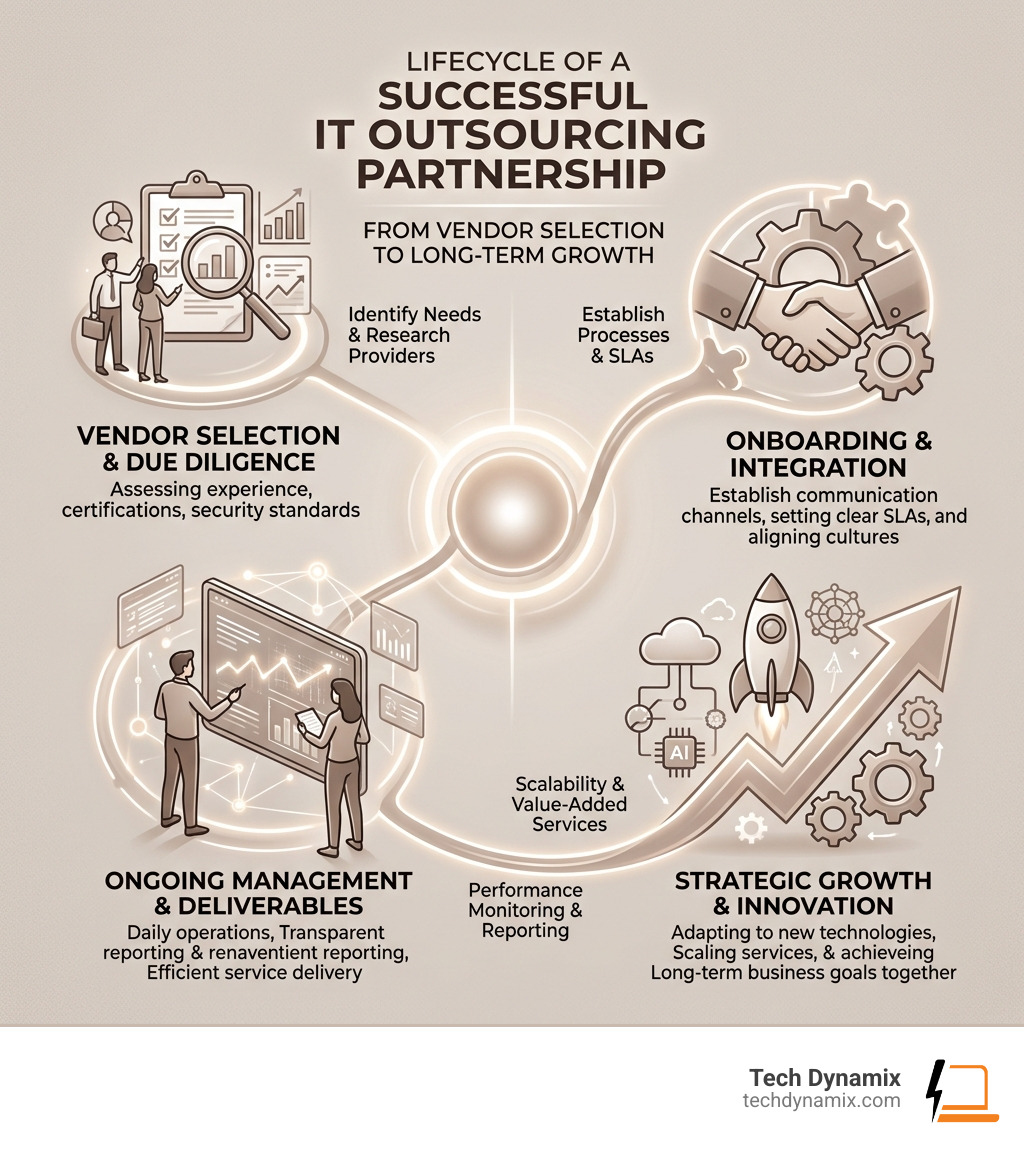
Not all providers are created equal. In fact, some can be downright dangerous if they don’t follow industry standards. When we talk to businesses in Northeast Ohio, we tell them to look for four pillars: Experience, Certifications, SLAs, and Response Times.
Evaluating Security and Compliance Standards
The stakes have never been higher. In 2024, the average global cost of a data breach reached a staggering $4.88 million. For a small business in Lake County, a breach of that size isn’t just a setback; it’s a death sentence.
Your IT outsourcing provider must be obsessed with security. Ask them about:
- Encryption: Is your data encrypted at rest and in transit?
- Multi-Factor Authentication (MFA): Do they enforce it across the board?
- Compliance: Do they understand HIPAA (for our healthcare clients) or CMMC (for our local manufacturers)?
For a deeper dive, read The Comprehensive Guide to Ohio Managed IT and Network Security.
Cultural Alignment and Communication Models
While “offshore” outsourcing (hiring teams in distant countries) is popular for massive enterprises looking for the absolute lowest cost, it often fails for small to mid-sized businesses due to communication gaps.
For businesses in the Cleveland Metro East corridor, we often recommend an onshore or nearshore model. Having a provider that speaks your language (literally and culturally) and works in your time zone is invaluable when a critical system goes down at 9 AM EST.
| Feature | Onshore (Local/U.S.) | Nearshore (Same Time Zone) | Offshore (Distant) |
|---|---|---|---|
| Cost | Premium | Moderate | Lowest |
| Communication | Excellent | Good | Variable/Difficult |
| Time Zone Overlap | 100% | High | Low |
| Cultural Fit | Perfect | High | Low |
| Best For | Strategic Support/Help Desk | Development Projects | Repetitive Tasks |
Navigating Pricing Models and Regional Costs
Budgeting for IT shouldn’t feel like a game of roulette. In 2026, the most successful partnerships are built on predictable, transparent pricing. Most providers offer one of three models:
- Hourly/Break-Fix: You pay for what you use. This is usually the most expensive in the long run because the provider only makes money when you have problems.
- Project-Based: A flat fee for a specific task (like a cloud migration).
- Monthly Managed Retainer: A “per-user” or “per-device” flat fee. This is our preferred model because it aligns our goals with yours—we both want your systems to run perfectly so we don’t have to fix them!
If you’re wondering about the specific numbers, we’ve updated our resource on How Much Does IT Support Really Cost in 2025? (which remains accurate for our 2026 projections).
Essential Questions for Your Potential IT Outsourcing Provider
Before you sign a contract, put them in the hot seat. If they can’t answer these clearly, walk away:
- “Who answers the phone?” Is it a non-technical receptionist who just takes a message, or a trained technician who can start fixing the problem immediately?
- “What is your average response time?” Don’t accept “we’re fast.” Ask for the data.
- “Who owns the data?” Ensure the contract explicitly states that you own all your data, licenses, and configurations.
- “How do you handle onboarding?” A provider without a 30-60-90 day onboarding plan is just winging it.
Avoiding Common Pitfalls and Hidden Expenses
The biggest mistake businesses make is ignoring the “exit strategy.” Even if you love your provider now, you need to know what happens if the relationship ends. Will they hold your passwords hostage? Will they charge you thousands of dollars to “export” your data?
Transparency is the antidote to hidden expenses. Ensure your IT outsourcing provider includes things like “ongoing maintenance” and “security updates” in their base fee so you don’t get a “nickel and dime” invoice at the end of the month.
Future-Proofing: AI and Cybersecurity Trends
As we look toward the rest of 2026 and into 2027, two things are dominating the conversation: Artificial Intelligence and advanced Cybersecurity.
AI isn’t just a buzzword anymore; it’s a tool that’s saving businesses millions. Organizations using AI and automation for security save an average of $2.22 million compared to those that don’t. Why? Because AI can spot a “zero-day” threat (a brand new virus) by analyzing suspicious behavior faster than any human could.
The Rise of AI-Augmented Development and Support
We are seeing a 100% boost in productivity for certain IT tasks thanks to AI-enabled engineering. For you, this means faster project delivery and fewer bugs. In the help desk world, AI-augmented support means that repetitive tickets (like password resets) are handled instantly by bots, freeing up human technicians to solve your complex network issues.
Cybersecurity as the Foundation of Outsourcing
In 2026, you can’t talk about an IT outsourcing provider without talking about cybersecurity. The threat landscape has moved from “script kiddies” to sophisticated state-sponsored actors and AI-driven phishing attacks.
A proactive provider doesn’t just install antivirus; they implement:
- Endpoint Detection and Response (EDR): Monitoring every laptop and phone for weird behavior.
- Dark Web Monitoring: Checking if your employees’ credentials have been leaked.
- Security Awareness Training: Teaching your team how to spot that “fake” email from the CEO.
Frequently Asked Questions about IT Outsourcing
What is the difference between managed services and IT outsourcing?
Think of IT outsourcing as the broad category—hiring someone else to do a job. Managed services is a subset of outsourcing where the provider takes ongoing, proactive responsibility for a whole system (like your entire network) rather than just completing a one-off task.
How do I ensure my data remains secure with an external provider?
Look for a provider that uses “Zero Trust” architecture, multi-factor authentication, and regular third-party audits. You should also ensure they have comprehensive cyber liability insurance and that your data is stored in encrypted, redundant data centers within the U.S.
What are the typical cost savings when moving from in-house IT to an outsourced model?
Most businesses see a 20-40% reduction in technology spend. This comes from eliminating the overhead of full-time salaries, benefits, and the specialized tools (which can cost thousands per month) that an IT outsourcing provider already owns and shares across their client base.
Conclusion
Finding an IT outsourcing provider that actually cares isn’t about finding the biggest name in the phone book—it’s about finding a partner that understands the unique pulse of Northeast Ohio business. Whether you are a manufacturing plant in Mentor or a non-profit in Cleveland, your technology should be the wind in your sails, not an anchor dragging you down.
At Tech Dynamix, we’ve spent over 20 years proving that local expertise combined with enterprise-grade tools is the secret sauce for business growth. We don’t just close tickets; we build roadmaps.
If you’re ready to stop worrying about your server and start focusing on your legacy, we’re here to help. Explore our full range of Services and let’s see how we can secure your future together.