Why Your Business Can’t Afford to Ignore Endpoint Detection Response
Endpoint detection response (EDR) is a cybersecurity technology that continuously monitors endpoints like laptops, desktops, mobile devices, and servers to detect, investigate, and respond to cyber threats in real time. Unlike traditional antivirus software that relies on known threat signatures, EDR uses behavioral analytics and machine learning to identify suspicious activity and stop attacks before they cause damage.
Quick Definition:
- What it is: A security platform that watches all devices connected to your network
- How it works: Records endpoint activity, analyzes behavior patterns, and automatically responds to threats
- Why it matters: Detects advanced threats that bypass traditional antivirus, including ransomware and zero-day exploits
- Key benefit: Provides complete visibility into what’s happening on every endpoint, plus the tools to investigate and remediate incidents quickly
Your endpoints are the weakest link in your security infrastructure. Every laptop, phone, and IoT device connected to your network represents a potential entry point for attackers. With remote work expanding the attack surface, businesses can no longer rely on perimeter defenses alone.
The term “endpoint threat detection and response” was coined by Anton Chuvakin of Gartner in 2013, and the market has exploded since then. According to industry reports, the EDR market was valued at $6.5 billion in 2025 and is expected to grow to $50.5 billion by 2034. This growth reflects a simple reality: modern threats require modern defenses.
Think of EDR as a security camera system for your IT environment. Traditional antivirus is like a locked door—it keeps out known threats. But EDR is like having security guards who watch everything happening inside your building, recognize suspicious behavior, and respond immediately when something looks wrong.
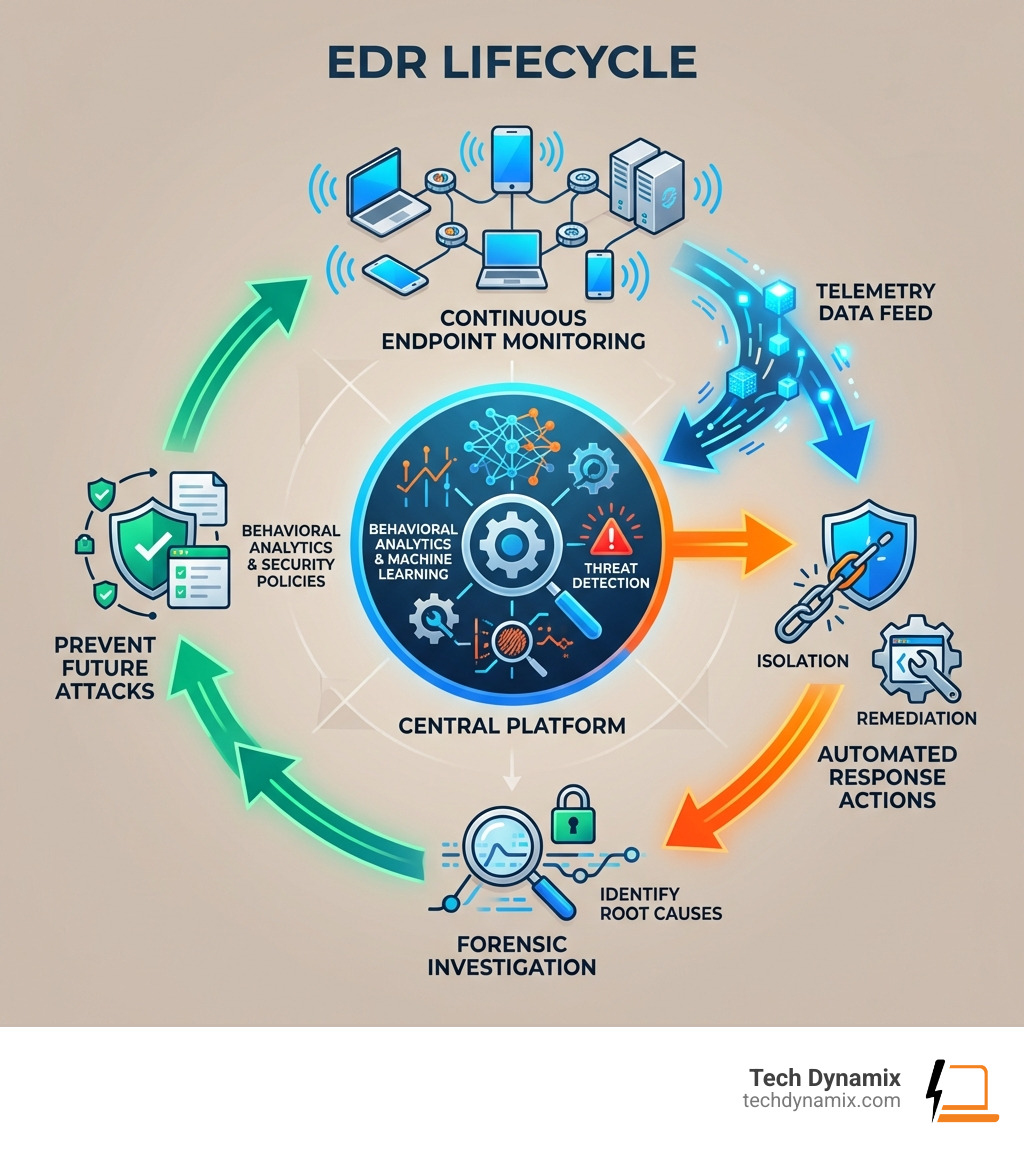
EDR solutions work by deploying software agents on each endpoint that continuously collect data about processes, network connections, file changes, and user activities. This telemetry gets sent to a central platform where advanced analytics identify Indicators of Compromise (IOCs) and Indicators of Attack (IOAs). When a threat is detected, the system can automatically isolate infected devices, block malicious processes, and roll back systems to a clean state.
I’m Jay Baruffa, and over my 20 years in IT systems support and infrastructure design, I’ve seen how Endpoint detection response has become essential for protecting businesses from sophisticated cyber threats. At Tech Dynamix, we help Northeast Ohio businesses implement EDR solutions that reduce risk, improve response times, and create scalable security frameworks that grow with your organization.
Defining Endpoint Detection Response for the Modern Enterprise
At its core, Endpoint Detection and Response (EDR) is a cybersecurity technology designed to continuously monitor and record activity on endpoint devices, identifying and investigating suspicious behavior, and ultimately responding to mitigate threats. It’s not just about blocking known malware; it’s about understanding what’s happening on your devices and reacting to anything out of the ordinary, whether it’s a known threat or something entirely new.
The concept of EDR, initially known as Endpoint Threat Detection and Response (ETDR), was formally introduced by Gartner analyst Anton Chuvakin in 2013. This marked a significant shift in thinking about endpoint security, moving beyond simple prevention to encompass a more active and investigative approach. As we’ve seen, the market for EDR solutions has exploded since then, reflecting the growing need for more advanced protection.
Essentially, EDR provides a comprehensive view of all activities on your endpoints – from process execution and network connections to file modifications and user actions. This continuous monitoring is crucial because today’s cyber threats are stealthier and more persistent than ever. They often bypass traditional perimeter defenses and aim to establish a foothold within your network. EDR acts as our internal security detail, constantly on alert.
For businesses across Northeast Ohio, from Painesville to Cleveland and beyond, this continuous monitoring is vital. Our local businesses face the same sophisticated threats as larger enterprises, including ransomware, which the FBI frequently warns about, as detailed in our article FBI Issue New Ransomware Warning. Without EDR, a successful attack on a single endpoint could quickly spread throughout an entire network, leading to devastating consequences. EDR gives us the ability to detect these intrusions early and respond effectively.
How EDR Technology Works to Neutralize Threats
Endpoint detection response operates through a multi-layered approach involving data collection, analysis, and rapid response.

At the heart of EDR is telemetry. A lightweight agent on each endpoint gathers data on process information, network activities, kernel insights, user logins, and file system changes. This data is sent to a central console for analysis using behavioral analytics and machine learning. Unlike traditional antivirus, EDR identifies patterns and anomalies, learning what “normal” behavior looks like to spot deviations that indicate malicious activity.
EDR identifies Indicators of Attack (IOAs) and Indicators of Compromise (IOCs) by correlating real-time data with global threat intelligence. It can also integrate with SIEM systems, enriching analytics with data from firewalls and network devices for a holistic view of your IT infrastructure.
Most EDR solutions provide a forensic recording of activity, often stored for 90 days or more. This allows security analysts to perform root cause analysis and understand how a threat progressed.
Key Capabilities of Endpoint Detection Response
EDR solutions provide tools to manage and neutralize threats across four essential phases:
- Detection: Continuously monitors endpoints to identify suspicious activities, including zero-day threats and fileless attacks, by analyzing behavior in real-time.
- Containment: Rapidly isolates affected endpoints to prevent lateral movement. This is critical for stopping ransomware before it spreads.
- Investigation: Provides detailed logs and historical records, acting like a “DVR” for your devices to help analysts trace the attack’s origin.
- Elimination (and Recovery): Terminates malicious processes and can roll back systems to a pre-infection state, ensuring the environment is returned to a healthy state.
For more on how we integrate these into a holistic strategy, visit our Cybersecurity Solutions page.
Proactive Threat Hunting with Endpoint Detection Response
EDR empowers threat hunting—actively searching for undetected threats that bypassed initial defenses. Analysts use the MITRE ATT&CK framework to map endpoint activities to known adversary tactics.
- Comprehensive Data: Records hundreds of security events, providing the fuel for deep investigation.
- Behavioral Analytics: Uncovers stealthy attackers who blend into normal network traffic.
- Historical Context: Allows for retrospective analysis to find initial infection vectors from weeks or months ago.
- Custom Searches: Enables analysts to run queries to see if a suspicious executable has run elsewhere in the network.
This proactive approach significantly reduces the window of opportunity for attackers, protecting Northeast Ohio businesses from advanced persistent threats (APTs).
EDR vs. Traditional Antivirus: A Necessary Evolution
Traditional antivirus (AV) was once the gold standard, but modern threats require a more active approach. Endpoint Detection and Response is a fundamental shift from simple prevention to continuous monitoring.
| Feature | Traditional Antivirus (AV) | Endpoint Detection and Response (EDR) |
|---|---|---|
| Primary Focus | Prevention of known threats | Detection, investigation, and response |
| Detection Method | Signature-based | Behavioral analytics, ML, IOAs/IOCs |
| Threat Scope | Known malware, viruses | APTs, zero-days, fileless malware, ransomware |
| Visibility | Limited to scan results | Continuous, real-time recording |
| Response | Quarantine/Block | Isolate, roll back, forensic analysis |
| Proactive Security | Low | High (Threat hunting) |
Traditional AV relies on signatures. It struggles with zero-day threats (new vulnerabilities with no signature), fileless malware (operating in memory), and human-driven attacks.
EDR takes a behavior-based approach. If a program acts suspiciously, EDR flags it, even if the code is brand new. It also offers retrospective remediation, allowing you to “undo” damage by rolling back systems to a clean state. EDR complements antivirus; many solutions integrate next-generation antivirus (NGAV) for a unified defense. For our clients, we often combine EDR with robust Managed Services for comprehensive protection.
Why EDR is Essential for Modern Business Protection
For businesses in Northeast Ohio, Endpoint Detection and Response is now a necessity. Here is why:
- Protection Against Advanced Threats: EDR combats zero-day exploits, ransomware, and fileless malware that bypass traditional signature-based tools.
- Faster Incident Response: Real-time visibility and historical data allow security teams to quickly contain and eliminate threats, reducing the risk of a catastrophic breach.
- Comprehensive Visibility: Eliminates blind spots across all devices, whether in a Cleveland office or a remote home setup. This is a core part of unified endpoint management (UEM).
- Proactive Threat Hunting: Allows teams to find Indicators of Compromise (IOCs) before an attacker can cause significant harm.
- Remote and Hybrid Work Security: Extends protection to distributed endpoints, mitigating risks like phishing and insider threats that are amplified by remote work.
- Compliance: Provides the logging and monitoring required by healthcare and financial regulations.
- Data Loss Prevention: Monitors data transfers to prevent sensitive information from leaving the organization.
- Scalability and Automation: Uses AI-driven automation to respond to threats at scale, reducing the burden on IT staff.
- Machine Learning: Separates legitimate threats from “noise,” allowing analysts to focus on critical incidents.
- Reducing Attack Surface: Identifies vulnerabilities and misconfigurations before they can be exploited.
EDR provides an intelligent defense that adapts to the changing landscape, giving Northeast Ohio businesses peace of mind.
Frequently Asked Questions about EDR
Can EDR capabilities be outsourced to a third party?
Yes. Managing EDR in-house requires 24/7 monitoring and specialized expertise. Managed Detection and Response (MDR) services, like those offered by Tech Dynamix, provide EDR as a service. We act as your outsourced Security Operations Center (SOC).
Benefits of MDR include:
- 24/7 Vigilance: Constant monitoring outside of business hours.
- Expert Analysis: Access to specialists in threat hunting and remediation.
- Resource Optimization: Your internal IT team can focus on core operations.
- Cost-Effectiveness: Enterprise-grade security without the overhead of a full in-house security team.
What is the relationship between EDR and XDR?
Endpoint Detection and Response (EDR) focuses on devices like laptops and servers. Extended Detection and Response (XDR) is an evolution that broadens this scope. XDR correlates data from endpoints, networks, cloud environments, email, and identity services.
If EDR is a security camera for a specific room, XDR is a surveillance system for the entire property. XDR provides broader visibility, improved detection of complex attacks, and centralized management across the entire attack surface.
How does EDR help in protecting against zero-day threats and APTs?
Zero-day threats and Advanced Persistent Threats (APTs) are designed to bypass traditional defenses. EDR stops them through:
- Behavioral Baselining: EDR learns “normal” behavior and flags deviations, catching unknown threats based on their actions.
- Indicators of Attack (IOAs): Focuses on intent (e.g., a process trying to encrypt files) rather than just file signatures.
- Machine Learning: Analyzes vast datasets to identify subtle patterns used by sophisticated adversaries.
- Sandbox Analysis: Suspicious files are executed in an isolated environment to observe their behavior safely.
- Retrospective Analysis: If a new threat is identified, EDR can search historical telemetry to see if the threat was present months ago.
- Rapid Containment: Immediately isolates affected devices to stop lateral movement while analysts perform root cause analysis.
By focusing on behavior and continuous vigilance, EDR provides a robust defense for businesses against the most advanced cyber threats.
Conclusion: Securing Your Business Future
In an era where cyber threats are more sophisticated and pervasive than ever, relying on outdated security measures is a risk no business can afford. Endpoint Detection and Response is not just another security tool; it’s a fundamental shift towards a proactive, intelligent, and comprehensive approach to protecting your digital assets. It moves us beyond simply locking the doors to actively patrolling the premises, understanding suspicious behavior, and responding swiftly to any emerging threat.
For small and mid-size businesses across Northeast Ohio, from Painesville to Mentor, and throughout the Greater Cleveland Area, the stakes are incredibly high. Our local economy thrives on innovation and trust, both of which can be shattered by a single cyberattack. Investing in robust EDR solutions means safeguarding your data, maintaining operational continuity, and protecting your reputation.
At Tech Dynamix, we understand these challenges firsthand. With over 20 years of experience, we provide high-quality IT consulting and managed IT services custom to the unique needs of Northeast Ohio businesses. We specialize in implementing cutting-edge cybersecurity solutions, including EDR, that integrate seamlessly with your existing infrastructure and empower your teams. Our expertise ensures that you not only have the best technology in place but also the expert support to leverage it effectively.
Don’t let your endpoints be the weakest link in your security chain. Accept the power of Endpoint Detection and Response and secure your business future with a partner who understands your needs and the local threat landscape.