Understanding the Managed Firewall Service
A managed firewall service is when a third-party provider handles the full setup, monitoring, and maintenance of your firewall – so your team doesn’t have to.
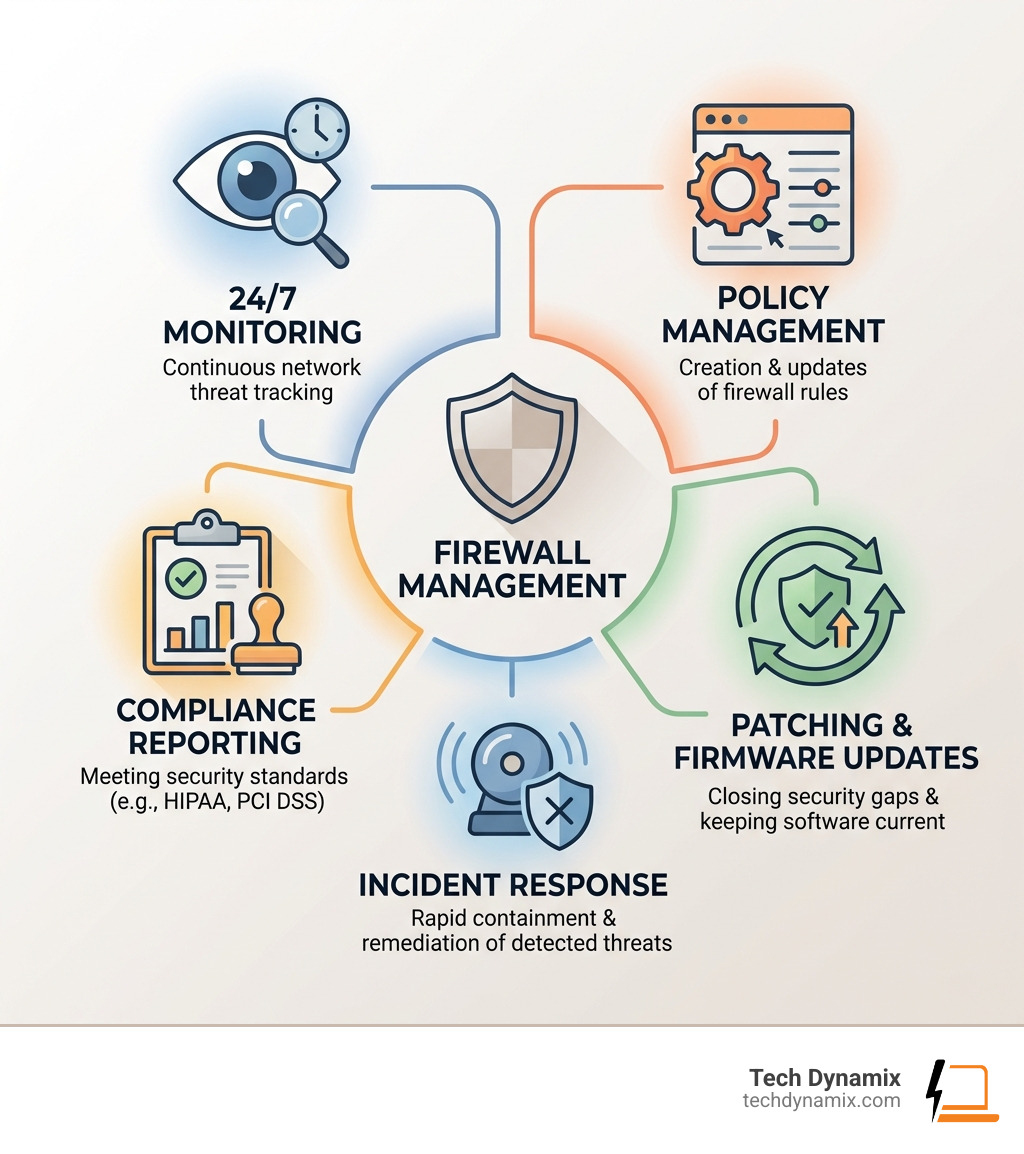
Here’s what that typically includes:
- 24/7 monitoring of network traffic and threats
- Policy management – creating and updating firewall rules
- Patching and firmware updates to close security gaps
- Incident response when threats are detected
- Compliance reporting for standards like HIPAA, PCI DSS, and GDPR
The numbers behind why this matters are hard to ignore:
- 43% of all cyberattacks now target small and mid-sized businesses
- 60% of SMBs that suffer a breach shut down within six months
- $1 million is the average cost of a data breach for an SMB
And the uncomfortable truth? Most breaches don’t happen because of sophisticated hackers. They happen because of simple misconfiguration errors – the kind that pile up when a busy IT team is stretched too thin.
Firewalls are not “set it and forget it” equipment. They need constant attention: new rules, updated firmware, tuned policies, and round-the-clock oversight. Without that, even a well-intentioned firewall can become a liability.
I’m Jay Baruffa, founder of Tech Dynamix, and with over 20 years in IT infrastructure and cybersecurity, I’ve seen how a managed firewall service transforms network security for businesses across Northeast Ohio – from reactive chaos to proactive, reliable protection. In this guide, I’ll walk you through everything you need to make an informed decision.
Simple Managed firewall service glossary:
Managed Firewall Service vs. DIY Management
Think of your firewall like the front gate of a high-security facility. In a DIY (Do-It-Yourself) scenario, you bought the gate, but you’re also the person who has to grease the hinges, check the ID of every person walking through, and update the lock every time a new master key is leaked on the dark web. If you’re busy running the business inside the facility, that gate is eventually going to get left open.
The “hidden costs” of DIY management are often what sink a small business. Misconfigurations are a leading cause of breaches. We often see rule sets that are way too broad-like the “any/any” rule where a technician opens everything up for troubleshooting and forgets to close it. This leaves your network exposed to the world.
A Managed firewall service shifts that burden. Instead of your lean IT team spending hours on firmware updates or manual log reviews, an expert provider handles the heavy lifting. This ensures that security isn’t just a task on a to-do list-it’s a 24/7 reality. For a deeper look at why professional oversight is a business must-have, check out our guide on unpacking managed network services.
| Feature | DIY Management | Managed Firewall Service |
|---|---|---|
| Monitoring | Occasional / Business Hours | 24/7/365 Proactive |
| Updates | Manual (Often delayed) | Automated & Verified |
| Expertise | Generalist IT Staff | Cybersecurity Specialists |
| Configuration | High Risk of Error | Best-Practice Hardening |
| Compliance | Manual Reporting | Automated Audit Logs |
Common Types of Managed Firewalls
As we move through 2026, the technology behind firewalls has evolved far beyond simple packet filtering. Depending on your business needs in Lake County or the Greater Cleveland area, we typically manage several types:
- Next-Generation Firewalls (NGFW): These are the gold standard. They don’t just look at where traffic is coming from; they look at what it is. They provide application-layer analysis, intrusion prevention (IPS), and deep packet inspection to catch sophisticated threats.
- Cloud-Based Firewalls (FWaaS): Perfect for businesses that have moved their infrastructure to the cloud. These are hosted remotely and filter traffic before it ever reaches your virtual environment.
- Hardware Appliances: The physical “black box” in your server room. These are robust and provide high throughput for local offices, especially in manufacturing or professional services sectors.
- Virtual Systems: Using virtualization to segregate different departments or client rulesets on shared hardware. This is common in high-compliance environments where data isolation is critical.
Properly selecting and deploying these requires a solid foundation in network design management, ensuring your security doesn’t become a bottleneck for your performance.
Ideal Customers and Real-World Use Cases
Who actually needs a managed firewall service? While every business with an internet connection is a target, certain groups benefit the most:
- Lean IT Teams: If you have one or two IT people handling everything from broken printers to cloud migrations, they don’t have time to be security analysts. We act as an extension of their team.
- Municipalities and Government Agencies: Local governments in places like Willoughby, Ohio, or Chardon, Ohio, handle sensitive citizen data. They are frequent targets for ransomware and require the strict compliance oversight that managed services provide. Managed IT for municipalities often focuses on these high-stakes security requirements.
- Compliance-Heavy Industries: Healthcare providers in Mayfield Heights or financial services in Mentor must meet HIPAA or PCI DSS standards. A managed service provides the “paper trail” (logs and audits) needed to prove you are protecting data.
- Multi-Location Businesses: A retail chain or a manufacturing company with plants across Northeast Ohio needs consistent security policies. You don’t want the Wickliffe branch to be less secure than the Painesville headquarters.
By utilizing managed services, these organizations can focus on their core mission-whether that’s teaching students, treating patients, or making parts-while we handle the digital perimeter.
Key Features and Included Services

When you sign up for a managed firewall service, you aren’t just buying hardware; you’re buying a suite of protective measures. Our goal is to remove the “complexity headache.”
- 24/7/365 Monitoring: Threats don’t take the weekend off. A true managed service includes round-the-clock staffing from a Security Operations Center (SOC) to catch anomalies the moment they appear.
- Policy Management & Tuning: We don’t just set rules and walk away. We continually tune your firewall to improve effectiveness and ensure that legitimate business traffic isn’t being blocked.
- Patching and Upgrades: Firmware vulnerabilities are discovered every week. We handle the updates during planned maintenance windows to ensure your “front gate” doesn’t have a broken lock.
- Incident Handling: If a “Severity 1” event occurs (like an active breach attempt), our team responds immediately. Many providers target a 99% service level for critical response.
- Advanced Threat Prevention: This includes sandboxing, botnet blocking, and malware scanning. For more on how this fits into a broader strategy, see our cybersecurity solutions.
You can also find specialized support for securing hosted infrastructure if your servers live in a data center rather than your office.
Integration with SD-WAN and SASE
Modern networking is about more than just a single office. With the rise of remote work, we often integrate managed firewalls with SD-WAN (Software-Defined Wide Area Network) and SASE (Secure Access Service Edge).
This creates a “unified visibility” model. Instead of having your firewall in a silo, it works in tandem with your network connectivity tools. This allows for:
- Dynamic Path Selection: Prioritizing Zoom calls over background downloads.
- ZTNA (Zero Trust Network Access): Ensuring that users only access exactly what they need, even when working from home in Richmond Heights or Lyndhurst.
- VPN Tunnels: Securely connecting branch offices or remote workers to the main network without exposing data to the public internet.
Effective network connectivity today requires security to be baked in, not bolted on.
Service Level Agreements and Uptime
One of the biggest advantages of a managed firewall service is the accountability. When you do it yourself, if the firewall goes down at 2:00 AM on a Sunday, you’re the one who has to fix it. With a managed provider, you have a Service Level Agreement (SLA).
Common industry targets include:
- 99.99% Uptime: Ensuring your business stays connected.
- Response Timeliness: 96% fulfillment for service requests and 99% for critical incident response.
- Proactive Replacement: If a hardware appliance fails, many “Hardware as a Service” (HWaaS) models include overnight shipping for a replacement.
Why Your Business Needs a Managed Firewall Service

The landscape of 2026 is significantly more dangerous than it was even five years ago. Cybercriminals now use AI to find “cracks” in firewalls—outdated firmware, open ports, or default passwords. Expert oversight isn’t just a luxury; it’s a survival tactic.
Our cybersecurity services guide highlights that a firewall is your first line of defense, but only if it’s actually being watched.
The Benefits of a Managed Firewall Service
Beyond just “not getting hacked,” there are tangible business benefits:
- Compliance Peace of Mind: Whether it’s PCI DSS for retail, HIPAA for healthcare, or GDPR for international business, firewalls are a core requirement. We provide the compliance security audits and documentation to keep the auditors happy.
- Reduced CapEx: With many managed models, you don’t have to buy a $5,000 piece of hardware every three years. It’s included in a predictable monthly fee.
- Expert Knowledge: You get access to engineers who live and breathe firewall security. They know the “best practices” that prevent common failures.
- Focus on Growth: Your IT team can stop fighting fires (pun intended) and start working on strategic projects that actually grow your business. For more on meeting these standards, read The Ultimate Guide to IT Compliance.
Proactive Threat Prevention
We’ve moved past the era of “reactive” security. Today’s managed firewall service uses AI-driven threat intelligence. This means if a new zero-day exploit is discovered in Europe at 8:00 AM, your firewall in Northeast Ohio can be updated to block it by 8:05 AM.
Real-time blocking of malicious traffic, geofiltering (blocking traffic from known “bad actor” countries like North Korea), and deep packet inspection are all standard. This works alongside tools like Endpoint Detection and Response to create a “shield” around your entire digital footprint.
Pricing, Hardware, and Choosing a Provider
Pricing for a managed firewall service isn’t one-size-fits-all. It’s usually based on a few key factors:
- Rule Complexity: A firewall with 50 simple rules is cheaper to manage than one with 400 complex rules.
- Throughput: How much data is moving through your pipes? A gigabit connection requires more powerful hardware and more oversight.
- Hardware Ownership: Do you want to own the box (CapEx), or do you want the provider to provide it as a service (OpEx)?
- High Availability (HA): Do you need a “failover” pair? If your business cannot afford a single minute of downtime, we deploy two firewalls that work in tandem.
Typical pricing can range from a few hundred dollars a month for a small office to several thousand for a complex enterprise setup with HA pairs. You can explore our security offerings to see how we structure these solutions.
How to Choose the Right Managed Firewall Provider
Don’t just pick the cheapest option. A “bargain” firewall service that only monitors logs and doesn’t actually manage policies is just an expensive alarm bell. You want a partner, not just a vendor.
Look for:
- Local Expertise: Do they know the Northeast Ohio business landscape? Can they be on-site in Mentor or Willoughby if a physical hardware failure occurs?
- Technical Depth: Do they support top-tier vendors like Fortinet or Check Point?
- Co-Management Options: Do you still have access to your portal? A good provider like Tech Dynamix offers a “co-managed” model where you retain visibility while we handle the heavy lifting.
- Support Limits: Is support 24/7, or just “business hours”?
Frequently Asked Questions about Managed Firewalls
How much does a managed firewall service cost?
It varies by complexity. A small business might see costs between $150 and $300 per month including hardware and support. Larger enterprises with complex rule sets and high-throughput requirements might pay $1,500 to $7,500 per month for managed HA pairs.
Will a managed hardware firewall slow down my network speeds?
It can, slightly. Because the firewall is actually inspecting every packet of data for viruses and malware, there is a tiny bit of latency. However, modern enterprise-grade hardware is designed to handle gigabit speeds without a noticeable impact on your daily work.
Do I need to provide my own hardware for the service?
Not necessarily. Most providers offer a “Hardware as a Service” (HWaaS) model where the appliance is included in your monthly fee. If you already own high-quality hardware, many providers (including us) can offer a management-only service to take over the administration and monitoring.
Conclusion
In April 2026, a firewall is no longer an optional “extra”—it is the foundation of your business’s digital safety. Whether you are a small manufacturer in Concord Township or a healthcare provider in Mayfield Heights, the risks of a DIY approach are simply too high.
A managed firewall service from Tech Dynamix provides the expert oversight, 24/7 monitoring, and proactive threat prevention you need to stay focused on your business. We’ve spent over 20 years protecting Northeast Ohio businesses, and we’re ready to help you simplify your security.
Ready to secure your perimeter? Get more info about our cybersecurity services and let’s talk about building a shield for your business.