Why Managed Cloud IT Services Are Reshaping How Businesses Operate
Managed cloud IT services are the outsourcing of your cloud infrastructure, security, monitoring, and maintenance to a dedicated provider — so your team can focus on running the business instead of managing servers.
Here’s a quick summary of what they include:
- Infrastructure management — servers, storage, networking, and virtual environments
- 24/7 monitoring — proactive alerts before problems affect users
- Security and compliance — HIPAA, NIST, SOC 2, and more
- Backup and disaster recovery — automated, tested, and fast to restore
- Cloud migration support — planning, execution, and post-migration validation
- Cost optimization (FinOps) — reducing waste and keeping spending predictable
The cloud isn’t coming — it’s already here. By 2025, 85% of organizations are expected to adopt a cloud-first strategy, and 95% of new digital workloads will run on cloud-native platforms. That’s not a trend. That’s a fundamental shift in how business technology works.
But moving to the cloud is only half the challenge. Managing it well — keeping it secure, optimized, and aligned with your business goals — is where most companies struggle.
That’s exactly where a managed cloud IT services provider steps in.
I’m Jay Baruffa, founder of Tech Dynamix, with over 20 years of hands-on experience in IT infrastructure design, cybersecurity, and managed cloud IT services for businesses across Northeast Ohio. In this guide, I’ll break down everything you need to know — in plain language — so you can make a confident decision about your cloud strategy.
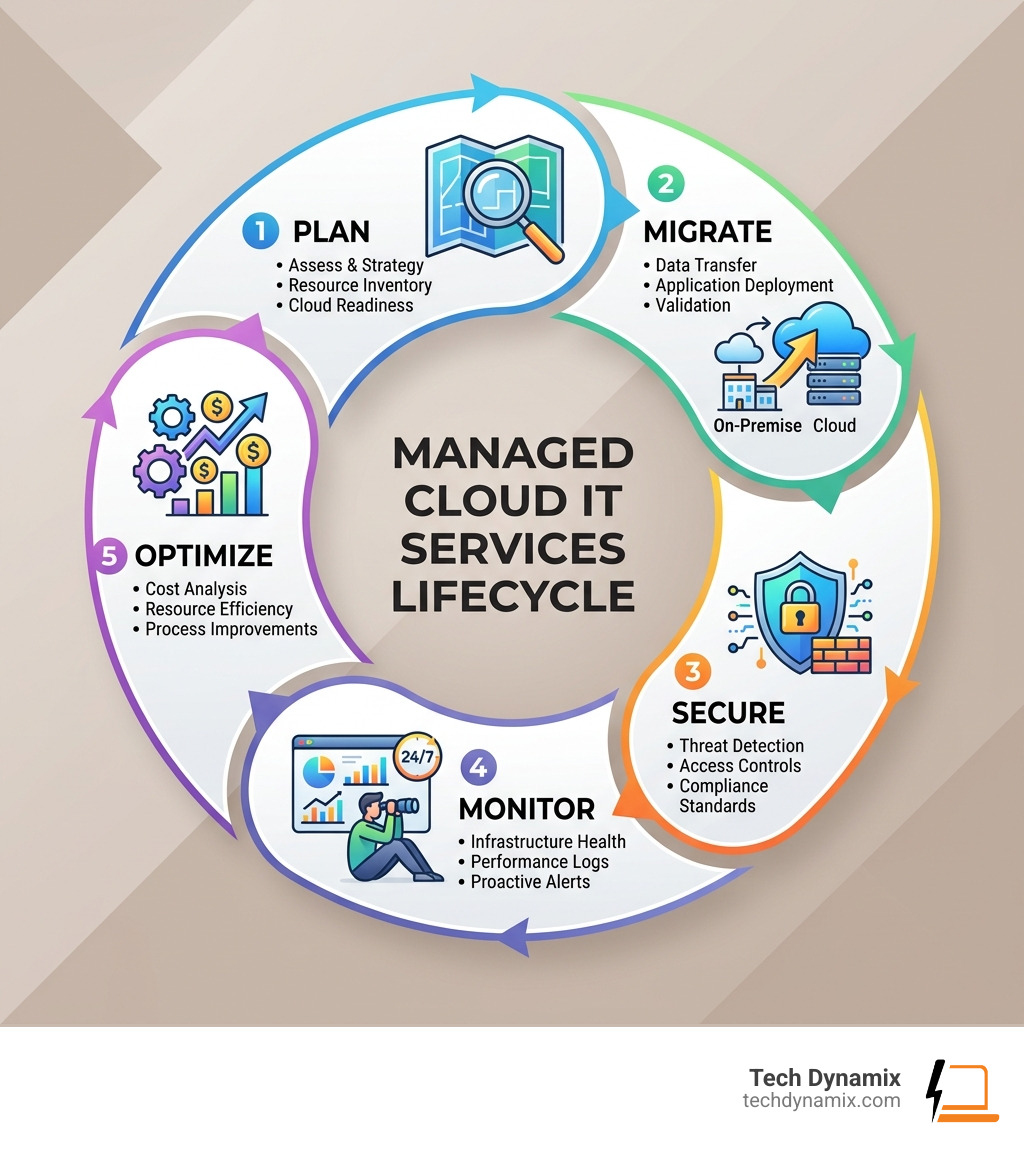
Easy managed cloud it services glossary:
What are Managed Cloud IT Services?
At its core, managed cloud IT services represent a partnership where a business offloads the partial or complete management of its cloud resources to a Managed Cloud Service Provider (MCSP). Think of it as having an entire department of cloud architects, security analysts, and system administrators at your disposal without the overhead of hiring them all individually.
Traditional cloud management often relies on your internal IT team to handle everything from patching virtual machines to configuring firewalls. In contrast, managed services move that burden to us. We don’t just give you the “keys” to a cloud server; we handle the steering, the maintenance, and the fuel efficiency.
Our core responsibilities in this model include:
- Initial Configuration: Setting up your environment according to industry best practices.
- Continuous Monitoring: Using 24/7 tools to spot performance dips or security threats.
- Patching and Updates: Ensuring your operating systems and applications are never vulnerable to known exploits.
- Resource Scaling: Adjusting your computing power up or down based on real-time demand.
For many local firms in Lake and Geauga Counties, unlocking the power of managed private cloud has become the preferred way to maintain total control over data while shedding the headaches of hardware ownership.
Service Models: IaaS, PaaS, and SaaS
Understanding managed cloud IT services requires a quick look at the “as-a-Service” family tree. Each model offers a different level of control and management:
- Infrastructure-as-a-Service (IaaS): This is the foundation. We manage the physical servers, storage, and networking, while you (or we, on your behalf) manage the operating systems and applications. It’s the ultimate in flexibility.
- Platform-as-a-Service (PaaS): Primarily for developers, this provides a framework to build, test, and deploy apps without worrying about the underlying infrastructure.
- Software-as-a-Service (SaaS): Think Microsoft 365 or specialized EMR software. You use the software via the web, and the provider handles everything else.
Whether you are looking for your Ohio cloud connection or need help managing a complex IaaS environment, these models allow for a modular approach where you only pay for what you need.
Public, Private, and Hybrid Architectures
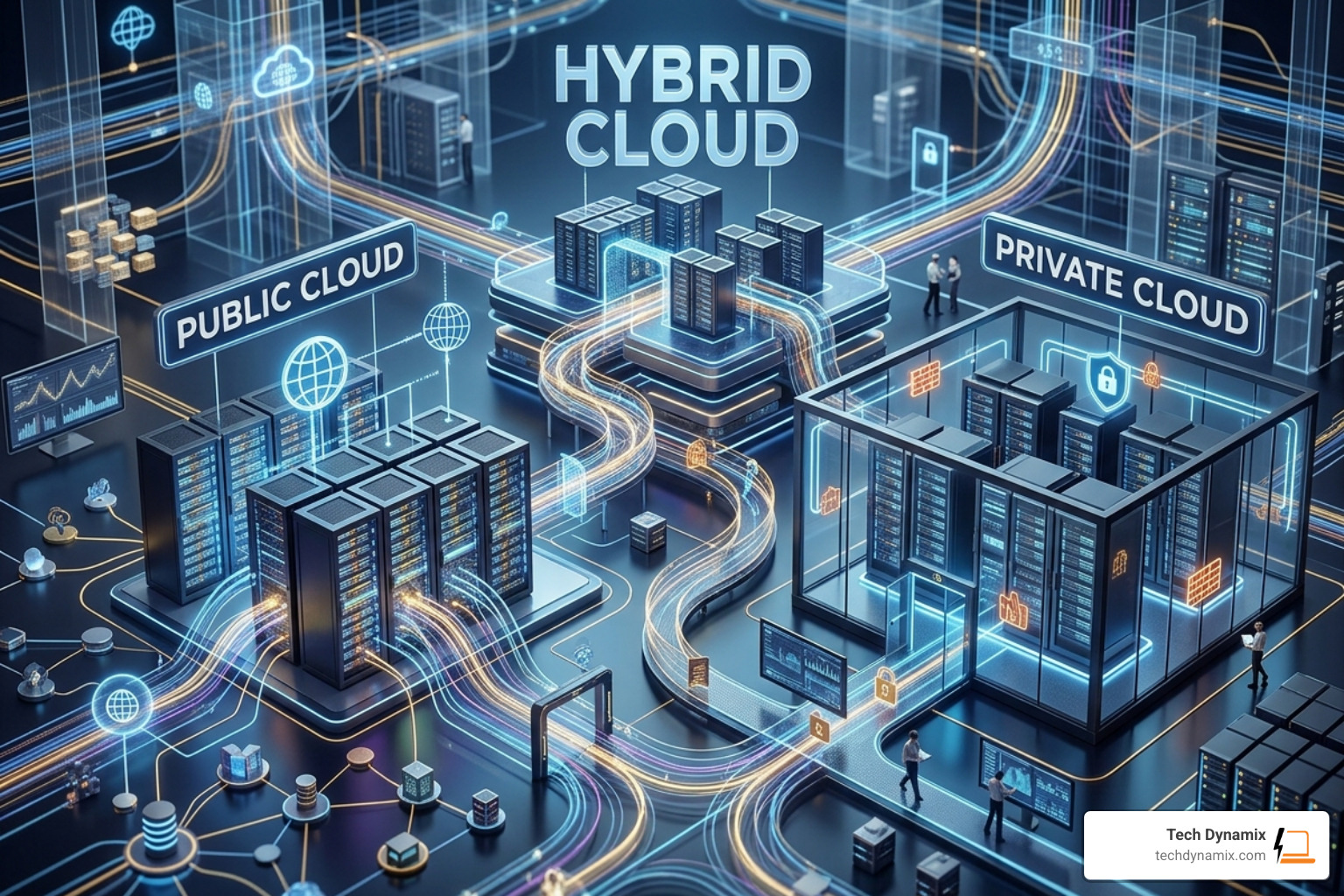
Not all clouds are built the same. Your choice of architecture impacts your security, performance, and cost:
- Public Cloud: Resources like Microsoft Azure or AWS are shared across multiple “tenants.” It’s highly scalable and cost-effective but requires expert configuration to ensure your data stays isolated.
- Private Cloud: These are dedicated resources solely for your business. It’s the gold standard for high-security industries like healthcare or finance in the Greater Cleveland Area.
- Hybrid Cloud: This is the “best of both worlds” approach. You might keep sensitive customer data on a private server while using the public cloud for high-volume web traffic.
If you’ve ever felt confused by these terms, check out our guide demystifying cloud data centers for a deeper look at where your data actually lives.
The Strategic Benefits of Managed Cloud IT Services
Why do businesses in Northeast Ohio make the switch? It usually comes down to three things: focus, performance, and peace of mind. By offloading technical minutiae, your leadership team can focus on growth rather than “keeping the lights on.”
| Feature | In-House Cloud Management | Managed Cloud IT Services |
|---|---|---|
| Cost Structure | High CapEx / Unpredictable OpEx | Predictable Monthly Subscription |
| Security | Limited to internal expertise | 24/7 Global Threat Intelligence |
| Scalability | Manual and slow | Automated and instantaneous |
| Uptime | Dependent on staff availability | Backed by strict SLAs |
For those exploring specific platforms, Ohio’s cloud frontier: a deep dive into Amazon Web Services explains how these benefits manifest in one of the world’s most popular cloud environments.
Cost Optimization and FinOps in Managed Cloud IT Services
One of the biggest “gotchas” in the cloud is the monthly bill. Without proper oversight, it’s easy to leave expensive resources running that nobody is using. This is where FinOps (Financial Operations) comes in.
We provide “managed spend visibility.” We analyze your resource utilization to identify “zombie” servers or unnecessary licensing. By moving to a consumption-based model and constantly tuning your environment, we turn the cloud from a black hole of expenses into a predictable, optimized line item. No more “sticker shock” at the end of the month.
Improving Business Agility and Performance
In today’s market, the ability to pivot is everything. If a manufacturer in Willoughby suddenly needs to launch a new client portal, they can’t wait six weeks for hardware to arrive. With managed cloud IT services, that infrastructure can be provisioned in minutes.
We also focus on performance tuning. This means ensuring your data is stored on the right “tier” of storage so that your applications run fast, but you aren’t paying for ultra-premium speed on files you only access once a year.
Security, Compliance, and Disaster Recovery
Security is the number one concern we hear from business owners in Lake County and beyond. The cloud is inherently secure, but how you use it determines your actual risk. We implement a “layered” security approach that includes identity management, encryption, and continuous threat monitoring.
For regulated industries, we align your cloud environment with specific standards:
- HIPAA: For our healthcare clients in Mayfield Heights and Concord.
- NIST/CMMC: For government contractors.
- SOC 2: For financial and professional services.
We also address the “multi-tenancy” risk. In a public cloud, your data lives on the same physical hardware as others. We use advanced isolation techniques and “secure landing zones” to ensure your data remains private and protected from “noisy neighbors” who might otherwise hog resources. To learn more about how we keep systems running, see your go-to guide for cloud availability center insights.
Disaster Recovery as a Service (DRaaS)
Traditional backups are often “set it and forget it” — until they fail when you need them most. Our approach to Disaster Recovery as a Service (DRaaS) focuses on two metrics: RTO (Recovery Time Objective) and RPO (Recovery Point Objective).
In plain English: How fast can you get back to work, and how much data can you afford to lose? With cloud-based DRaaS, we can often achieve remediation in hours, not days, by “spinning up” your entire server environment in a secure secondary data center if your primary site goes dark.
Navigating Cloud Migration and Ongoing Management
A successful move to the cloud isn’t a “lift and shift” — it’s a strategic transition. We follow a proven methodology to ensure zero data loss and minimal downtime:
- Assessment: We review your current-state IT and identify which workloads are cloud-ready.
- Roadmapping: We build a timeline and budget that aligns with your business goals.
- Migration Execution: We use automation to move data securely, often performing the “cutover” after hours to avoid disrupting your team.
- Validation: We test every application and connection to ensure performance meets our standards.
For a deeper dive into how this works locally, read about unlocking cloud migration expertise or see how the 5 best cloud migration Ohio providers compared.
The Role of AI and Automation in Managed Cloud IT Services
Modern management isn’t just about humans clicking buttons. We use human-directed AI and automation tools like Ansible and Terraform to manage your environment.
- Predictive Monitoring: AI can spot patterns in server logs that suggest a failure is imminent before it happens.
- Automated Patching: Security updates are applied instantly across your entire fleet of virtual machines.
- Self-Healing Systems: If a service crashes, automation can often restart it or re-provision a new instance automatically.
Choosing the Right Managed Cloud Service Provider
When vetting an MCSP, don’t just look at the price tag. Look for:
- Local Expertise: Do they understand the Northeast Ohio business landscape?
- Transparency: Do they provide clear performance reports and “no-hidden-fee” pricing?
- Certifications: Are they experts in Microsoft 365, Azure, or AWS?
- Response Times: A 30-minute average response time is the gold standard for keeping a business running.
Frequently Asked Questions about Managed Cloud IT Services
What is the difference between managed cloud and traditional cloud management?
Traditional management is reactive — you fix things when they break, and your internal team handles the daily chores. Managed cloud IT services are proactive. We use automation and 24/7 monitoring to prevent issues before they start, and we take full ownership of the infrastructure’s health, security, and cost-efficiency.
How do managed cloud services help with regulatory compliance?
We build “compliance-by-design” into your environment. This means configuring the cloud to meet specific standards (like HIPAA or SOC 2) from day one. We handle the encryption, access controls, and audit logging required to pass your next regulatory review, saving you dozens of hours of manual paperwork.
What are the main pros and cons of hiring an MCSP?
Pros: Predictable costs, 24/7 expert support, better security, and the ability to scale instantly. It frees your team to focus on high-value projects. Cons: It requires a monthly subscription (OpEx), and you must trust your provider with your data. That’s why choosing a transparent, high-retention partner is critical.
Conclusion
At Tech Dynamix, we believe that technology should move your organization forward, not hold it back. For over 20 years, we’ve served small and mid-size businesses across Northeast Ohio — from Mentor and Willoughby to the Cleveland Metro East Corridor.
Our commitment to excellence is reflected in our 98.5% client retention rate and 99% CSAT-rated support. When you call us, you aren’t reaching a generic call center; you’re reaching a local team that averages 30-minute response times.
Whether you are in manufacturing, healthcare, or professional services, we are here to be your all-in-one technology partner. Ready to simplify your IT? Learn more about our managed services and let’s build a cloud strategy that actually works for you.