Is Local Cloud Hosting in Ohio Right for Your Business?
Cloud hosting Ohio businesses rely on has grown into a competitive market, with local providers offering real advantages over larger national platforms. According to the standard definition of cloud computing, these services provide on-demand availability of computer system resources without direct active management by the user.
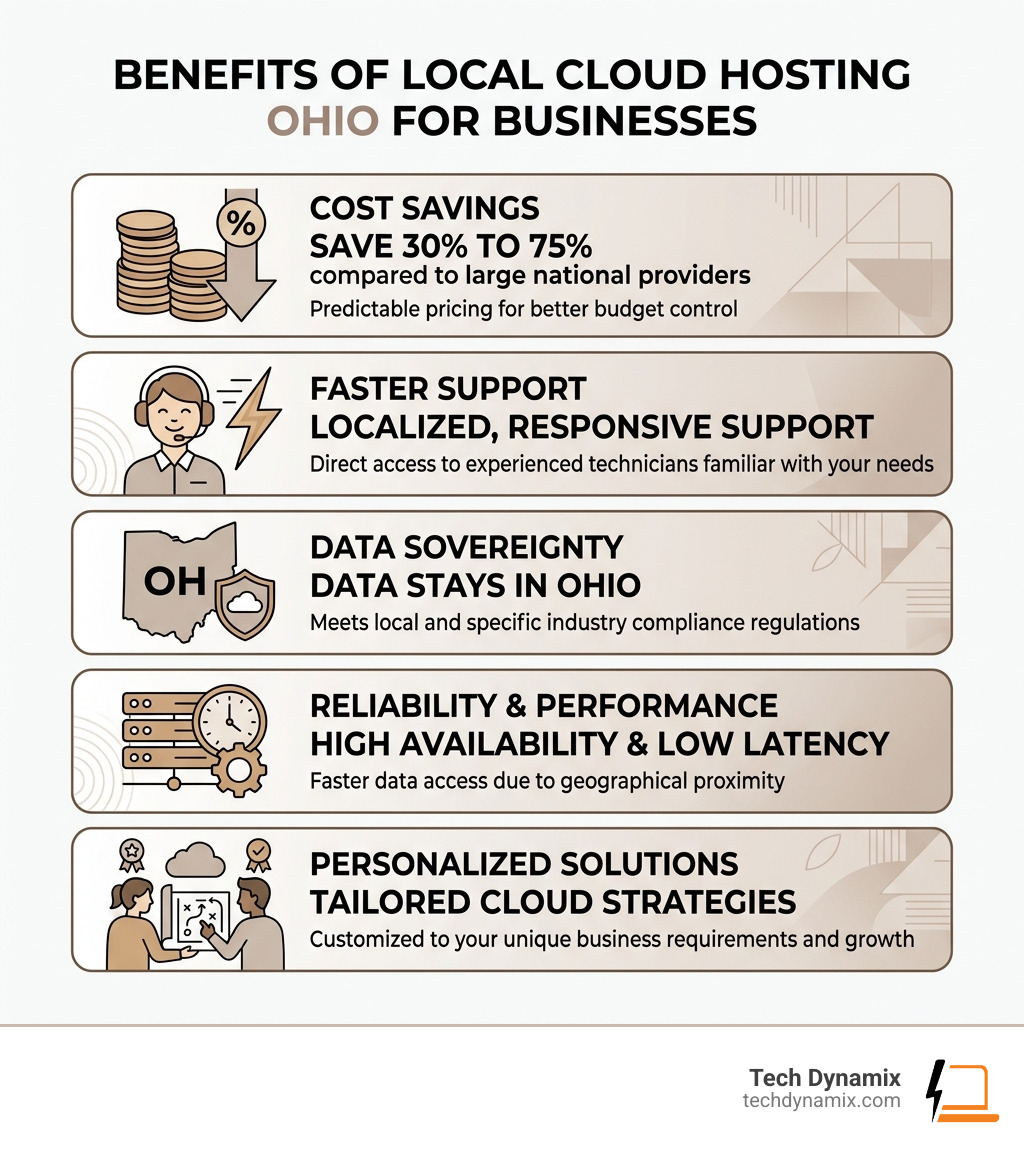
Ohio businesses are increasingly moving away from expensive, one-size-fits-all cloud platforms. Local providers can save you 30% to 75% while delivering faster support, clearer data sovereignty, and compliance expertise built for regulated industries.
But not every provider fits every business. The right choice depends on your workload, compliance requirements, budget, and how much hands-on support you need. When evaluating local options, businesses should prioritize providers that offer high uptime SLAs, transparent pricing, and specialized support for their specific industry.
I’m Jay Baruffa, and with over 20 years of experience in IT infrastructure, cybersecurity, and enterprise systems design, I’ve helped Northeast Ohio businesses navigate the complexities of cloud hosting in Ohio firsthand. In this guide, I’ll break down your options so you can make a confident, informed decision.
Cloud hosting Ohio terms simplified:
Understanding the Landscape of Cloud Hosting Ohio

When we talk about Cloud hosting Ohio, we aren’t just talking about a server in a closet. Ohio, and particularly the Columbus and Cleveland corridors, has become a massive hub for enterprise-grade data centers. These facilities are built to rigorous standards, often featuring Tier 4 characteristics that ensure your data is always accessible.
But what does “Tier 4” actually mean for your business? It translates to “Five Nines” or 99.999% uptime. In practical terms, that is less than six minutes of unscheduled downtime per year. For a manufacturing plant in Willoughby or a medical clinic in Mentor, that level of reliability is the difference between a productive day and a costly operational standstill.
Local data centers provide geographic diversity. For example, some providers maintain facilities in both Cleveland and Columbus to ensure that even if a major regional event occurs, your data remains safe and accessible. This local infrastructure is the backbone of Demystifying Cloud Data Centers: A Comprehensive Guide, which helps businesses understand that “the cloud” is actually a very real, very secure physical location right here in the Buckeye State.
Comparing Cloud Hosting Options: Public, Private, and Hybrid
Choosing the right type of cloud is like choosing the right office space. Do you want a coworking space (Public), your own dedicated building (Private), or a bit of both (Hybrid)?
| Feature | Public Cloud | Private Cloud | Hybrid Cloud |
|---|---|---|---|
| Resource Type | Shared (Multi-tenant) | Dedicated (Single-tenant) | Mix of both |
| Security | Standardized | Highly Customizable | Tailored to workload |
| Control | Provider-managed | Full User Control | Flexible |
| Best For | Startups, General Apps | Sensitive Data, Compliance | Complex Workflows |
Public Cloud
Public cloud services are highly scalable and cost-effective. They allow you to pay only for what you use, making them great for growing businesses in places like Eastlake or Wickliffe that need to scale resources up or down based on demand.
Private Cloud
For organizations with sensitive workloads—such as healthcare providers in Lake County or financial firms in the Chagrin Valley—a private cloud offers maximum security. You get dedicated hardware and resources that aren’t shared with anyone else. This provides a “mission-critical” treatment that many national giants simply can’t match at a reasonable price point. You can learn more about this in our article on Unlocking the Power of Managed Private Cloud.
Hybrid and Specialized Solutions
Many Ohio businesses use a Hybrid PLUS approach, combining on-premise servers with private and public cloud environments. Furthermore, Ohio is a unique hub for specialized workloads like IBM Power solutions. If your business relies on IBM i or Power10 systems, local providers offer “Power in the Cloud” options that let you escape the hardware refresh cycle while keeping your mission-critical legacy applications running smoothly.
Why Local Ohio Providers Outperform National Giants
Large national cloud platforms are well known, but for a mid-sized business in Northeast Ohio, they can be impersonal and expensive. Local Cloud hosting Ohio providers often offer a 100% Uptime SLA, something larger providers may only support through more complex and costly configurations.
Massive Cost Savings
One of the most eye-opening statistics in our research is the price difference. Local Ohio providers can be 30% to 75% less expensive than larger national alternatives. They achieve this by:
- Eliminating hidden “egress” fees (charging you to move your own data).
- Providing transparent, flat-rate pricing.
- Offering colocation options starting as low as $139.95 per server.
Personal Support
When things go wrong at 2:00 AM, do you want to navigate a global ticketing system, or do you want to call a local expert who knows your name? Local providers offer 24/7/365 personal support. This isn’t just a call center; it’s a team of engineers based in Ohio who understand your local business environment.
Scalability and Flexibility in Cloud Hosting Ohio
Local cloud solutions aren’t just cheaper; they are more flexible. With “pay-as-you-grow” pricing, a business in Chardon or Madison can start small and scale their CPU, RAM, and storage instantly as they land new contracts. This agility is a core theme in The Complete Guide to Cloud Solutions, which highlights how local IaaS (Infrastructure as a Service) models allow for virtual data center replacements without the massive upfront capital expenditure of buying hardware.
Security and Compliance Standards for Local Hosting
Whether you are in healthcare, government, or manufacturing, security isn’t optional. Ohio-based cloud providers have spent decades refining their compliance postures. Many facilities in the Cleveland and Columbus areas have been SOC 2 Type 2 accredited since the mid-90s.
When you choose Cloud hosting Ohio, you can find providers that specifically cater to:
- HIPAA/HITECH: Essential for medical offices in Mayfield Heights and Richmond Heights.
- PCI DSS: Crucial for any business handling credit card transactions.
- FISMA & IRS 1075: Necessary for government contractors and financial services.
- SOC 1 & SOC 2: The gold standard for data center operational excellence.
By hosting locally, you also ensure data sovereignty. You know exactly where your data lives (e.g., in a Tier 3 or Tier 4 facility in Dayton, Columbus, or Cleveland) and that it is protected by USA-based engineers.
Strategic Migration to Cloud Hosting Ohio
The biggest fear most businesses have is downtime during migration. “What if our systems are down for a day?” In reality, modern migration processes are designed to be seamless.
Local experts use a deep discovery process to understand your current architecture before moving a single byte. This often includes:
- Assessment: Identifying which apps are “cloud-ready.”
- Planning: Creating a roadmap to minimize disruption.
- Execution: Often involving zero-downtime OS upgrades and data transfers.
- Support: Post-migration monitoring to ensure everything is running at peak performance.
For a deeper look at how to choose a partner for this journey, check out The 5 Best Cloud Migration Ohio Providers Compared.
Frequently Asked Questions about Cloud Hosting Ohio
What are the cost advantages of local Ohio cloud providers?
Local providers often offer 30% to 75% savings compared to larger national cloud platforms. This is largely because they eliminate hidden fees, such as data transfer costs, and provide more transparent, tiered pricing models tailored to SMB budgets. Additionally, many offer “pay-as-you-grow” models that prevent you from overpaying for unused resources.
How do Ohio cloud services ensure 100% uptime?
Top-tier Ohio facilities utilize N+1 redundant power, cooling, and fiber-optic networking. This means every critical system has a backup. By building data centers to Tier 3 and Tier 4 principles, local providers can offer a financially-backed 100% Uptime Service Level Agreement (SLA), ensuring your business stays online even during maintenance or local power outages.
Can local providers handle specialized workloads like IBM Power or HIPAA data?
Yes, Ohio is a specialized hub for these services. Specific data centers in the region focus on IBM Power cloud solutions (offering Power10 and Power11 environments) for businesses running legacy mission-critical apps. Furthermore, local providers maintain rigorous certifications including SOC 2, HIPAA, and PCI DSS to support highly regulated industries like healthcare and finance.
Conclusion
Choosing the right Cloud hosting Ohio provider is about more than just technology; it’s about finding a partner that understands the local landscape. At Tech Dynamix, we’ve spent over 20 years serving businesses across Northeast Ohio—from the manufacturing hubs of Lake County to the professional services firms in the Greater Cleveland Area.
We believe that cloud hosting should be proactive, secure, and above all, reliable. Whether you need a simple cloud backup solution or a full-scale migration to a managed private cloud, our goal is to be your all-in-one technology partner. We don’t just set it and forget it; we provide ongoing helpdesk support, cybersecurity protection, and strategic IT roadmaps to ensure your technology moves your organization forward.
Ready to see how the cloud can transform your operations without the “big cloud” price tag? More info about Microsoft 365 cloud support can help you get started with the most common cloud productivity tools, or contact us today to discuss a custom migration plan for your unique business needs.